Where It All Connects
How does it connect to the rest of HR?
Page 1 Where It All Connects
Read the explanation
This deck answers: how does job architecture connect to everything else in HR? It shows a virtuous cycle with three motions. Design flows in: strategy, the operating model, organization design, and work design shape the jobs. Decisions flow out: pay, talent, skills, careers, workforce planning, and systems use the jobs. Learning flows back: recruiting difficulty, pay pressure, career bottlenecks, skills gaps, and changing work show when the architecture needs to evolve. Change management keeps the cycle turning. For each part, the deck shows what it gives the job architecture and what it gets back, with a Brightside example, follows one business change as it ripples through the whole cycle, and ends with what a healthy architecture makes easy. It closes with a ripple-tracing activity and its model answers, three quick questions, and a recap.
Page 2 Before You Start
Read the explanation
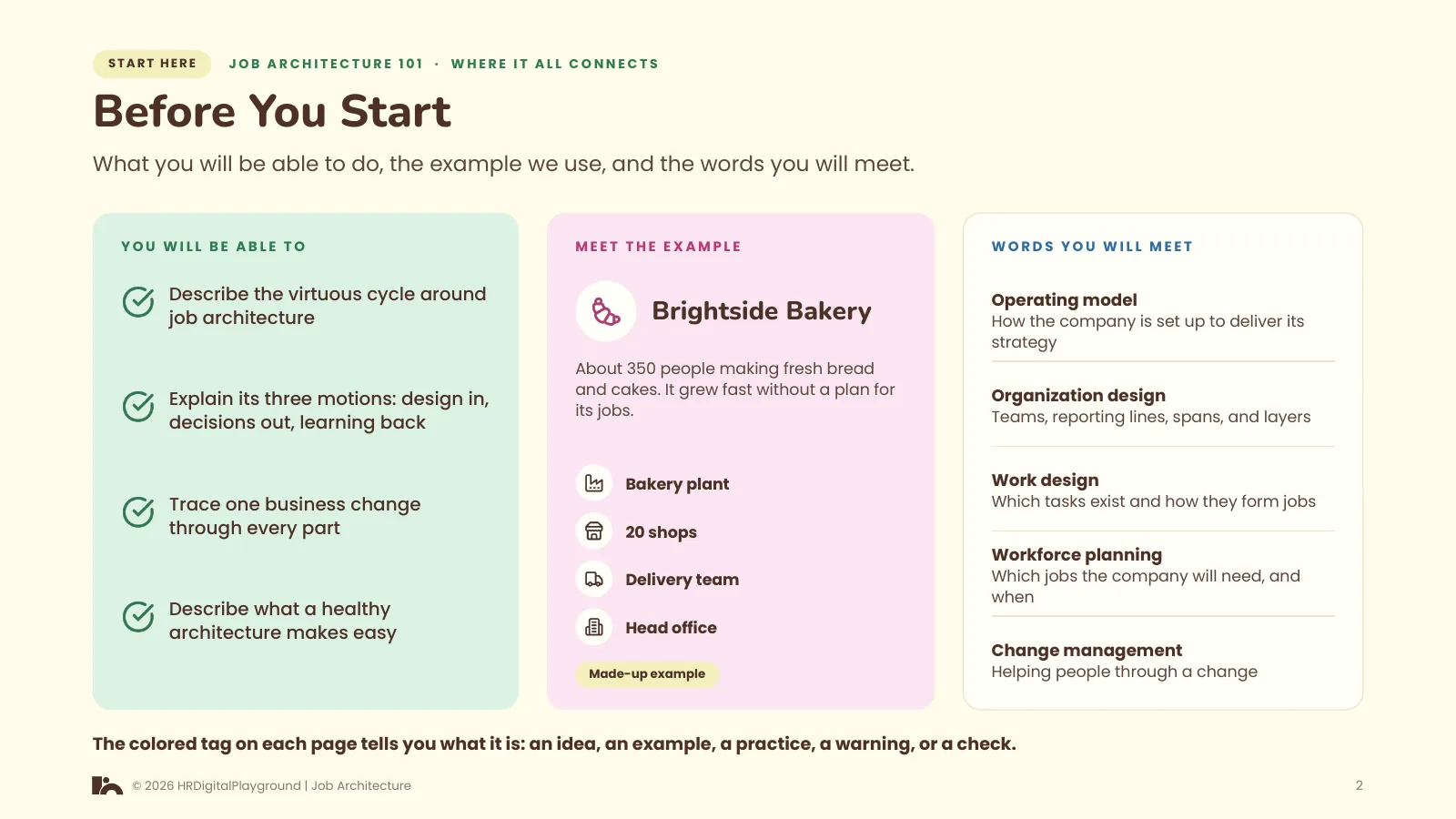
This deck covers where it all connects. It is written for someone with no background in HR, compensation, or organization design, and it follows adult learning principles: why before what, one realistic example throughout, practice with answers, a short quiz, and a one-page recap. The example is Brightside Bakery, a made-up company of about 350 people with a bakery plant, twenty shops, a delivery team, and a head office. It grew fast without a plan for its jobs, so it has far more titles than real jobs and no shared way to compare them. The words on this page are defined again where they first appear.
Page 3 The Virtuous Cycle
Read the explanation
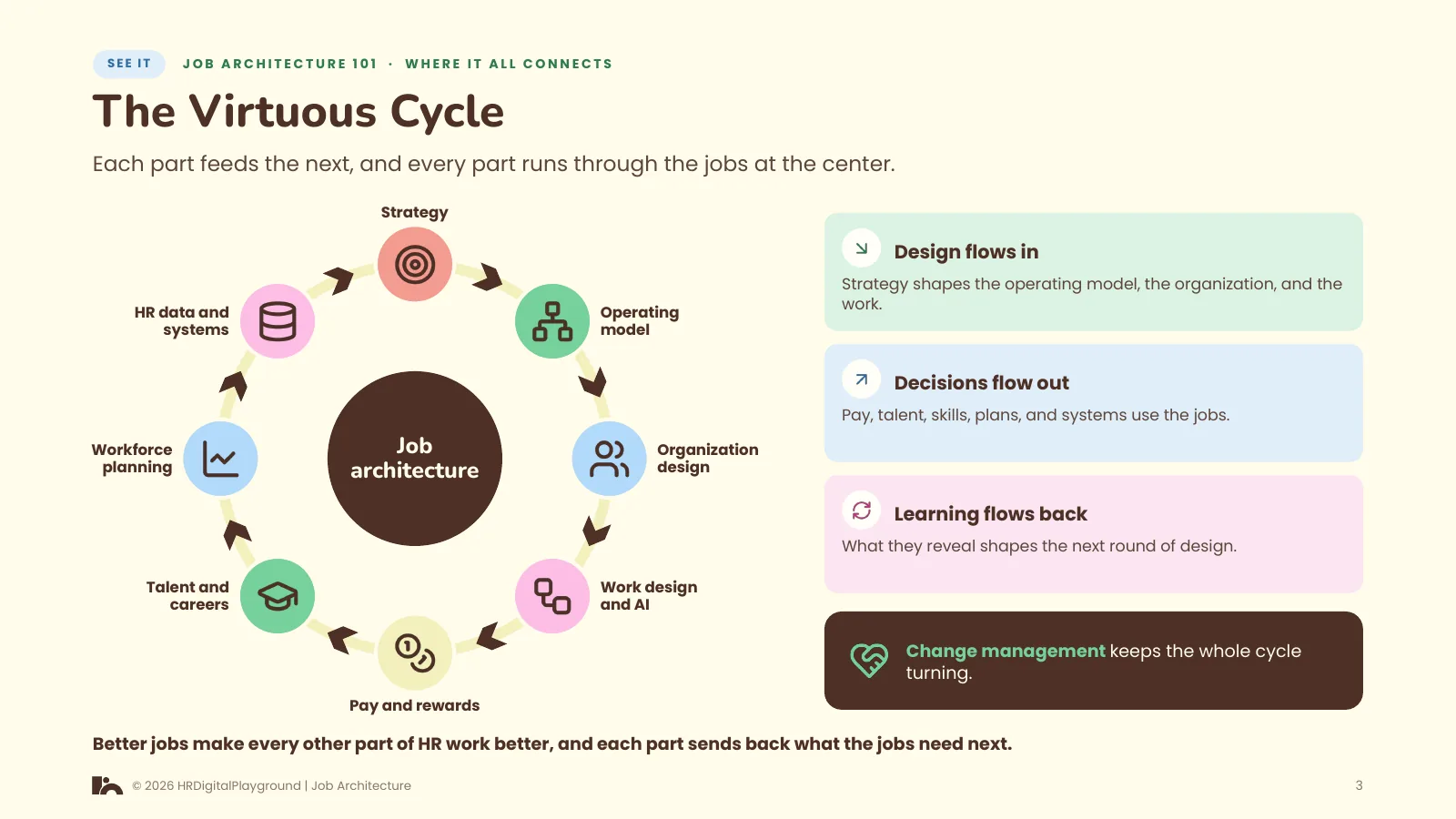
Job architecture sits at the center of a cycle that runs through almost everything HR and leadership do. Strategy decides where the business is going. The operating model sets up how the company will deliver it. Organization design shapes the teams, reporting lines, spans, and layers. Work design decides which tasks exist and how they bundle into jobs, including what AI or automation will do. Those jobs, organized into families and levels, are the job architecture. From there, the cycle flows outward: pay and rewards price the jobs, talent processes hire, grow, and develop people into them, workforce planning decides how many of each job the company will need, and HR data and systems record all of it. What those processes reveal, such as pay pressure, skill gaps, or too many layers, flows back into the next round of design. That is why it is a virtuous cycle: each turn makes the jobs clearer, and clearer jobs make every other part work better. Change management wraps around the whole cycle, because every turn changes someone's work, title, or pay.
Page 4 Three Motions: In, Out, and Back
Read the explanation
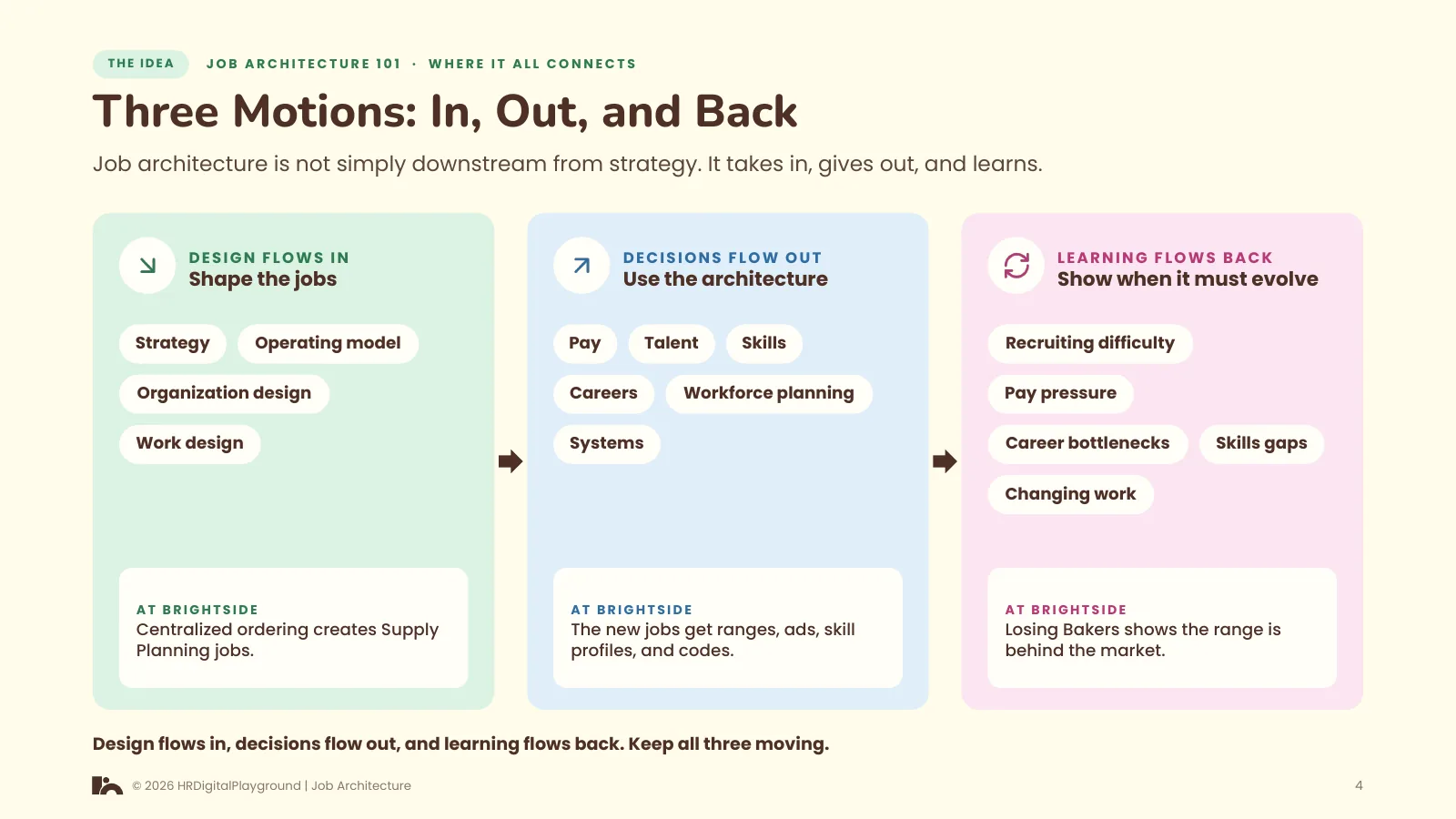
It is tempting to see job architecture as the last step, something that simply records decisions made upstream. It is more useful to see three motions. Design flows in: strategy, the operating model, organization design, and work design shape which jobs exist and how big they are. At Brightside, centralizing ordering creates Supply Planning jobs. Decisions flow out: pay, talent, skills, careers, workforce planning, and HR systems all consume the architecture. The new Supply Planning jobs get ranges, job ads, skill profiles, codes, and a place in the headcount plan. Learning flows back: recruiting difficulty, pay pressure, career bottlenecks, skills gaps, and changing work reveal when the architecture needs to evolve. When Brightside keeps losing Bakers, that signal flows back, the market data is re-checked, and the range moves. When AI changes the Dispatcher's work, the job is re-assessed. An architecture that only takes in and gives out goes stale. The learning motion is what keeps it true.
Page 5 Strategy and Operating Model
Read the explanation
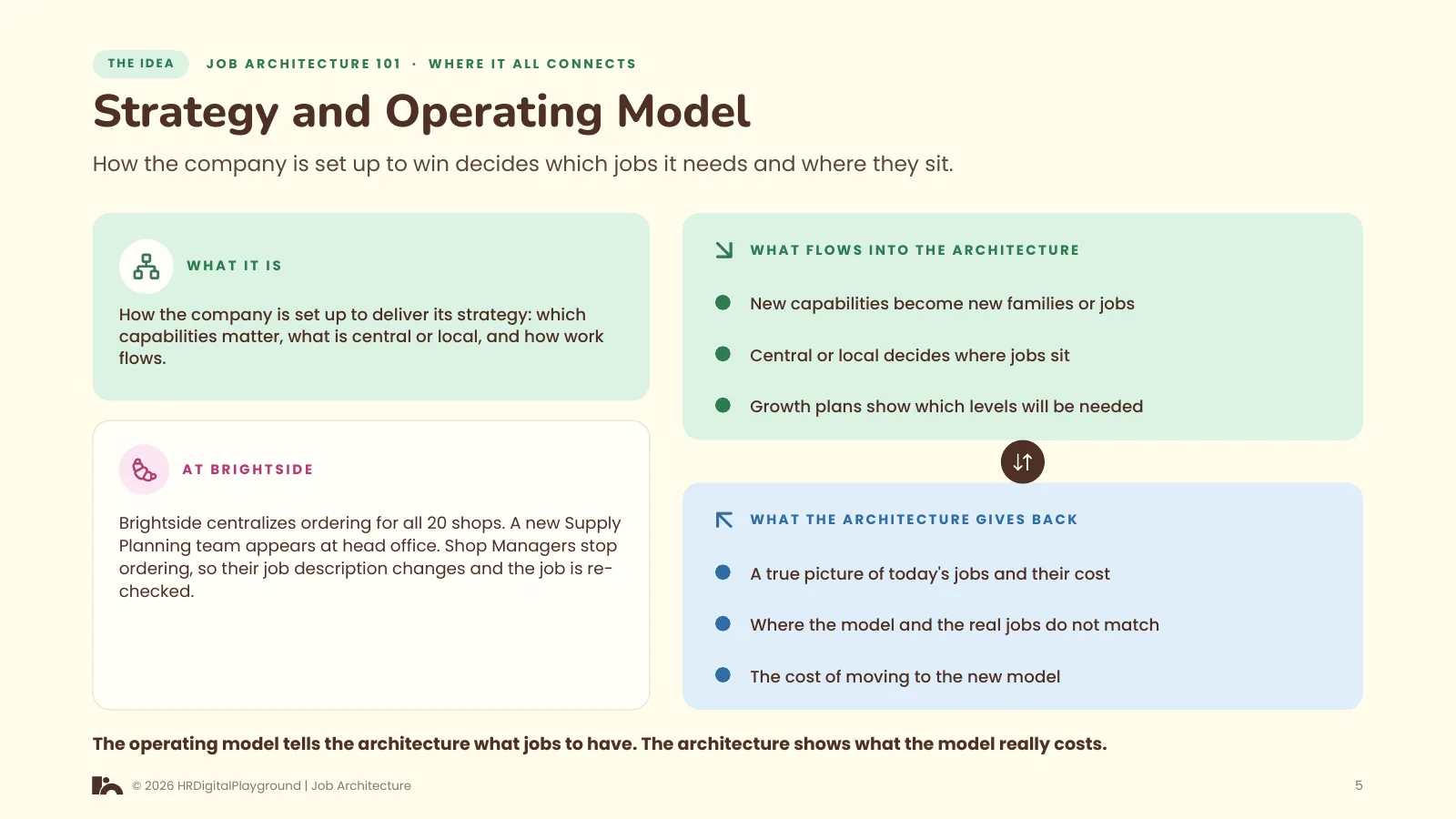
An operating model describes how a company is set up to deliver its strategy: which capabilities matter most, what is done centrally and what is done locally, and how work flows from one team to the next. It gives the job architecture its brief. A new capability, such as online sales, becomes a new family or new jobs. A decision to centralize a service decides where those jobs sit. Growth plans show which levels will be needed, such as more senior experts. In return, the job architecture gives the operating model a true picture of today's jobs and their cost, shows where the model on paper and the real jobs do not match, and lets leaders cost the move from today's model to the new one. At Brightside, centralizing ordering creates a Supply Planning team at head office and removes ordering from the Shop Manager job.
Page 6 Organization Design
Read the explanation
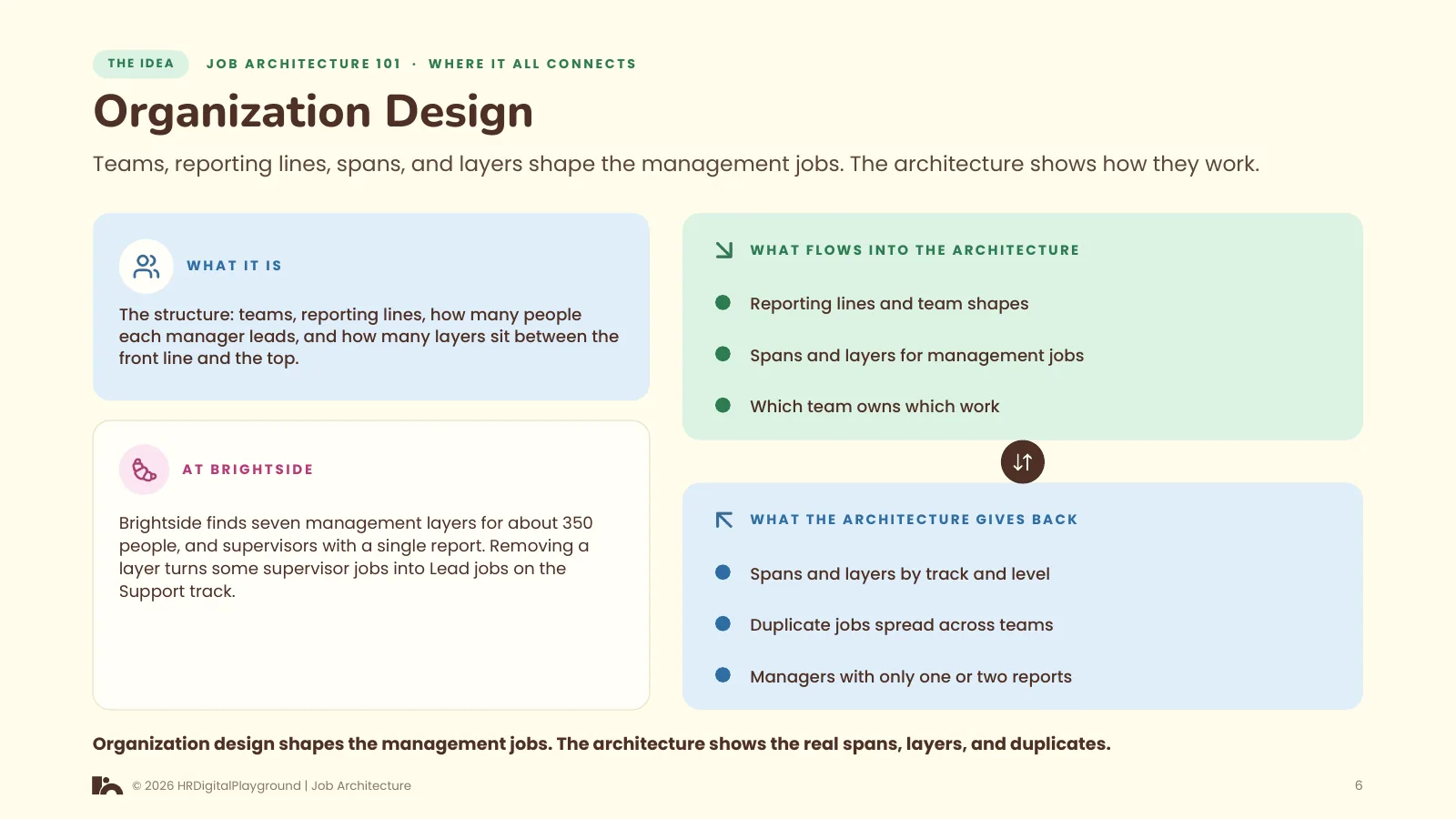
Organization design sets the structure: which teams exist, who reports to whom, how many people each manager leads, called the span of control, and how many management layers sit between the front line and the top. It feeds the job architecture the reporting lines, the shape of teams, and the spans and layers that define management jobs. In return, the architecture makes the organization measurable. Because every job has a track and level, leaders can see spans and layers by level, find duplicate jobs spread across teams, and spot managers with only one or two direct reports, which often signals a job that is really a senior expert role. At Brightside, the analysis finds seven management layers for about 350 people and several supervisors with a single report. Removing one layer turns some supervisor jobs into Lead jobs on the Support track, with clear expectations and no pay cut.
Page 7 Work Design and AI
Read the explanation
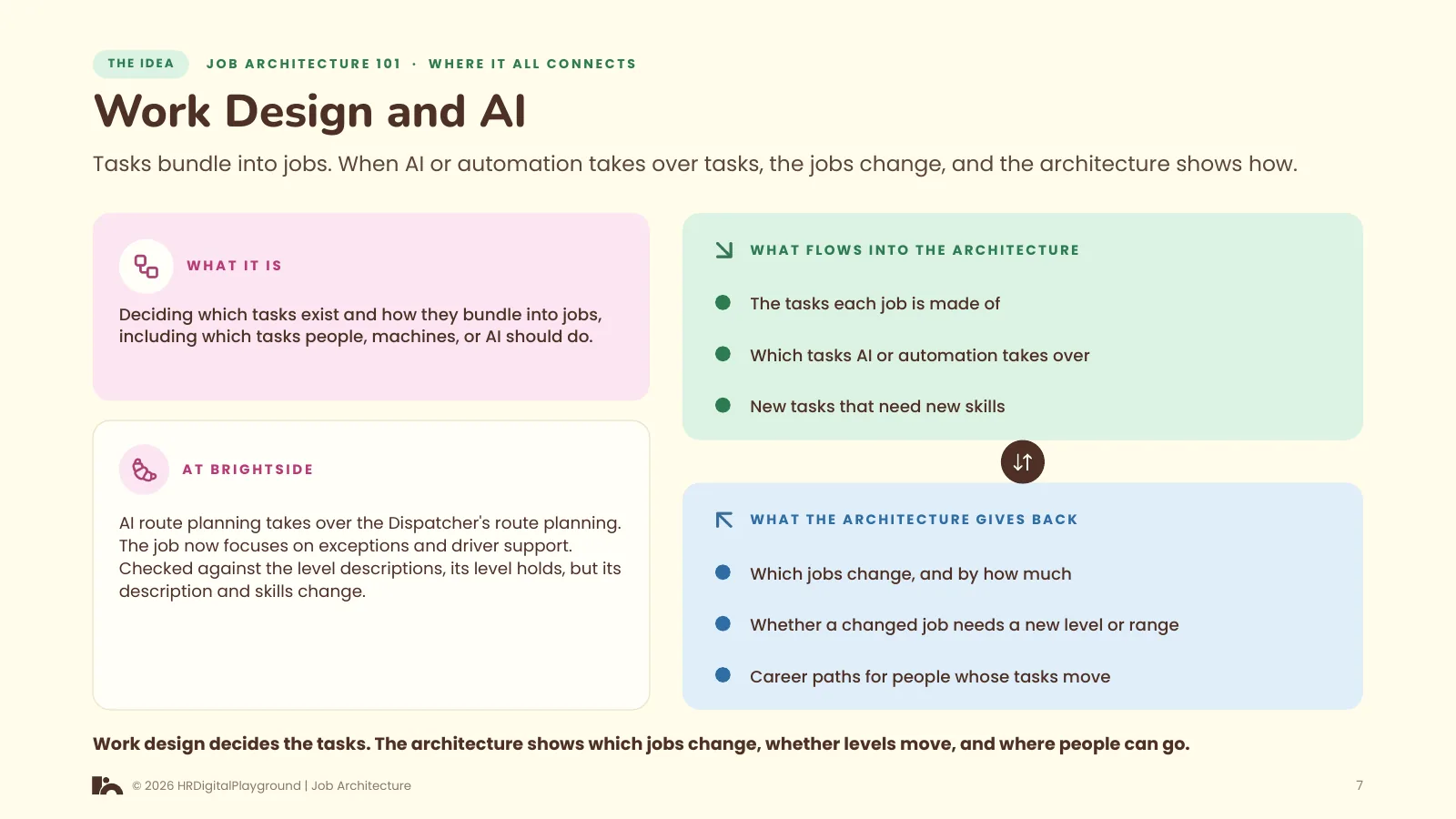
Work design decides which tasks the company needs and how they are bundled into jobs, including which tasks people, machines, or AI should do. It feeds the job architecture the task content of each job, the tasks that automation or AI will take over, and the new tasks that need new skills. In return, the architecture shows which jobs change and by how much, whether a changed job needs a new level or pay range, and which career paths are open to people whose tasks move. At Brightside, AI route planning takes over the Dispatcher's route planning. The Dispatcher job now focuses on exceptions, driver support, and improving routes. The job is re-checked against the level descriptions: its level holds, while its description and required skills change. Without a job architecture, changes like this happen informally, and pay and careers drift out of step with the work.
Page 8 Pay and Rewards
Read the explanation
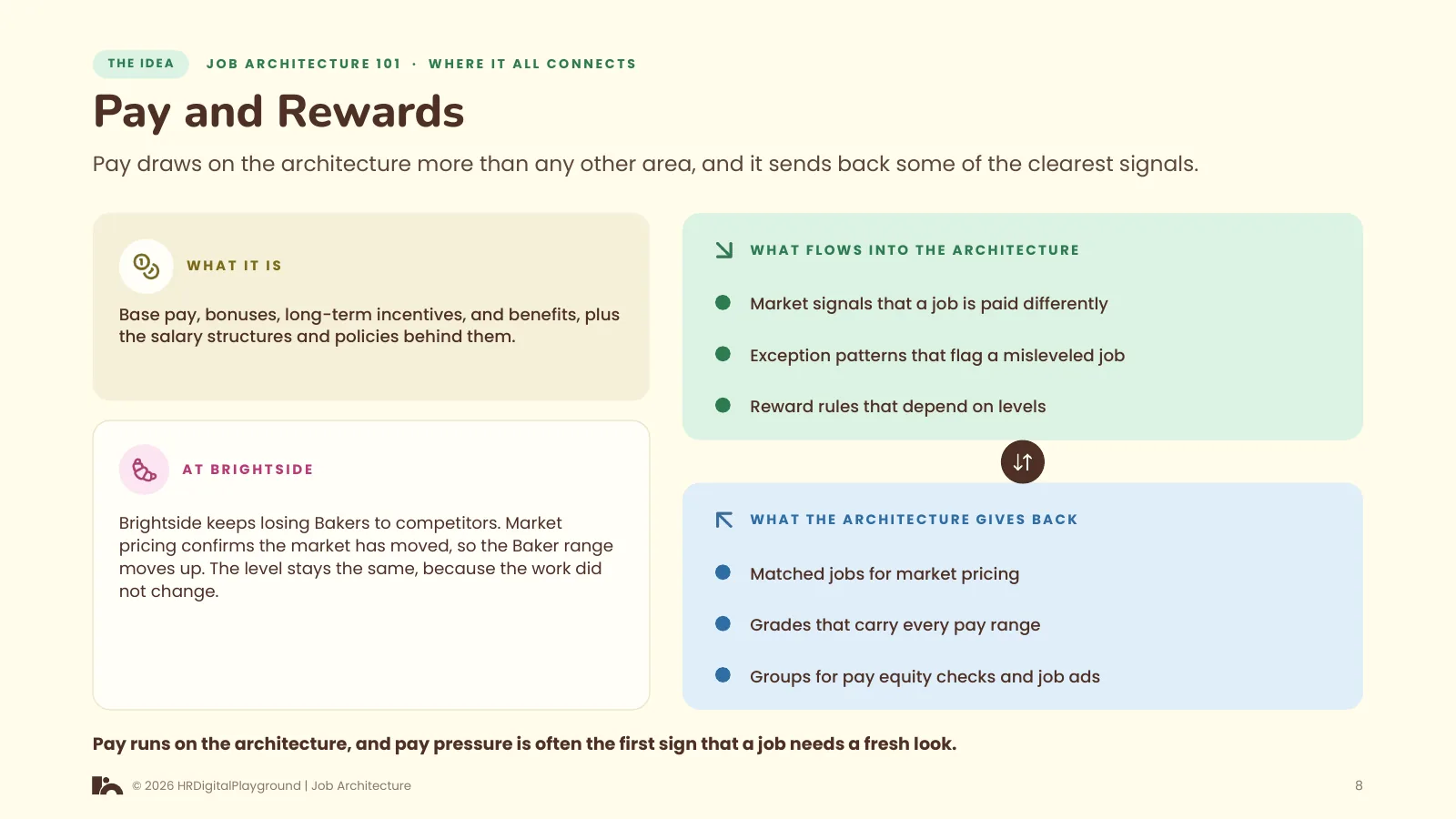
Pay and rewards cover base pay, bonuses, long-term incentives, and benefits, and the structures and policies behind them. They draw on the job architecture more than any other area: matched jobs for market pricing, grades that carry every pay range, and families and levels that form the groups for pay equity checks and posted ranges. They also send back clear signals. When the market pays much more for a job, the range may need to move. When one job keeps needing exceptions, it may be misleveled. And incentive rules, such as bonus targets by level, depend on levels being right. At Brightside, pay data shows the company keeps losing Bakers to competitors. Market pricing confirms the market has moved, so the Baker range moves up. The level stays the same, because the work did not change.
Page 9 Talent: Hiring, Careers, Performance, Learning
Read the explanation
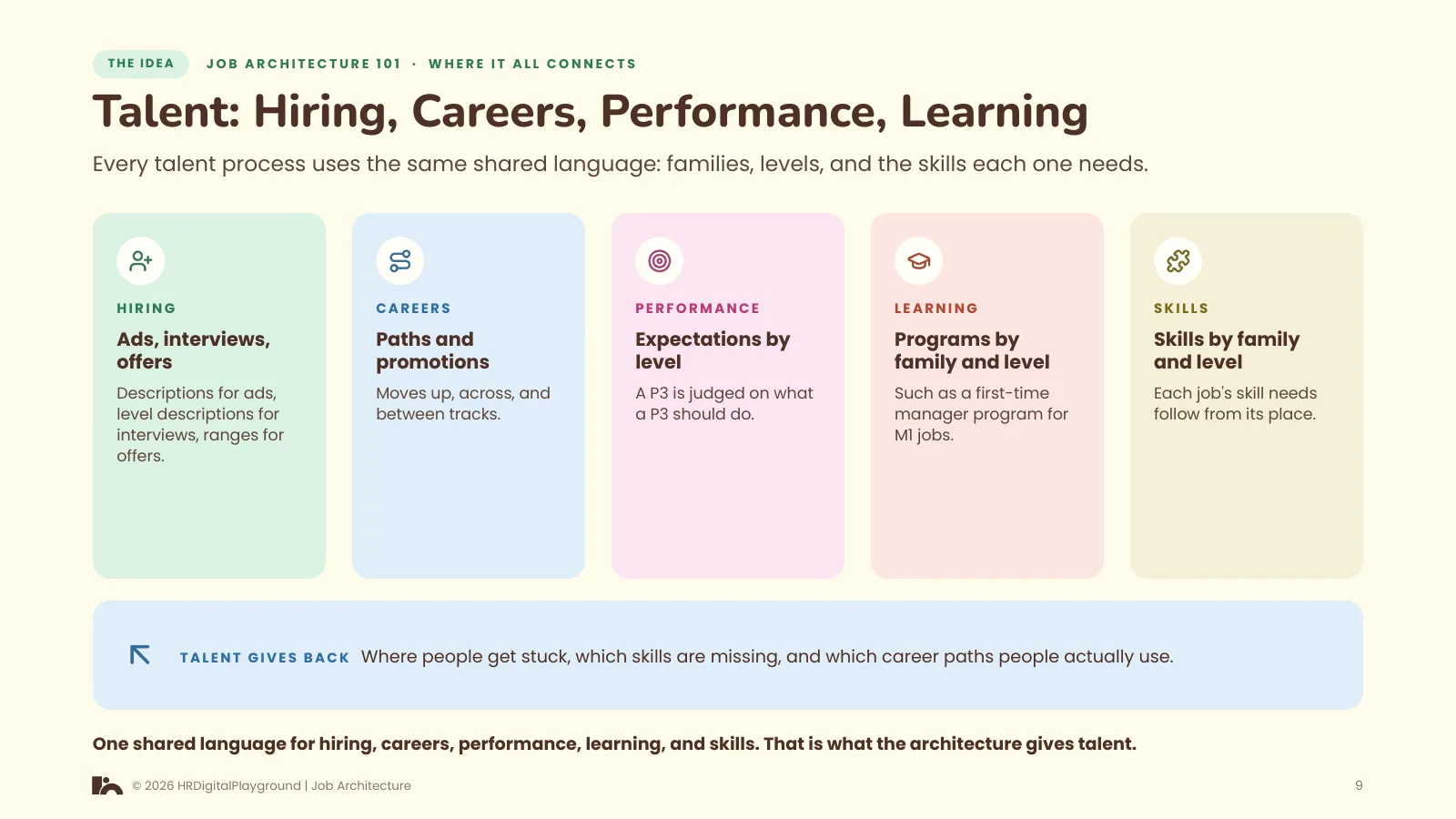
Talent processes all run on the same language the job architecture provides. Hiring uses job descriptions for ads, level descriptions for interview guides, and pay ranges for offers. Careers use the paths between jobs, promotion rules, and lateral moves. Performance uses the level descriptions to set expectations, so a P3 is judged against what a P3 should do. Learning builds programs by family and level, such as a new manager program for M1 jobs. Skills libraries attach skills to families and levels, so each job's skill needs follow from its place in the architecture. Talent processes send back what they learn: where people get stuck, which skills are missing, and which career paths people actually use. That feedback shapes the next round of work design and job descriptions.
Page 10 Workforce Planning and HR Data
Read the explanation
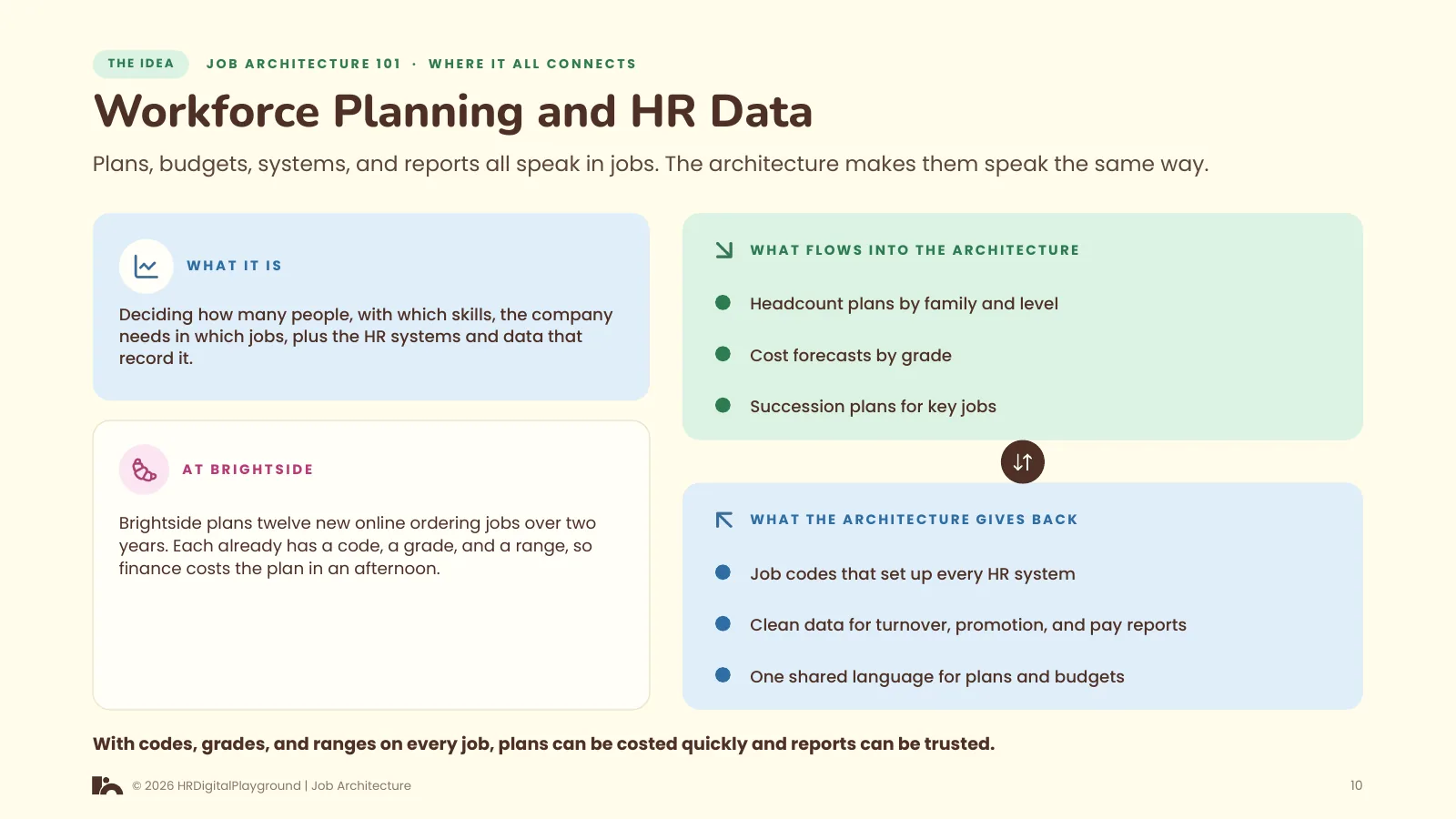
Workforce planning decides how many people, with which skills, the company will need in which jobs over the next few years. HR data and systems record all of it. Planning feeds the job architecture headcount plans by family and level, cost forecasts by grade, and succession plans for key jobs. The architecture gives back job codes that set up every HR system, clean and consistent data for turnover, promotion, and pay reports, and one shared language for plans and budgets across HR and finance. At Brightside, the plan for a new online ordering service needs twelve new jobs over two years. Because each new job already has a code, a grade, and a pay range, finance can cost the plan in an afternoon instead of weeks. Without a job architecture, every plan starts by arguing about what the jobs are.
Page 11 Change Management Keeps It Turning
Read the explanation
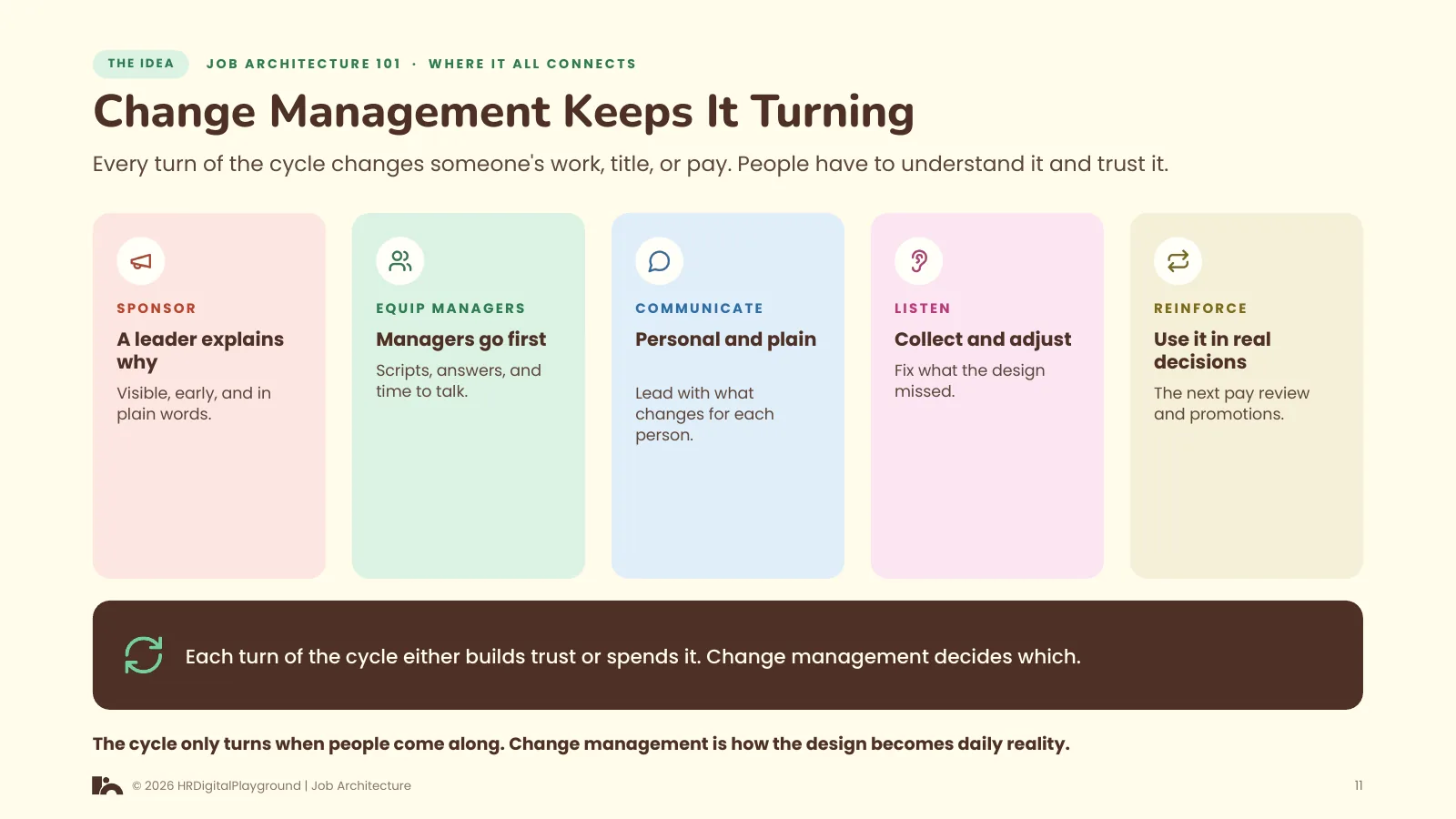
Every turn of the cycle changes something for someone: a new job, a changed title, a different level, a new range, a different team. Good design is wasted if people do not understand or trust it, so change management wraps around the whole cycle. Five practices do most of the work. A visible sponsor explains why the change matters. Managers are equipped first, with scripts, answers, and time to talk to their teams. Communication is early, plain, and personal, leading with what changes for each person. The company listens, collects questions, and adjusts where the design missed something. And the change is reinforced by using it in real decisions, such as the next pay review and the next promotions. When these are in place, each turn of the cycle builds trust instead of spending it.
Page 12 One Change, Many Ripples
Illustrative numbers, fictional company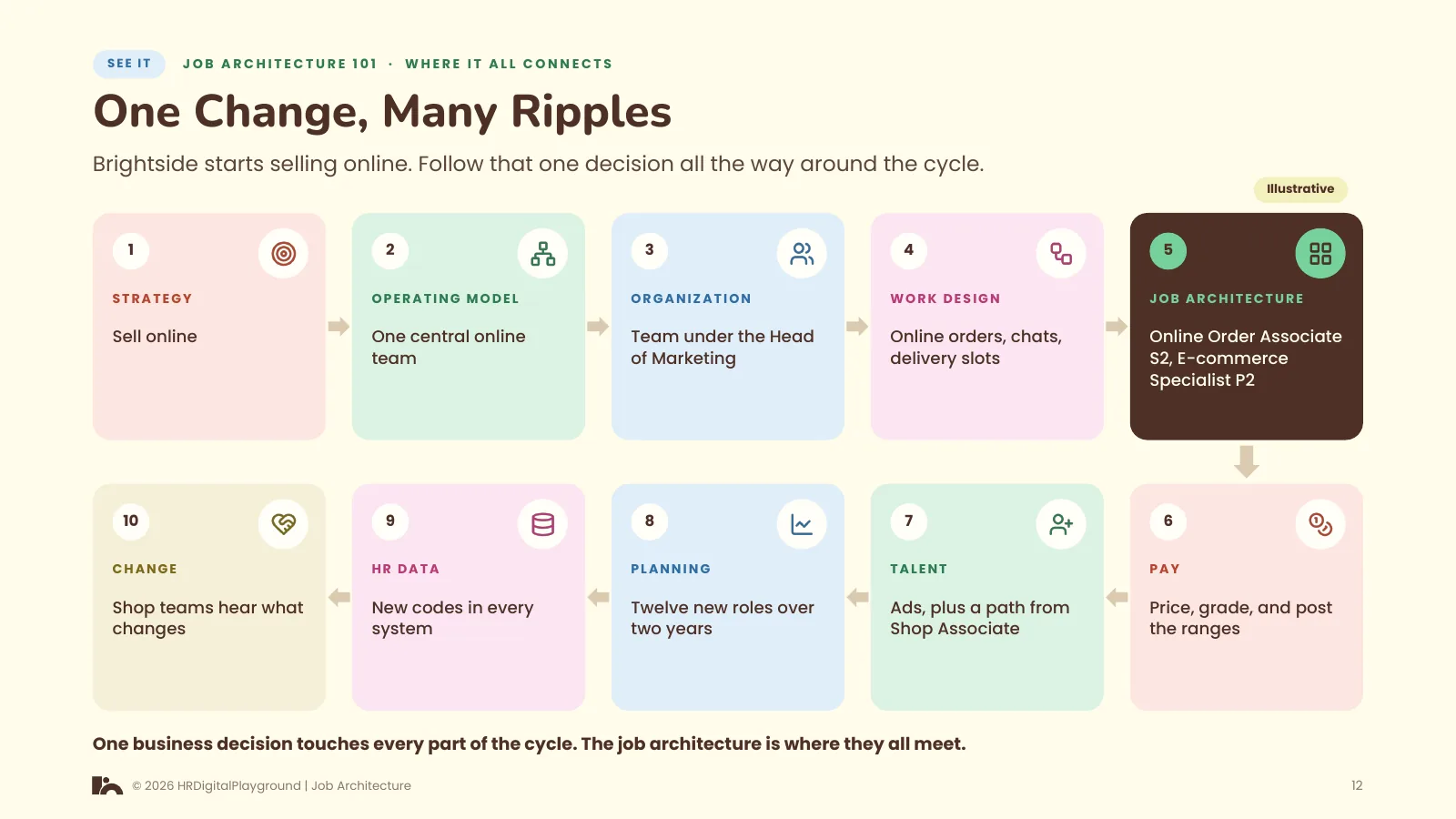
Read the explanation
This worked example follows one decision around the whole cycle. Brightside decides to sell online, which is a strategy choice. The operating model adds a central online ordering team rather than running it shop by shop. Organization design places the team under the Head of Marketing, with its own manager. Work design defines the new tasks: taking online orders, answering customer chats, and managing delivery slots. The job architecture adds new jobs in the Customer Service family, such as Online Order Associate at S2 and E-commerce Specialist at P2 in Marketing. Pay prices the new jobs, slots them into grades, and sets the ranges for job ads. Talent writes the ads and opens a path from Shop Associate to Online Order Associate. Workforce planning schedules twelve new roles over two years. HR data and systems add the new codes. And change management tells shop teams what changes for them and why. The illustrative details show how one decision touches every part.
Page 13 What Good Looks Like
Read the explanation
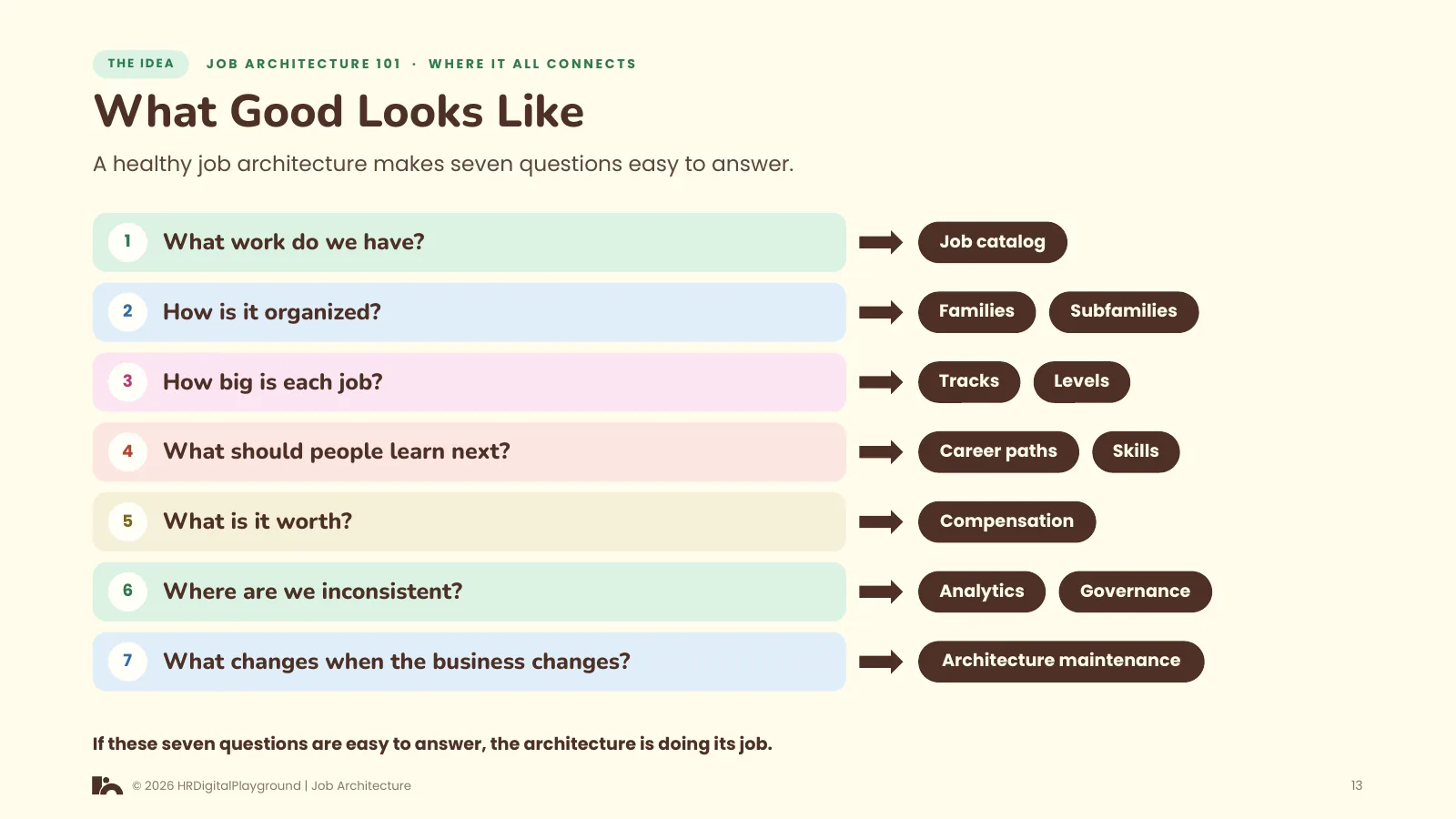
This page is a simple way to judge any job architecture, including your own. A healthy architecture makes seven questions easy to answer. What work do we have? The job catalog answers it. How is it organized? The families and subfamilies. How big is each job? The tracks and levels. What should people learn next? The career paths and the skills layer. What is it worth? Compensation: market pricing, grades, and ranges. Where are we inconsistent? Analytics and governance, such as pay equity checks, title audits, and the decision log. And what changes when the business changes? Architecture maintenance: event-driven reviews, a front door for new jobs, and a regular rhythm. If any of these questions takes weeks and a special project to answer, that is where to focus next.
Page 14 Trace a Ripple
Read the explanation
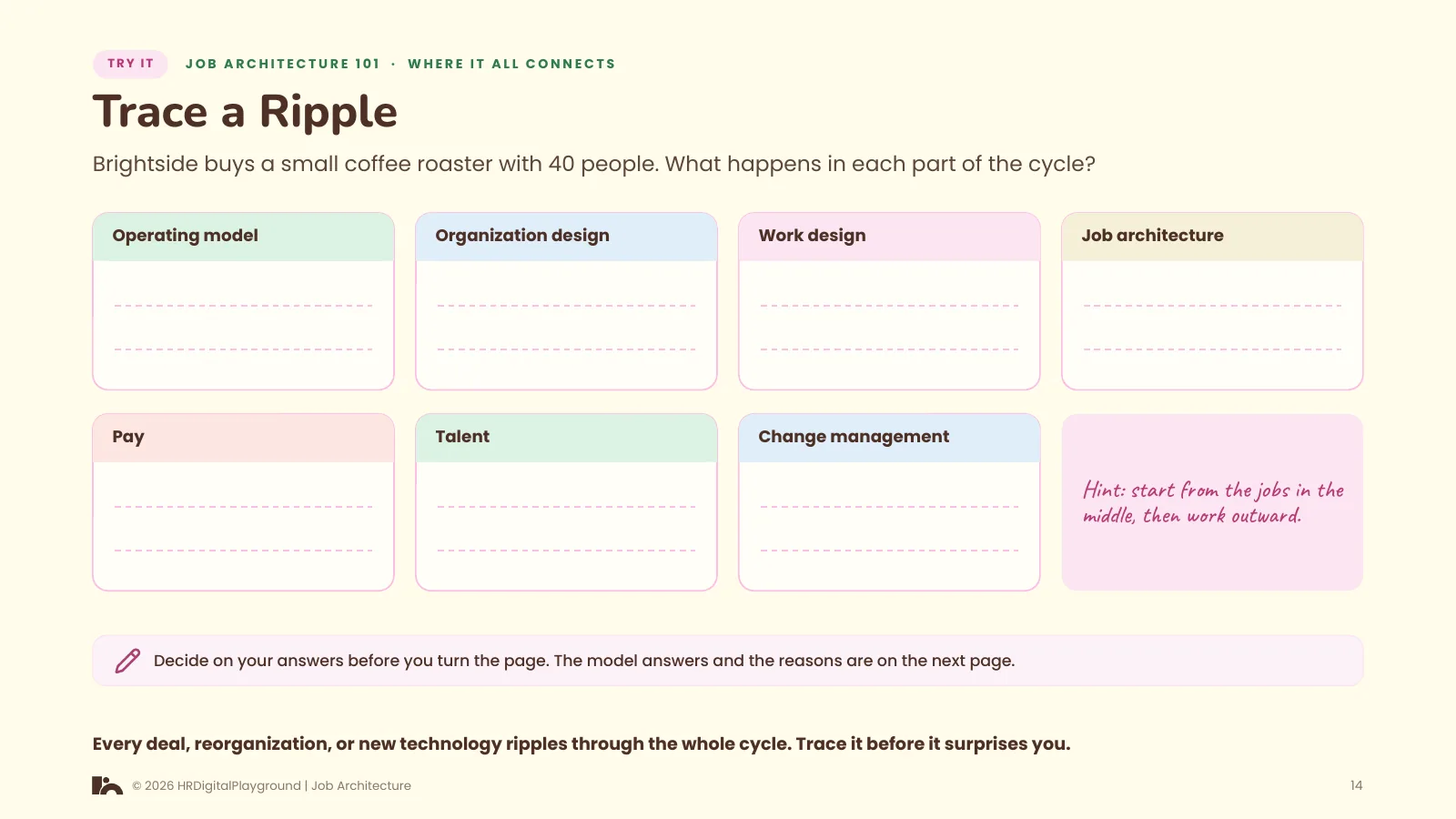
This activity practices thinking around the whole cycle. Brightside buys a coffee roaster with about 40 people. For each part of the cycle, write one thing that happens. Start from the jobs in the middle and work outward. Model answers are on the next page.
Page 15 Trace a Ripple: Model Answers
Read the explanation
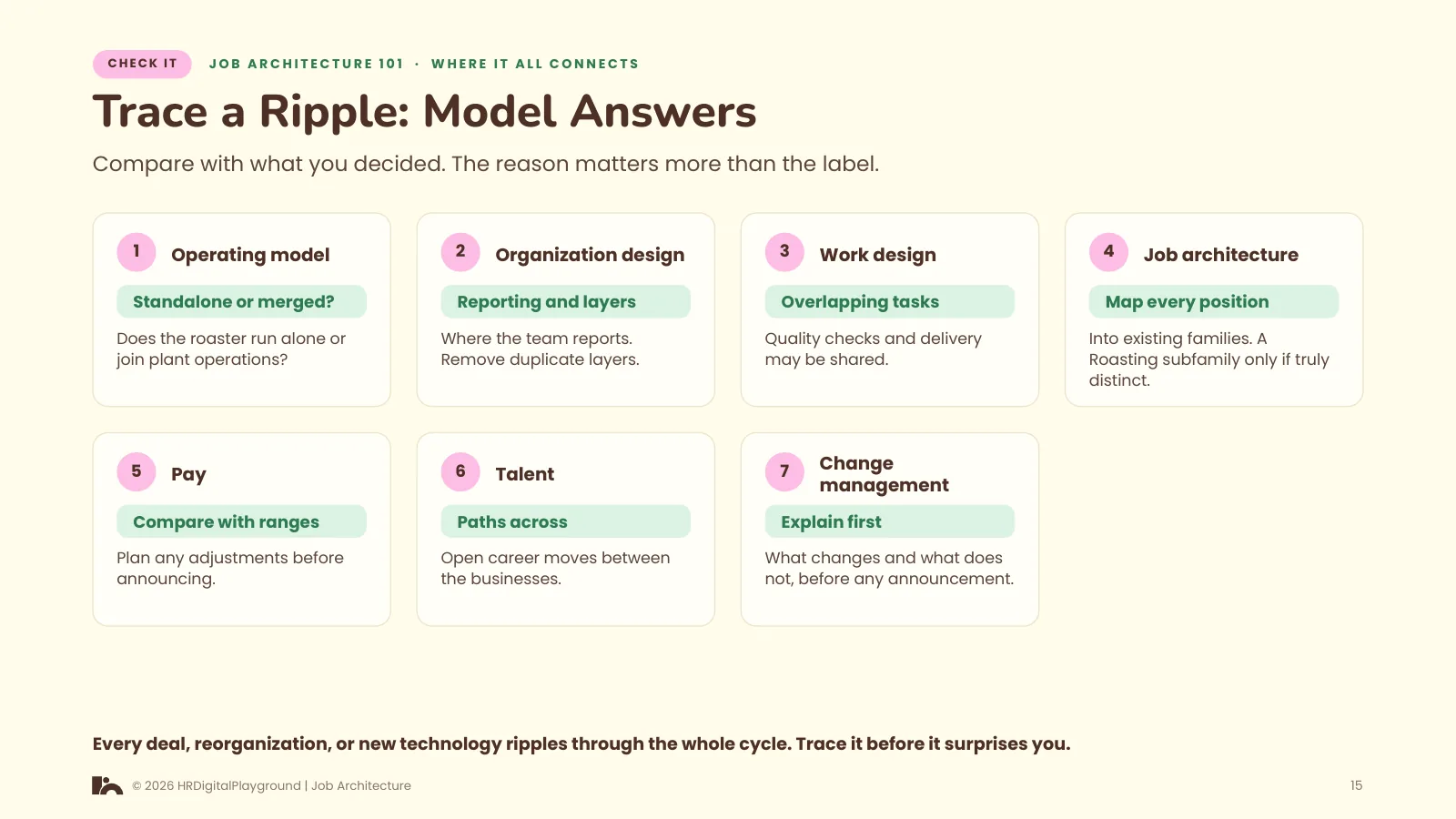
Model answers. The operating model decides whether the roaster runs on its own or joins the bakery plant's operations. Organization design decides where the roaster's team reports and removes any duplicate management layer. Work design checks which roaster tasks overlap with bakery tasks, such as quality checks and delivery. The job architecture maps each roaster position into Brightside's families and levels, adding a Roasting subfamily only if the work is materially distinct. Pay compares the roaster's pay with Brightside's ranges and plans any adjustments. Talent opens career paths between the two businesses. And change management explains to the roaster's people what changes, and what does not, before anything is announced. Other reasonable answers are fine. The point is to touch every part.
Page 16 Quick Check
Read the explanation
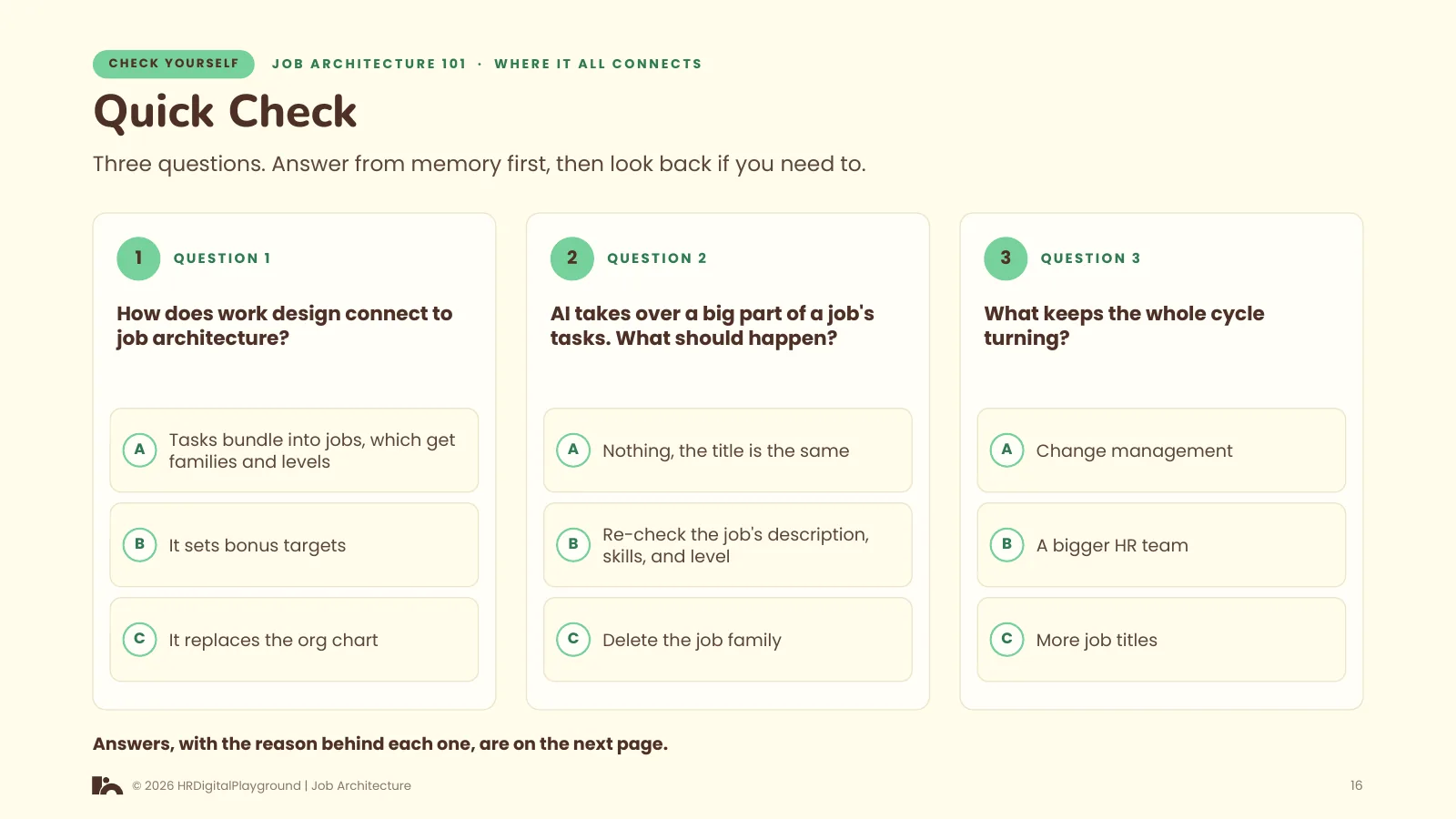
Three questions on the cycle. Question 1 checks how work design connects to the architecture. Question 2 checks what should happen when AI changes a job's tasks. Question 3 checks what keeps the cycle turning.
Page 17 Remember
Read the explanation
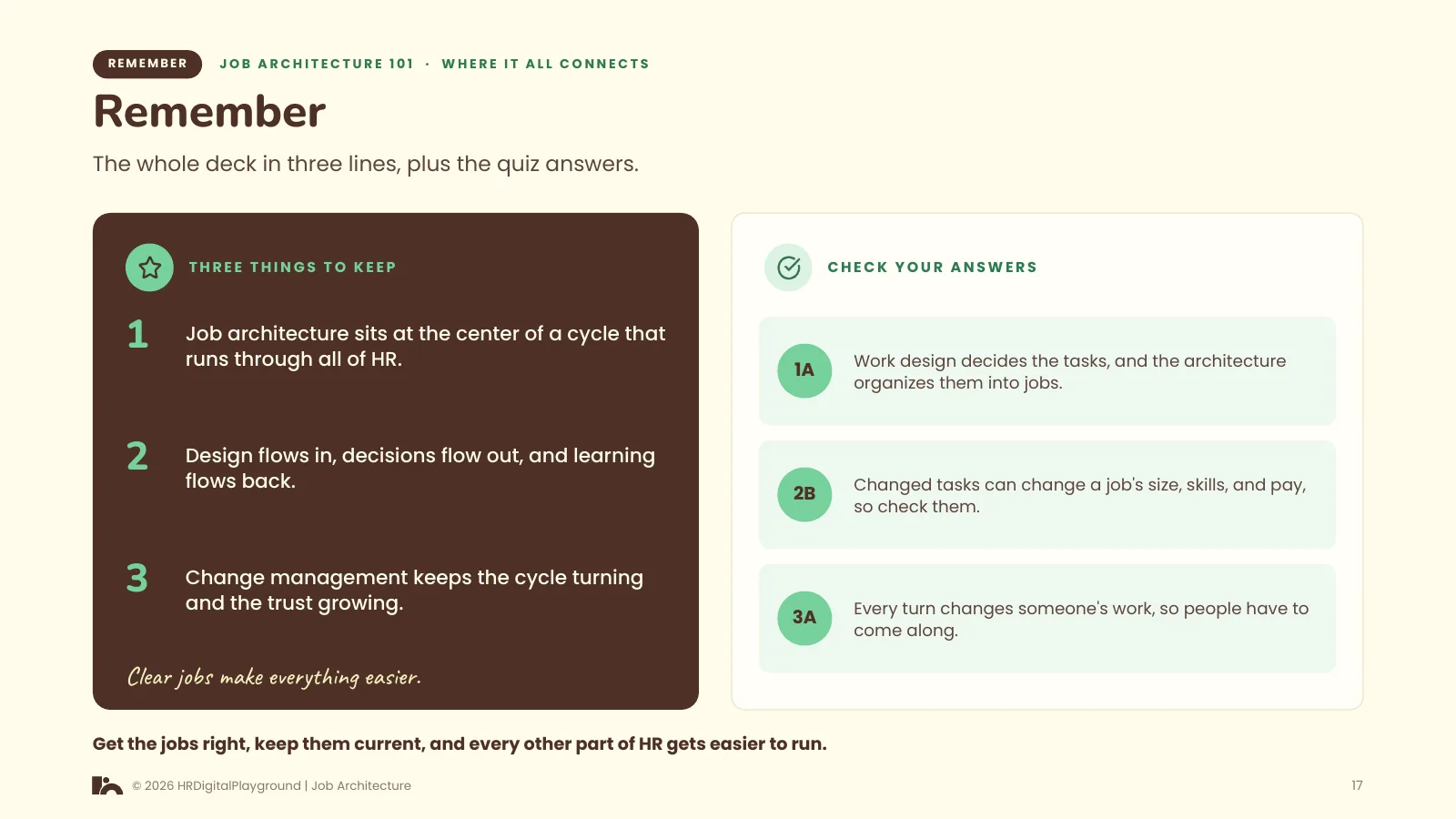
The recap keeps three ideas. Job architecture sits at the center of a virtuous cycle. It has three motions: design flows in from strategy, the operating model, organization design, and work design, decisions flow out to pay, talent, skills, careers, planning, and systems, and learning flows back when recruiting, pay, careers, skills, or the work itself show the architecture needs to evolve. And change management keeps the cycle turning, because every turn changes someone's work, title, or pay. Quiz answers: 1 is A, tasks bundle into jobs. 2 is B, re-check the description, skills, and level. 3 is A, change management.
Page 18 Copyright and Notices
Illustrative numbers, fictional company
Read the explanation
Job Architecture 101: Where It All Connects. Copyright 2026 HRDigitalPlayground | Job Architecture. Published September 2026. Brightside Bakery is a fictional company and all examples are illustrative. The material is general education, not legal, tax, or financial advice.