What People Ask
How do people actually use it?

Page 1 What People Ask
Read the explanation
This deck answers: how do people actually use job architecture? Most people never open the architecture itself. They ask a question about a title, a promotion, a pay range, or a new role, and the answer lives in the architecture. The deck covers what employees, managers, candidates, leaders, and the wider world ask, how repeated questions signal that part of the architecture needs a look, who should see what, what changes for employees and managers, and how to answer questions in a way that builds trust. It ends with a matching activity and its model answers, three quick questions, and a recap.
Page 2 Before You Start
Read the explanation
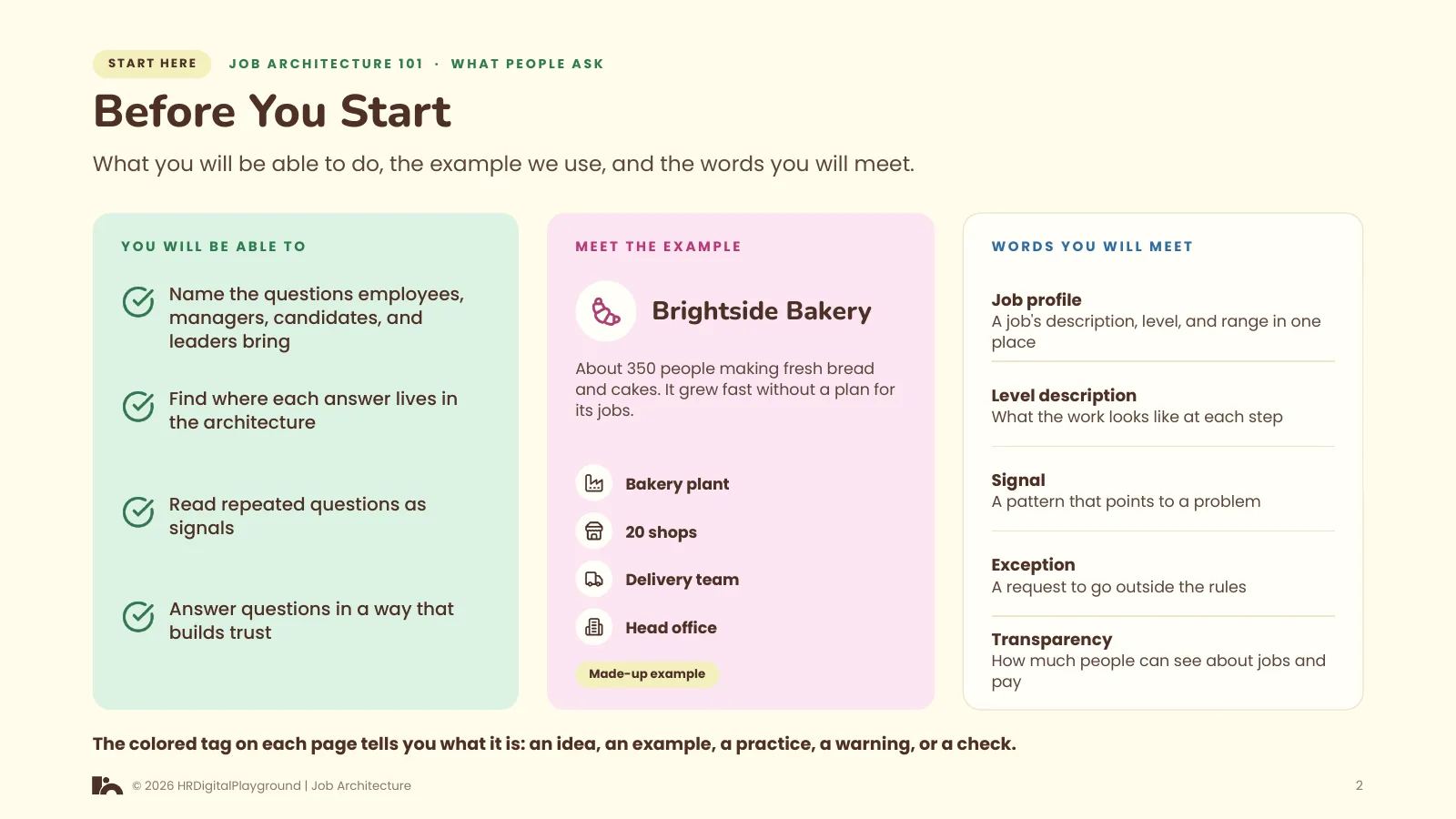
This deck covers what people ask. It is written for someone with no background in HR, compensation, or organization design, and it follows adult learning principles: why before what, one realistic example throughout, practice with answers, a short quiz, and a one-page recap. The example is Brightside Bakery, a made-up company of about 350 people with a bakery plant, twenty shops, a delivery team, and a head office. It grew fast without a plan for its jobs, so it has far more titles than real jobs and no shared way to compare them. The words on this page are defined again where they first appear.
Page 3 Questions Are the Front Door
Read the explanation
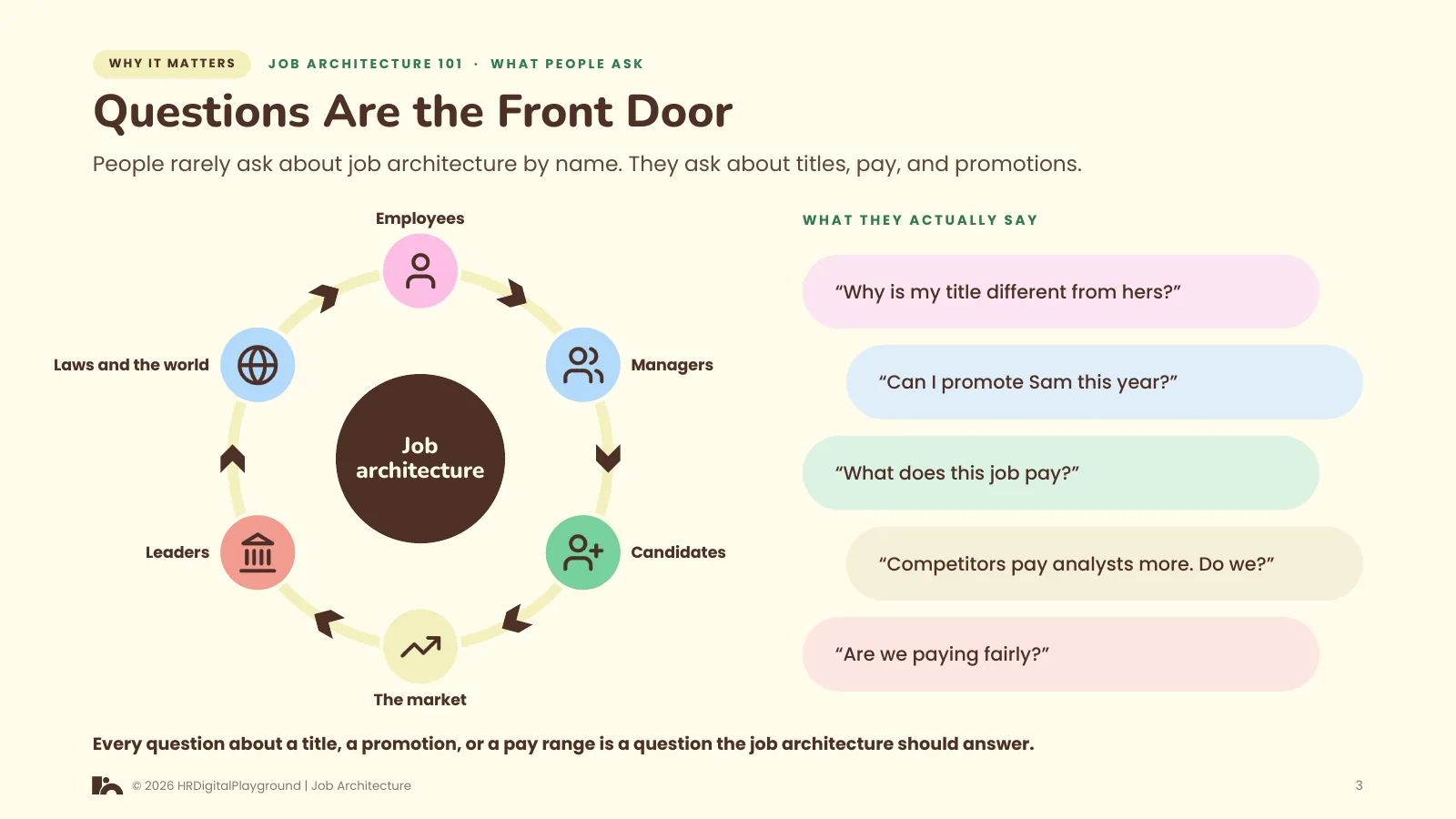
Very few people will ever open a job architecture and read it. Instead, they ask questions. An employee asks why a colleague has a different title. A manager asks whether they can promote someone. A candidate asks what a job pays. A leader asks whether pay is fair. A regulator asks for a pay report. Each of these is a question the job architecture should answer, quickly and the same way every time. That is why this deck treats questions as the front door. When the answers are easy to find and consistent, people trust the structure. When every question needs a special investigation, people conclude there is no real structure, whatever the documents say. The rest of this deck looks at each group's questions and where the answers live.
Page 4 What Employees Ask
Read the explanation
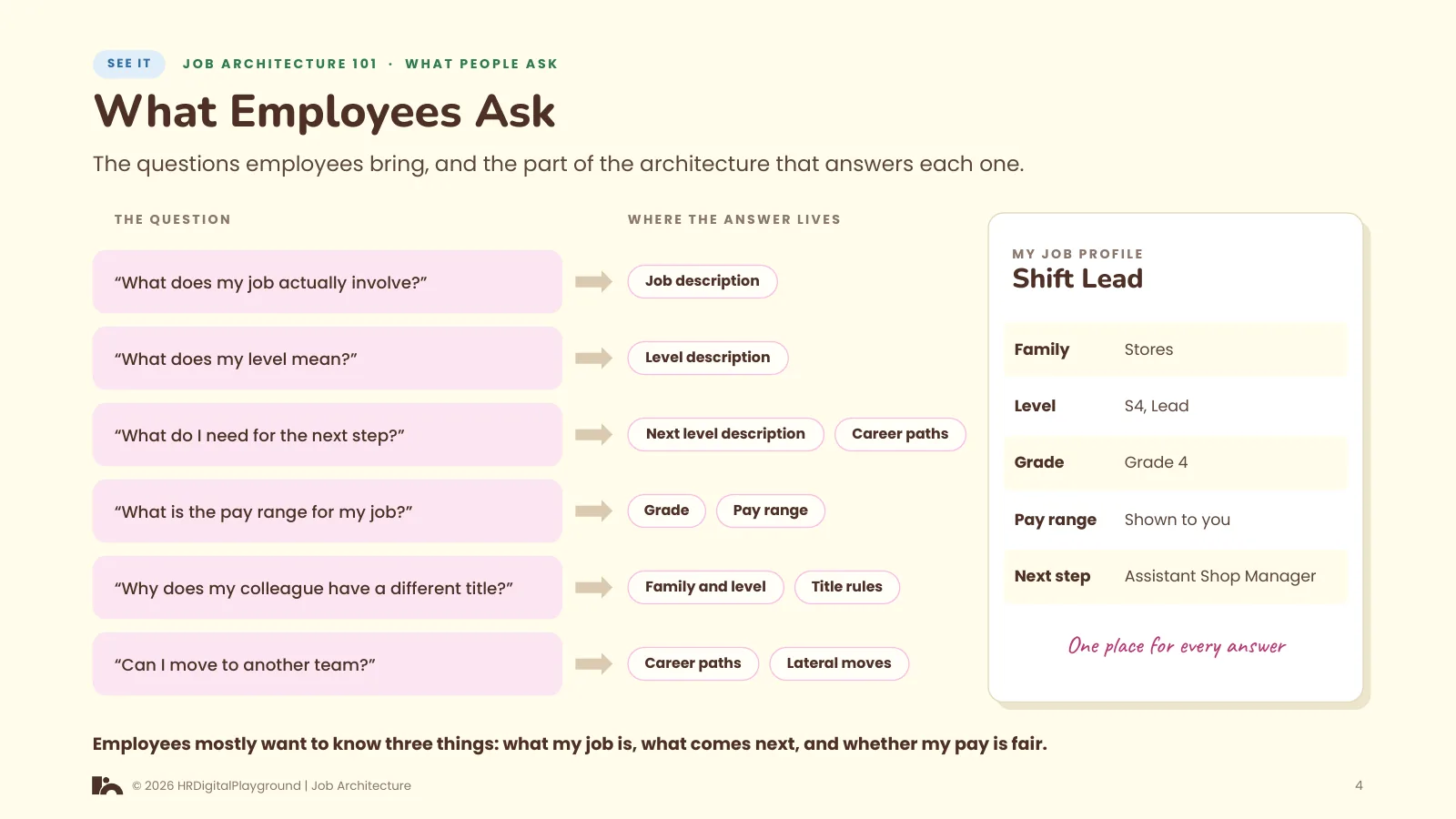
Employees ask the most personal questions, and the architecture should answer them plainly. What does my job involve? The job description. What does my level mean? The level description, which explains the work at each step. What do I need for the next step? The next level's description and the career paths from the job. What is the range for my job? The grade and its pay range, and in some places employees have a legal right to ask. Why does a colleague have a different title? Either the two jobs really differ, which the family and level placements show, or the titles are inconsistent, which is a cleanup item. Can I move to another team? The career paths, including lateral moves to jobs on the same grade. Many companies gather these answers into a job profile each employee can see.
Page 5 What Managers Ask
Read the explanation
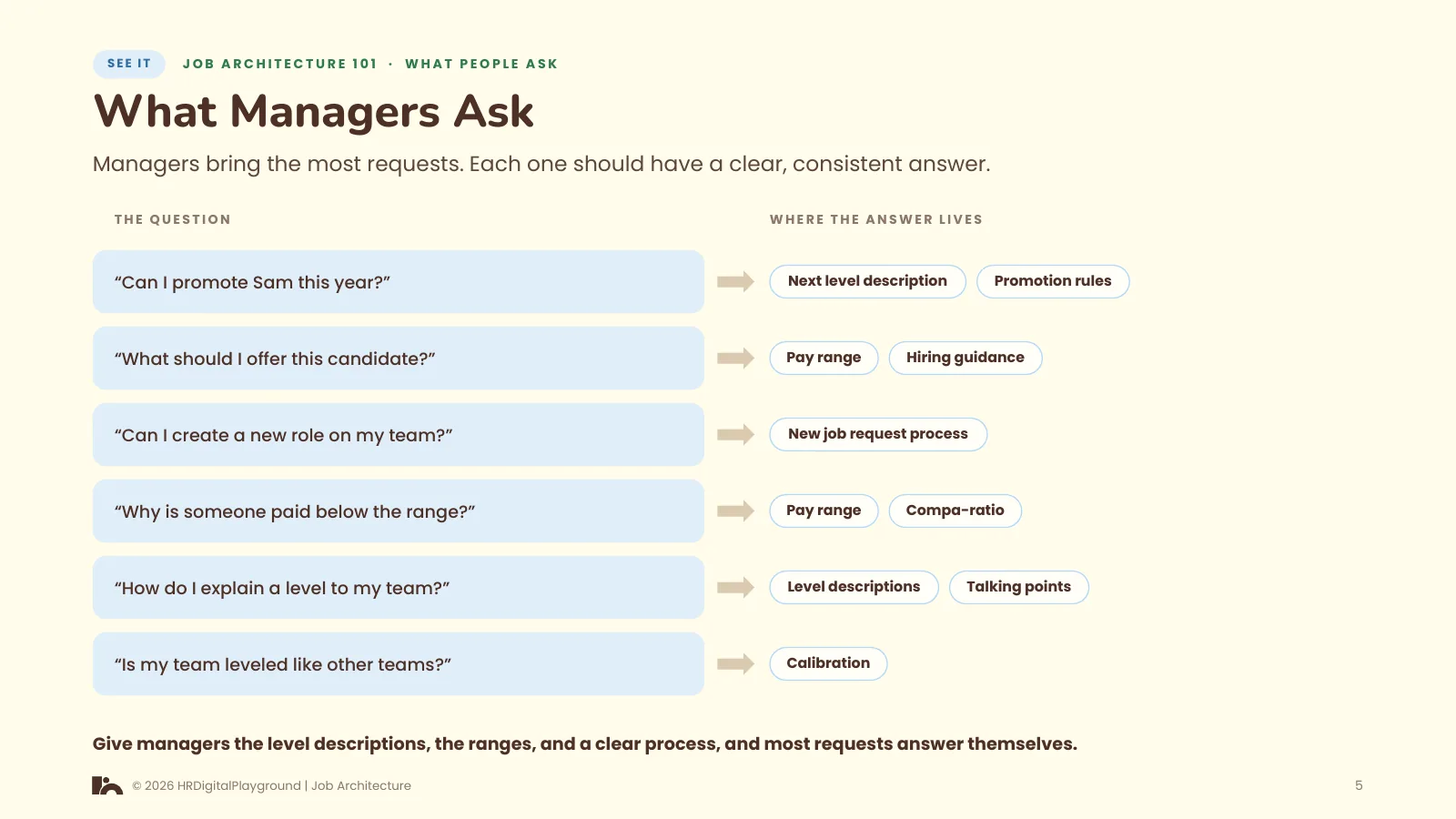
Managers ask the most frequent and most consequential questions. Can I promote Sam? The answer comes from comparing Sam's work with the next level's description and the company's promotion rules. What should I offer this candidate? The job's pay range and the company's hiring guidance, based on how ready the candidate is for the job. Can I create a new role? The new job request process, which checks whether an existing job already fits before anything new is created. Why is someone paid below the range? The range and the person's compa-ratio, which may show a fix is needed. How do I explain a level to my team? The level descriptions and talking points. Is my team leveled like other teams? Calibration, which compares placements across teams. When managers have these tools, they answer most questions themselves and escalate only real exceptions.
Page 6 What Candidates and the Market Ask
Read the explanation
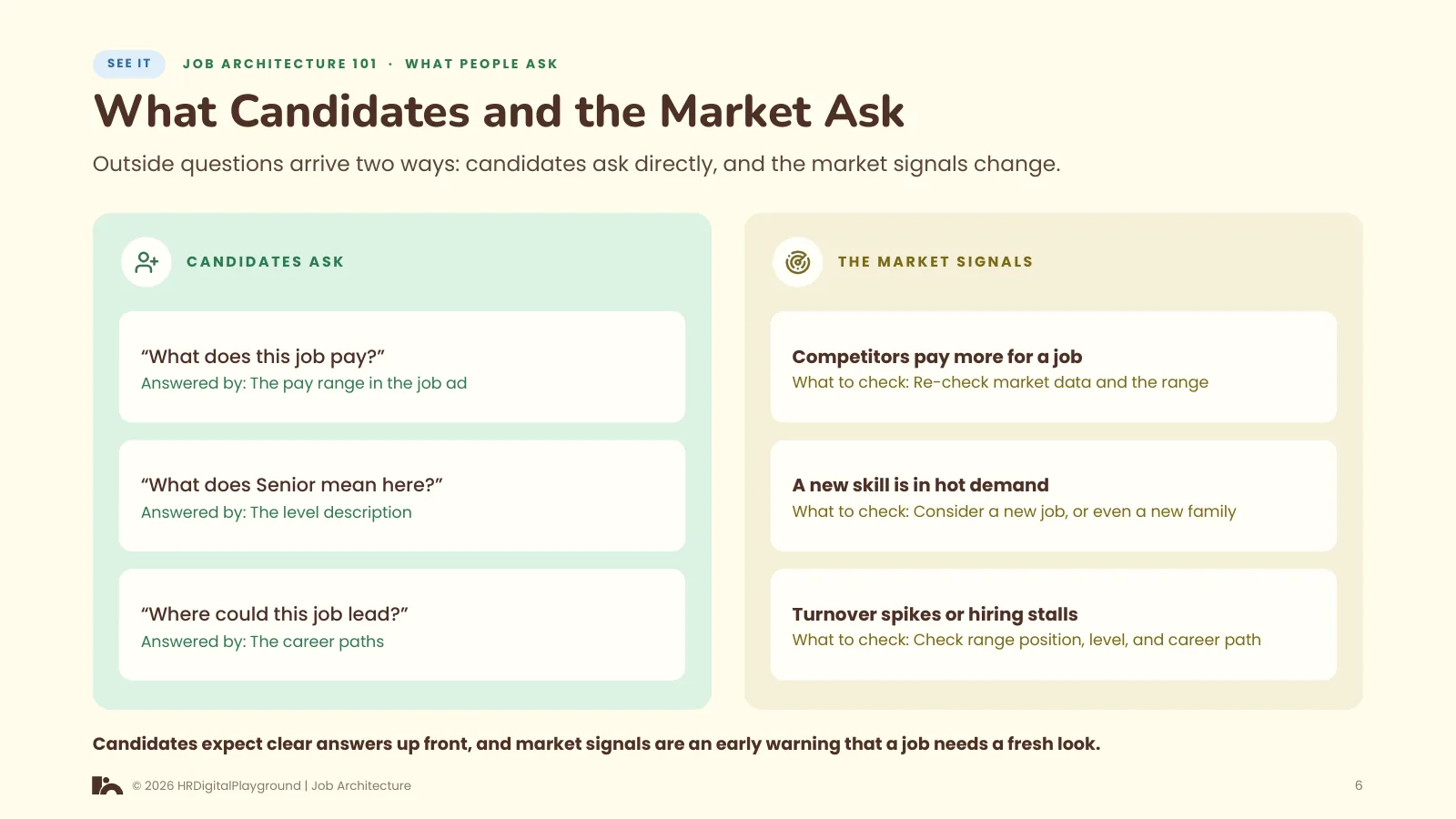
People outside the company interact with the job architecture too. Candidates ask what a job pays, which many laws now require employers to answer in the job ad. They ask what a title like Senior means at this company, which the level description answers, and what the career path looks like, which the career paths answer. The market asks questions in a different way, through signals. When competitors start paying much more for a job, it is time to re-check the market data and the range. When a new skill becomes hot, such as a new kind of data or AI work, the company may need a new job or even a new family. When turnover spikes or hiring stalls for one job, check where people sit in the range, whether the level is right, and whether the career path is visible. Each signal points back to a specific part of the architecture.
Page 7 What Leaders and the Wider World Ask
Read the explanation
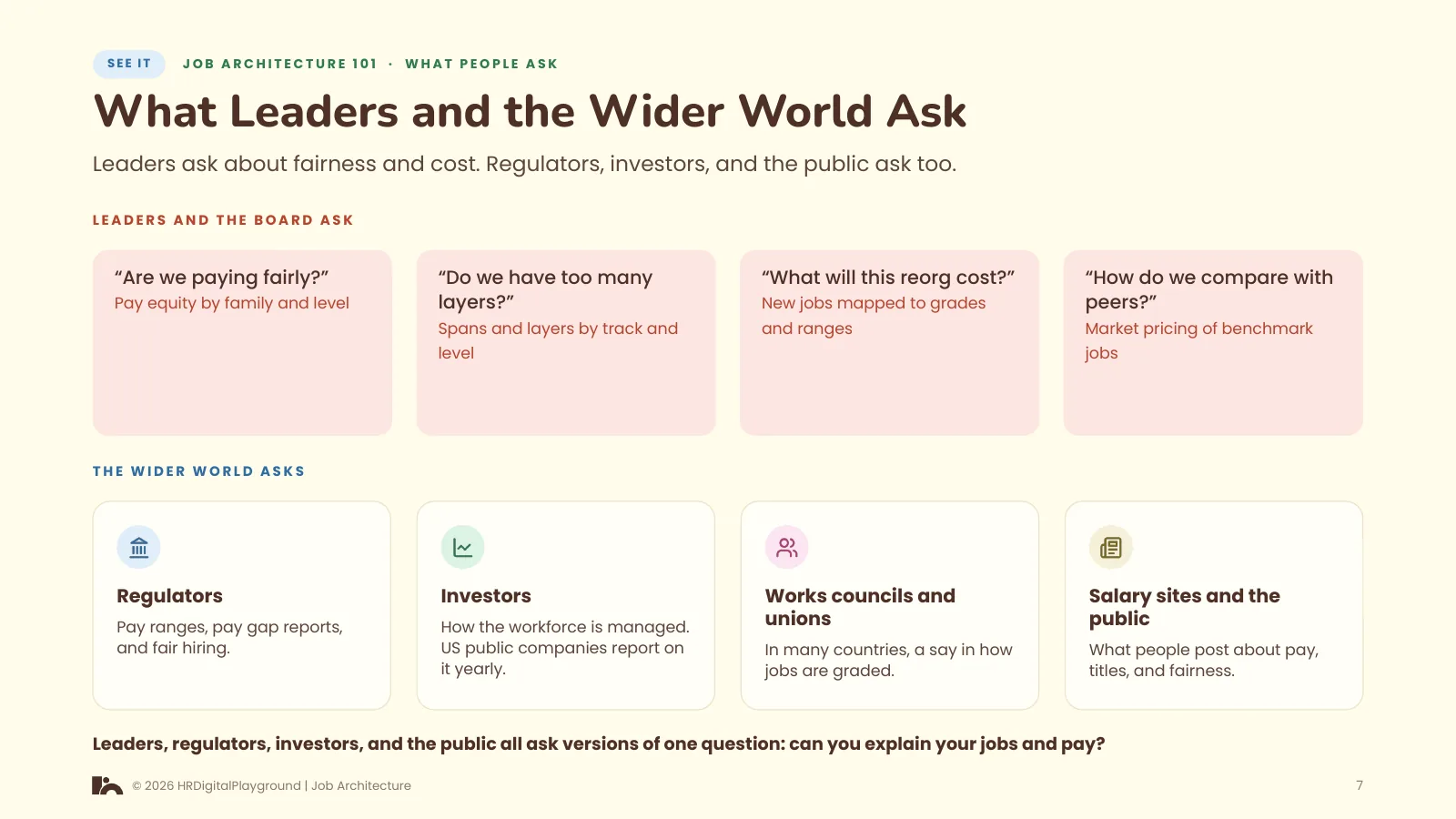
Leaders ask questions about the whole company. Are we paying fairly? Answered by pay equity checks built on families and levels. Do we have too many layers of management? Answered by spans and layers analysis using tracks and levels. What will this reorganization cost? Answered by mapping new and changed jobs to grades and ranges. How do we compare with our peers? Answered by market pricing. The wider world asks too. Regulators ask for pay ranges and pay reports. Investors increasingly ask about the workforce, and US public companies describe their human capital in their annual reports. In many countries, works councils or unions must be consulted on how jobs are evaluated and graded. And salary websites publish what people say they earn at the company, so inconsistent titles and pay become visible to candidates. A clear architecture lets the company answer all of these with confidence.
Page 8 When the Same Question Keeps Coming Back
Read the explanation
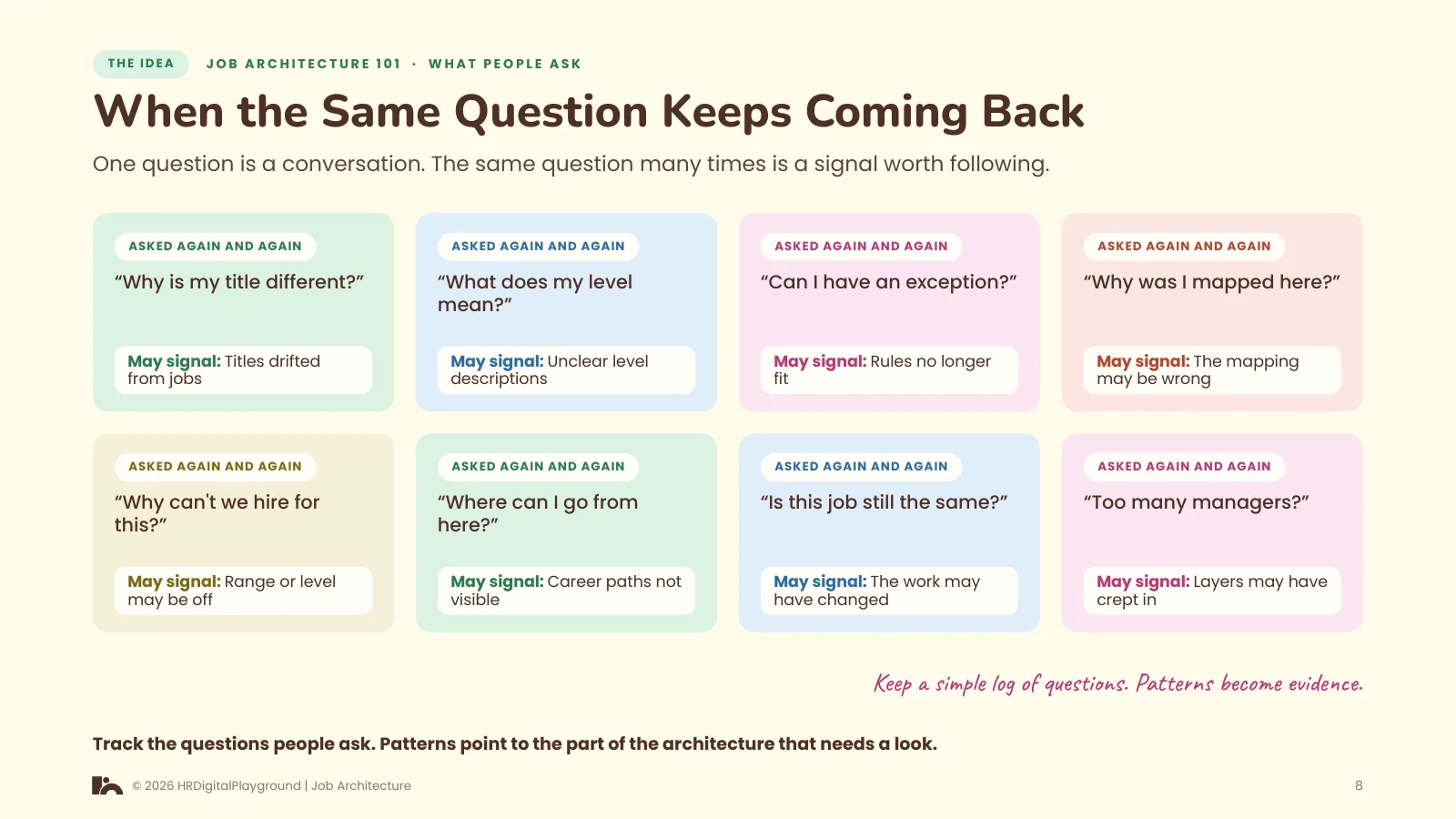
Questions are not only something to answer. When the same question keeps coming back, it is a signal. If many employees ask why their titles differ from colleagues doing similar work, titles have probably drifted away from the jobs, so check the title rules and mapping. If people keep asking what their level means, the level descriptions are probably unclear. If managers keep asking for exceptions, the rules may no longer fit the business. If employees repeatedly challenge how their job was mapped, the mapping may be wrong, so re-assess the job. If managers keep asking why they cannot hire for a job, the range or the level may be off, so check market data. If people keep asking where they can go next, career paths are not visible enough. If people ask whether a job is still the same job after a new tool or process, the work may have changed, so review the description and level. And if leaders keep asking about too many managers, layers may have crept in. Keeping a simple log of questions, even a spreadsheet, turns these patterns into evidence.
Page 9 Who Sees What
Read the explanation
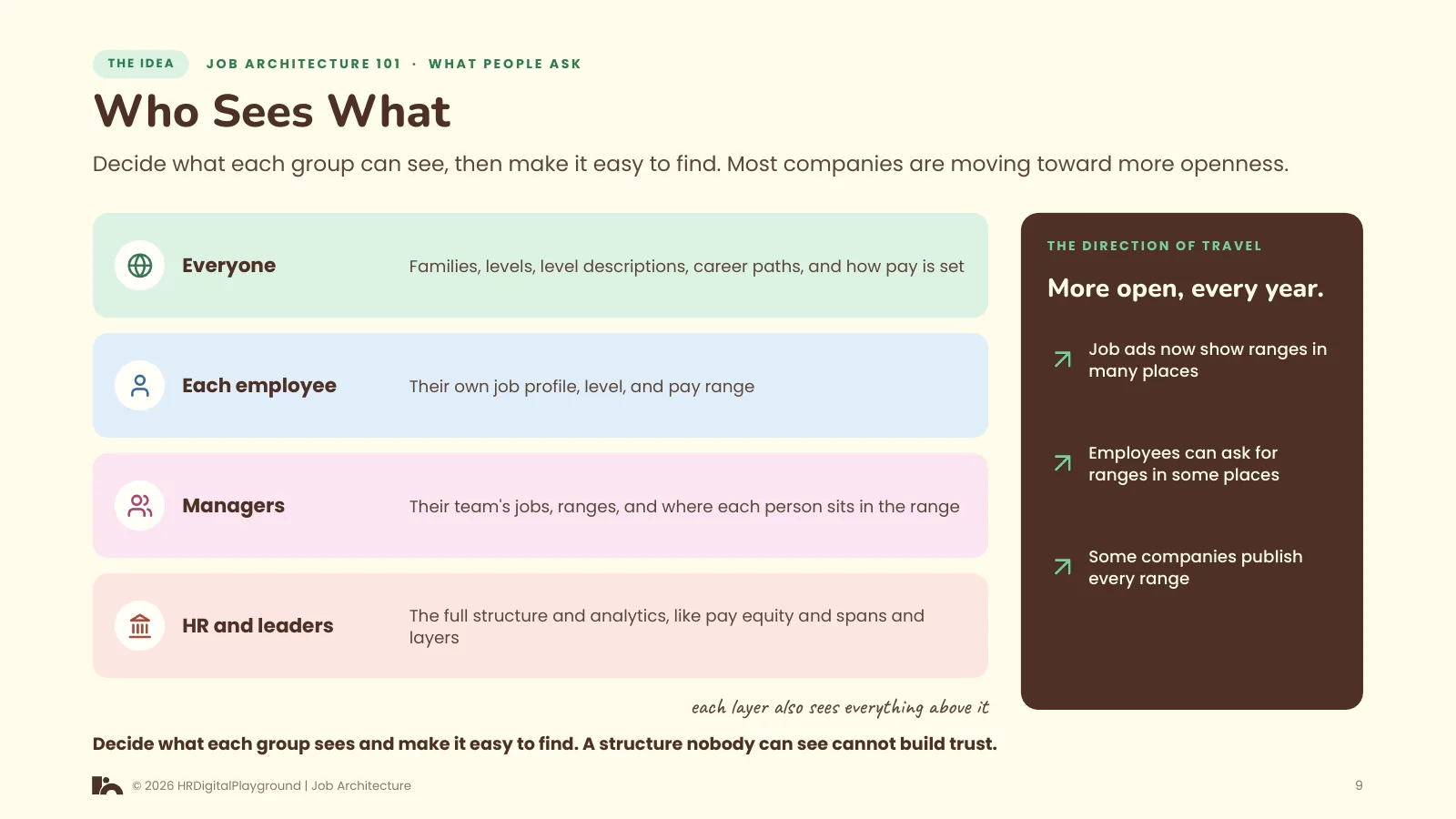
Every company has to decide how open to be about its job architecture. A common approach has four layers. Everyone can see the families, the levels and their descriptions, the career paths, and how pay is set in general. Each employee can see their own job profile, including their level and pay range. Managers can see the jobs, ranges, and where each person on their team sits in the range, so they can make fair decisions. HR and leaders can see the full structure and the analytics, such as pay equity and spans and layers. Some companies go further and publish every pay range to all employees, and laws are pushing in that direction, since in some places employees already have a right to ask. Whatever the choice, write it down, apply it consistently, and make the information easy to find, because people who cannot see the structure will assume it does not exist.
Page 10 What Changes for Employees and Managers
Read the explanation
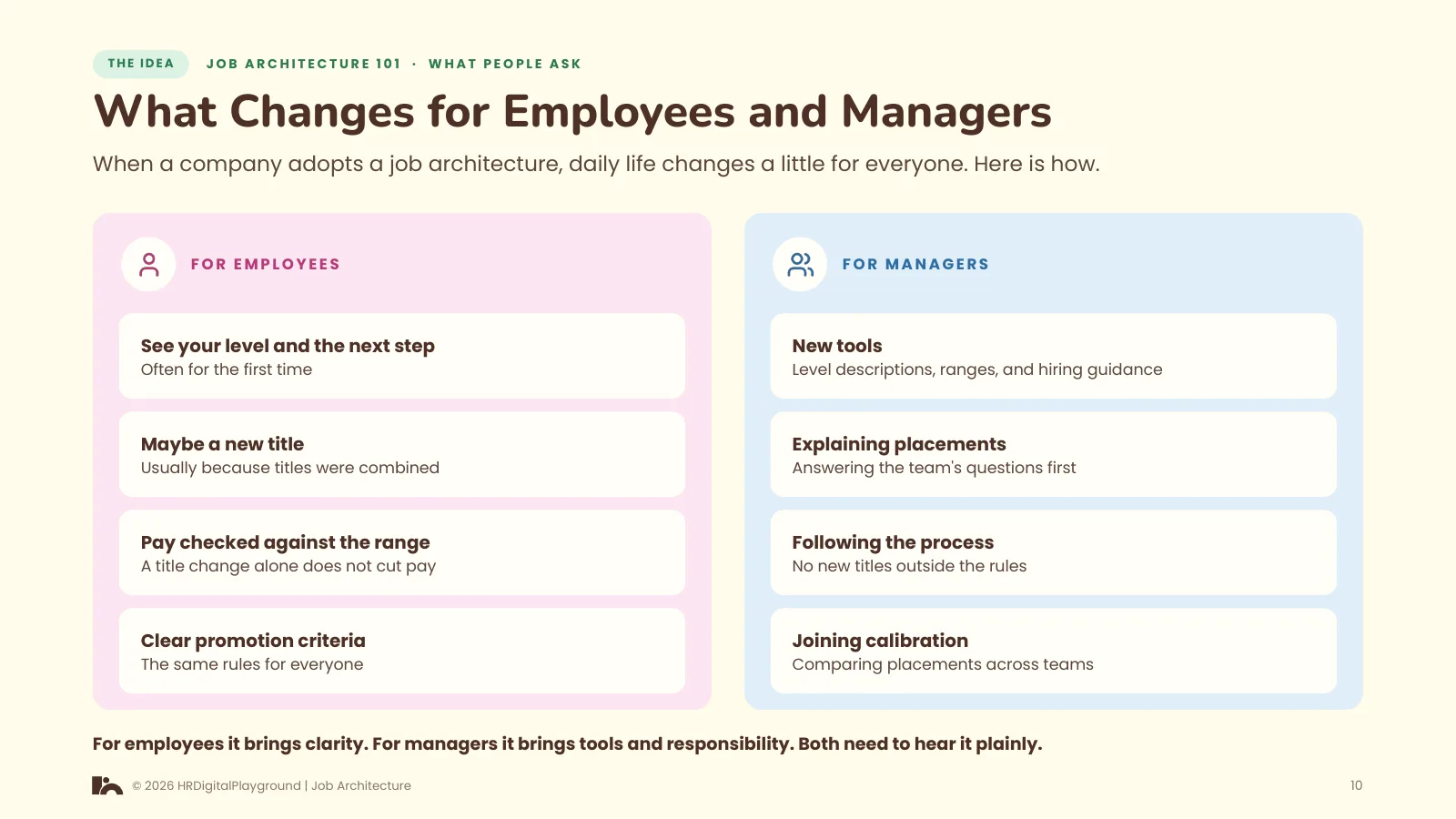
Adopting a job architecture changes a few things for everyone, and people handle change better when they know exactly what it means for them. Employees see their level and what the next step requires, often for the first time. Some get a new title, usually because several titles were combined into one job. Their pay is reviewed against the job's range, and a title change on its own does not cut anyone's pay. Promotion criteria become visible and consistent. And they can ask about the range for their job. Managers gain tools: level descriptions for development and promotion conversations, ranges and guidance for offers and raises, and a clear process for new roles. They also take on responsibility: explaining placements to their teams, following the process instead of inventing titles, and taking part in calibration. Explaining these changes plainly and early prevents most of the worry.
Page 11 Answering a Question Well
Read the explanation
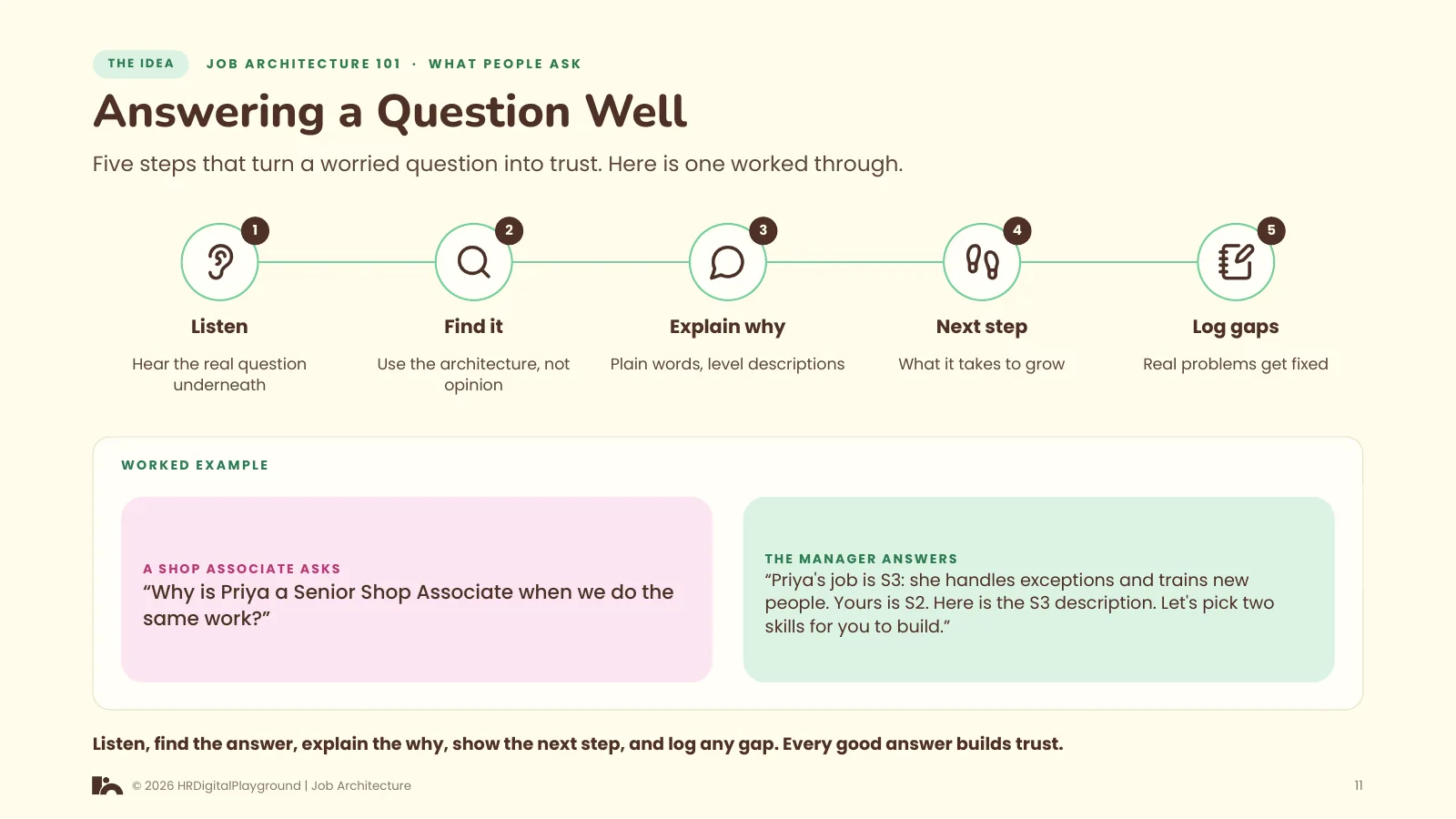
How a question is answered matters as much as the answer. A reliable approach has five steps. First, listen for the real question: why is my title different often means am I valued, or am I paid fairly. Second, find the answer in the architecture, such as the two jobs' families and levels, rather than giving an opinion. Third, explain the why in plain words, using the level descriptions. Fourth, show the next step, such as what the person would need to do to reach the next level. Fifth, if the question reveals a real problem, such as two titles for the same job, log it so the structure gets fixed. In the example, Priya is a Senior Shop Associate at S3 and the person asking is a Shop Associate at S2. The manager explains that the jobs are different sizes, shows the S3 description, and agrees two skills to build. If the two did the same work, the right answer would be to fix the titles.
Page 12 Where Does the Answer Live?
Read the explanation
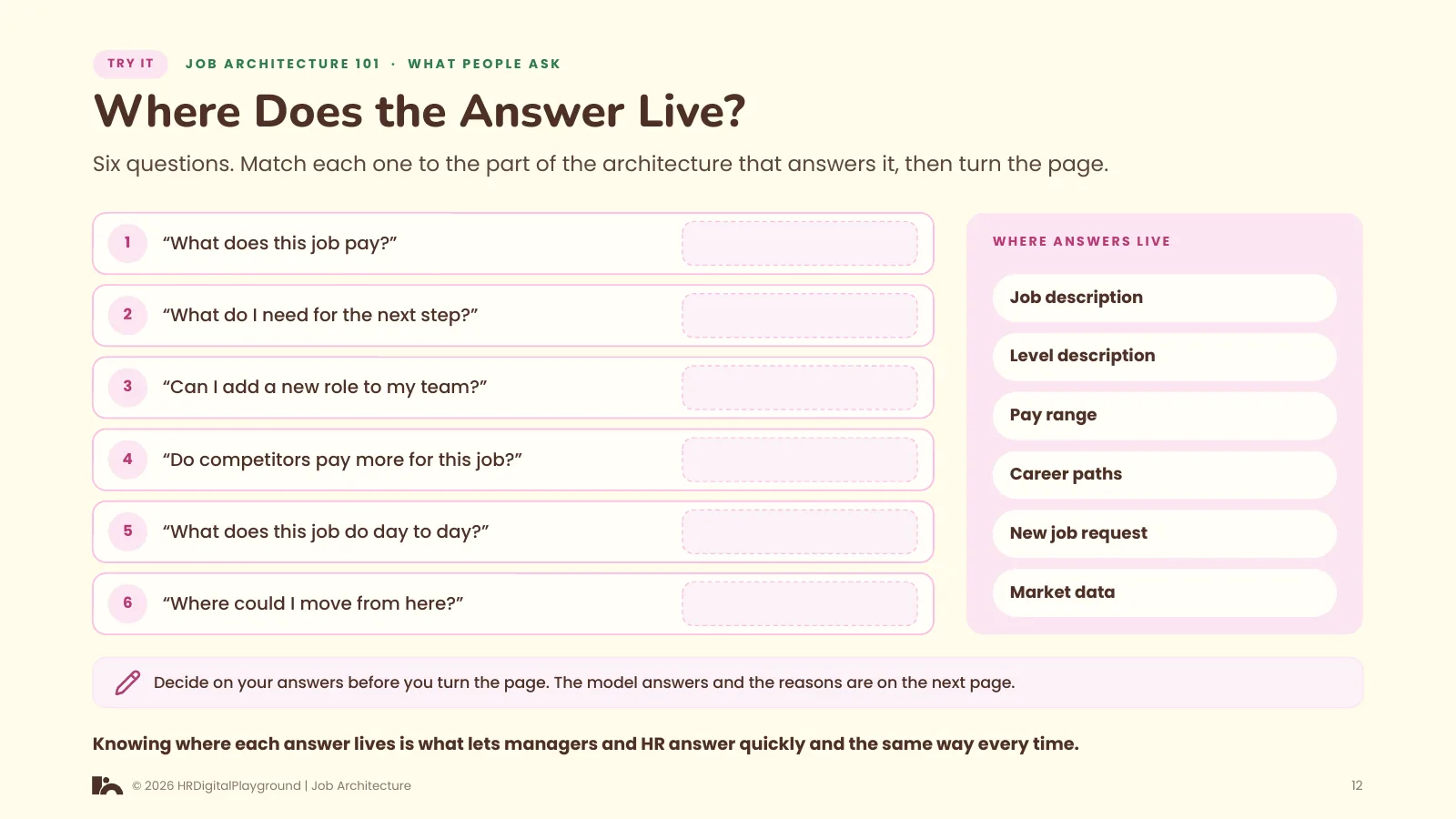
This activity practices finding answers. Match each of the six questions to the part of the architecture that answers it: job description, level description, pay range, career paths, the new job request process, or market data. The model answers are on the next page.
Page 13 Where Does the Answer Live: Model Answers
Read the explanation
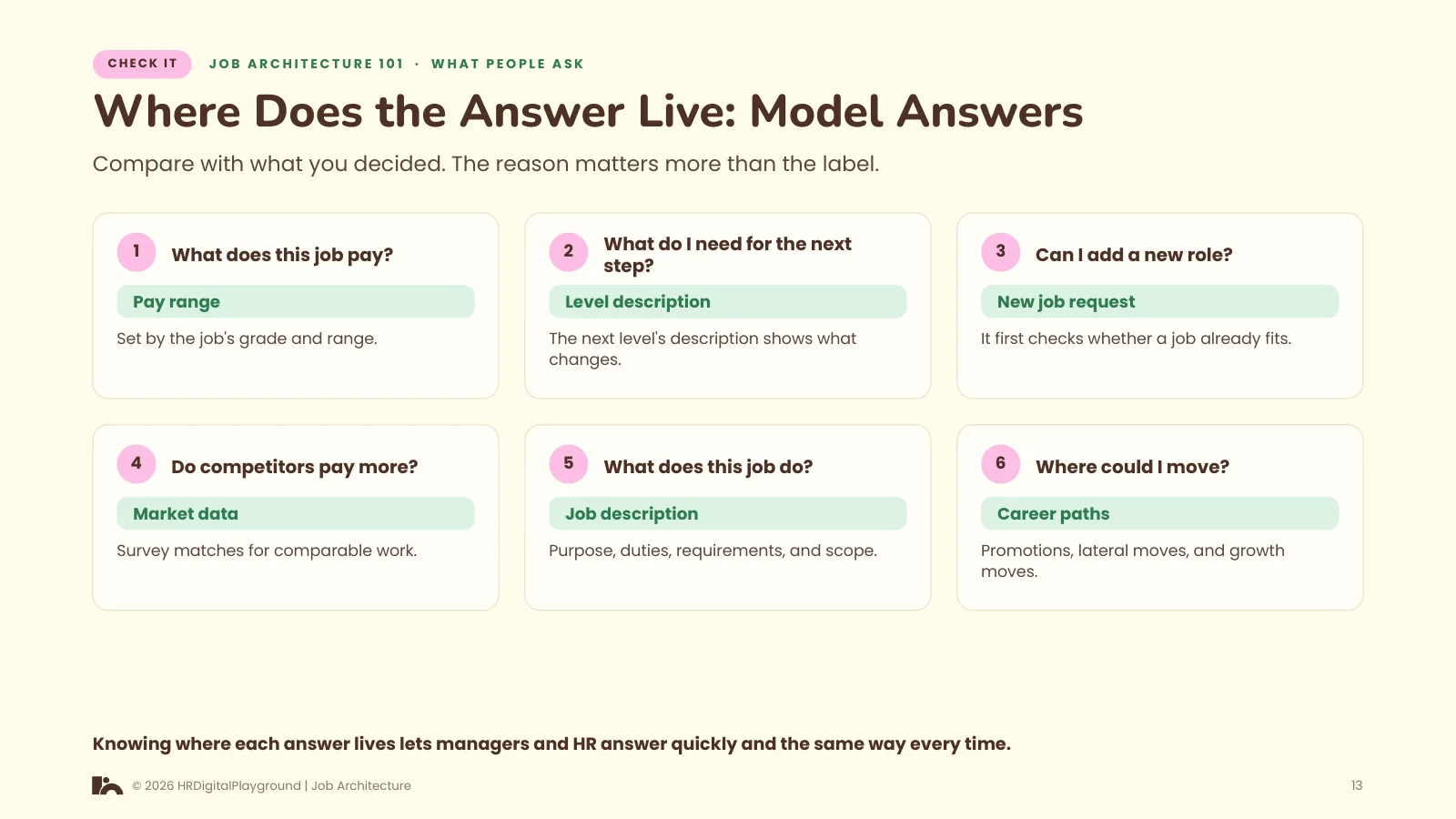
Model answers. What a job pays lives in the pay range. What the next step requires lives in the next level's description. Whether a new role can be added goes through the new job request process. Whether competitors pay more is answered by market data. What a job does day to day lives in the job description. And what moves are possible from a job lives in the career paths.
Page 14 Quick Check
Read the explanation
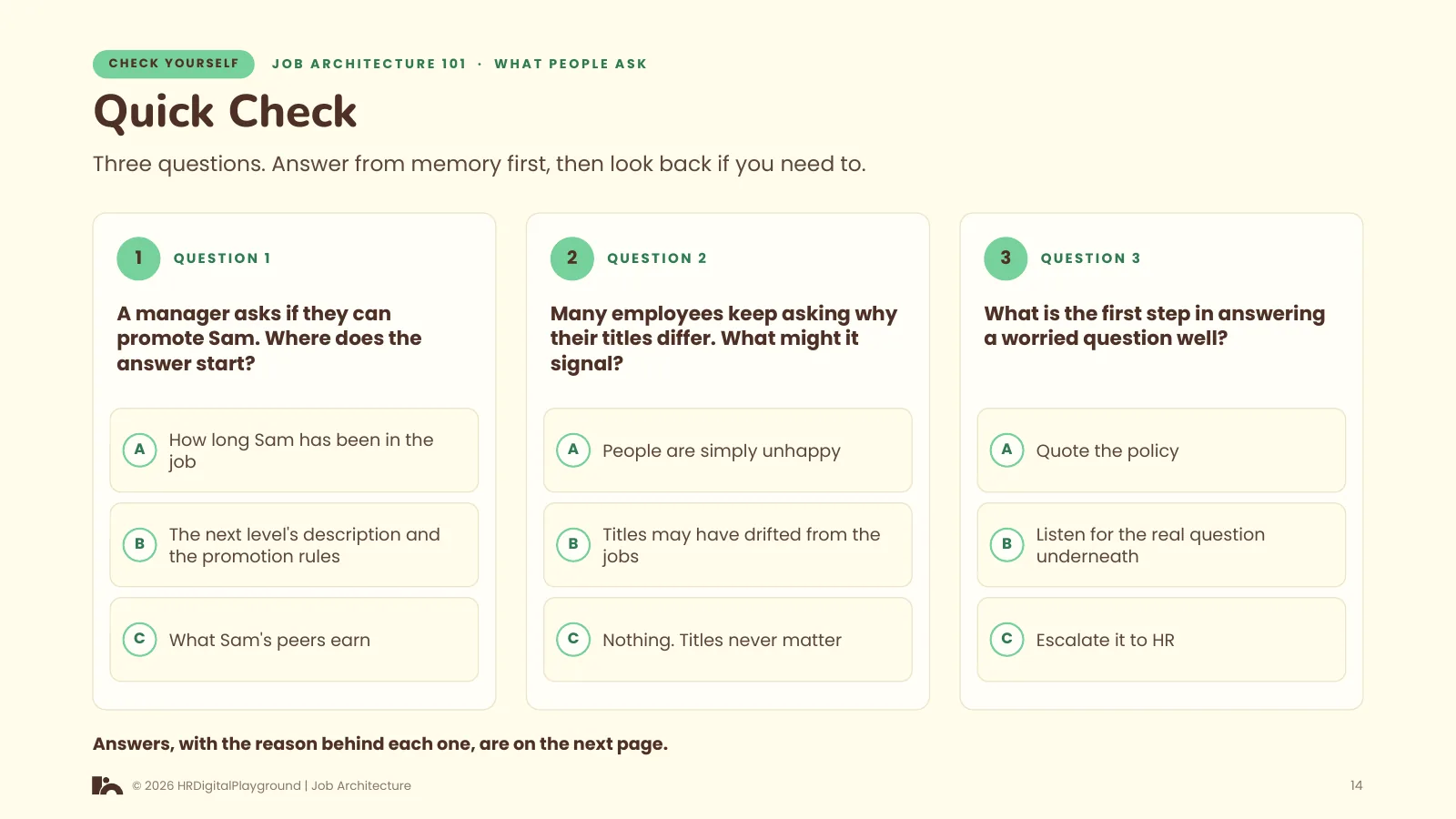
Three questions on how people use the architecture. Question 1 checks where a promotion answer comes from. Question 2 checks what a repeated question can signal. Question 3 checks the first step in answering a question well.
Page 15 Remember
Read the explanation
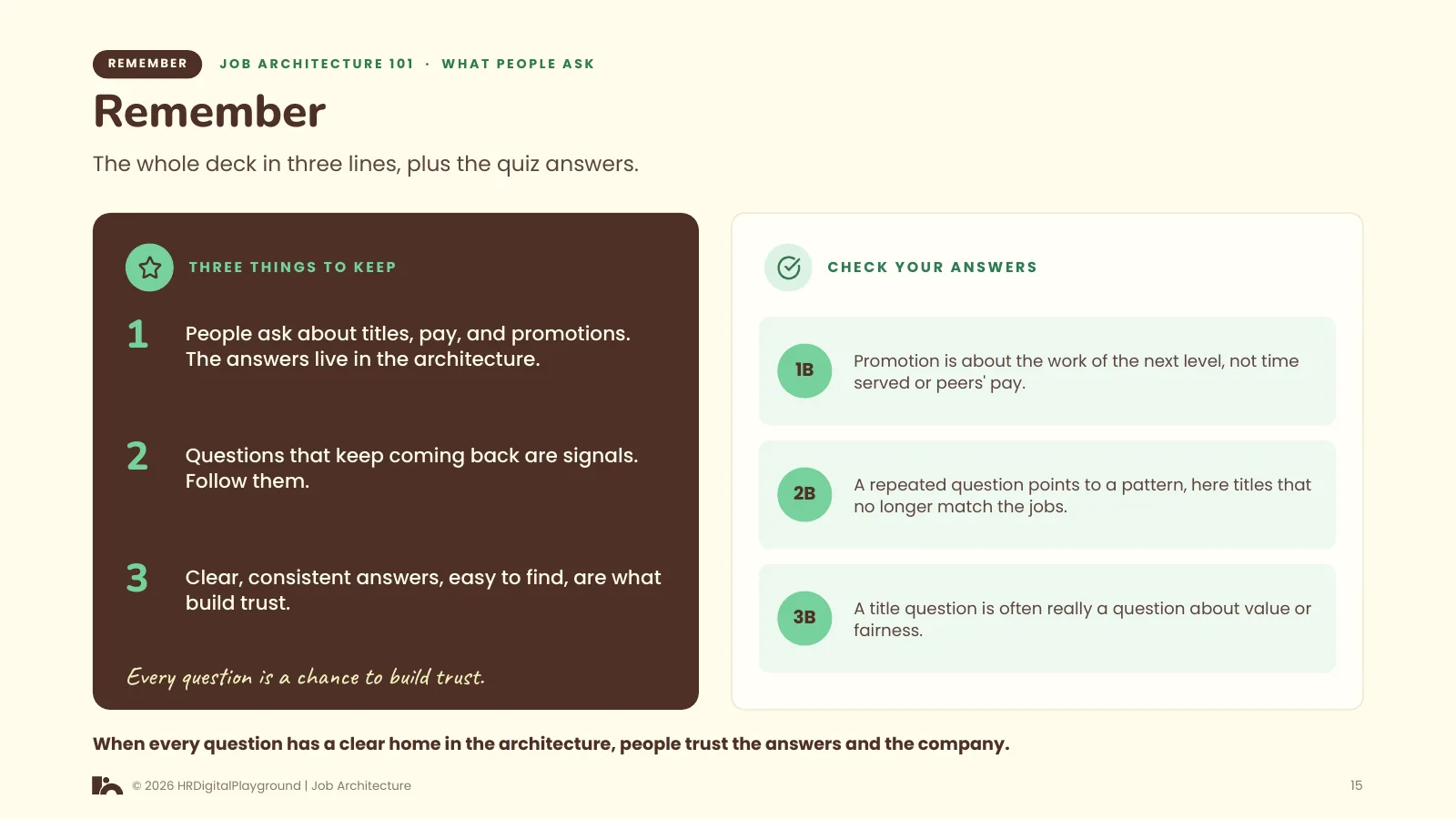
The recap keeps three ideas. Questions are the front door: employees, managers, candidates, leaders, and the wider world all ask about titles, pay, and promotions, and the answers should come from the architecture. Questions that keep coming back are signals that point to the part of the architecture that needs a look. And good answers, made easy to find, are how the architecture earns trust. Quiz answers: 1 is B, the next level's description and the promotion rules. 2 is B, titles may have drifted away from the jobs they describe. 3 is B, listen for the real question.
Page 16 Copyright and Notices
Illustrative numbers, fictional company
Read the explanation
Job Architecture 101: What People Ask. Copyright 2026 HRDigitalPlayground | Job Architecture. Published September 2026. Brightside Bakery is a fictional company and all examples are illustrative. The material is general education, not legal, tax, or financial advice.