The Skills Layer
What do skills add to the architecture?

Page 1 The Skills Layer
Read the explanation
This deck answers: what do skills add to a job architecture? Jobs tell you what work exists and where it fits. Skills describe the capabilities people need to do that work, and proficiency describes how deeply each skill must be applied. The deck shows how skills sit on top of the architecture rather than replacing it, four simple types of skills, a beginner proficiency scale, how proficiency changes with the size of a job, how to build a role skill profile, where skills evidence comes from, and how skills support careers, market decisions, and changing work. It ends with a practice scenario and its model answers, three quick questions, and a recap.
Page 2 Before You Start
Read the explanation
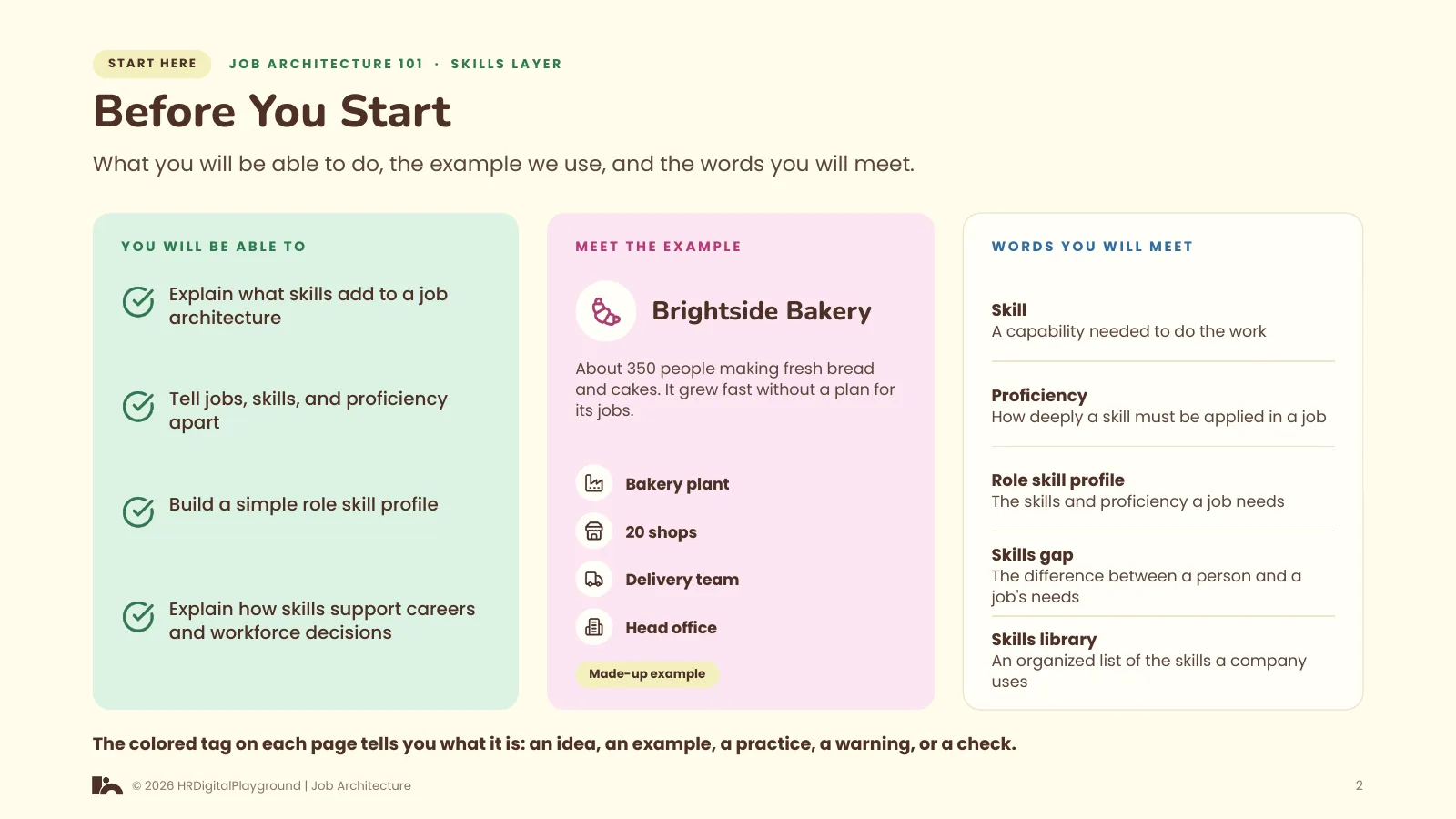
This deck covers the skills layer. It is written for someone with no background in HR, compensation, or organization design, and it follows adult learning principles: why before what, one realistic example throughout, practice with answers, a short quiz, and a one-page recap. The example is Brightside Bakery, a made-up company of about 350 people with a bakery plant, twenty shops, a delivery team, and a head office. It grew fast without a plan for its jobs, so it has far more titles than real jobs and no shared way to compare them. The words on this page are defined again where they first appear.
Page 3 Jobs and Skills Are Different
Read the explanation
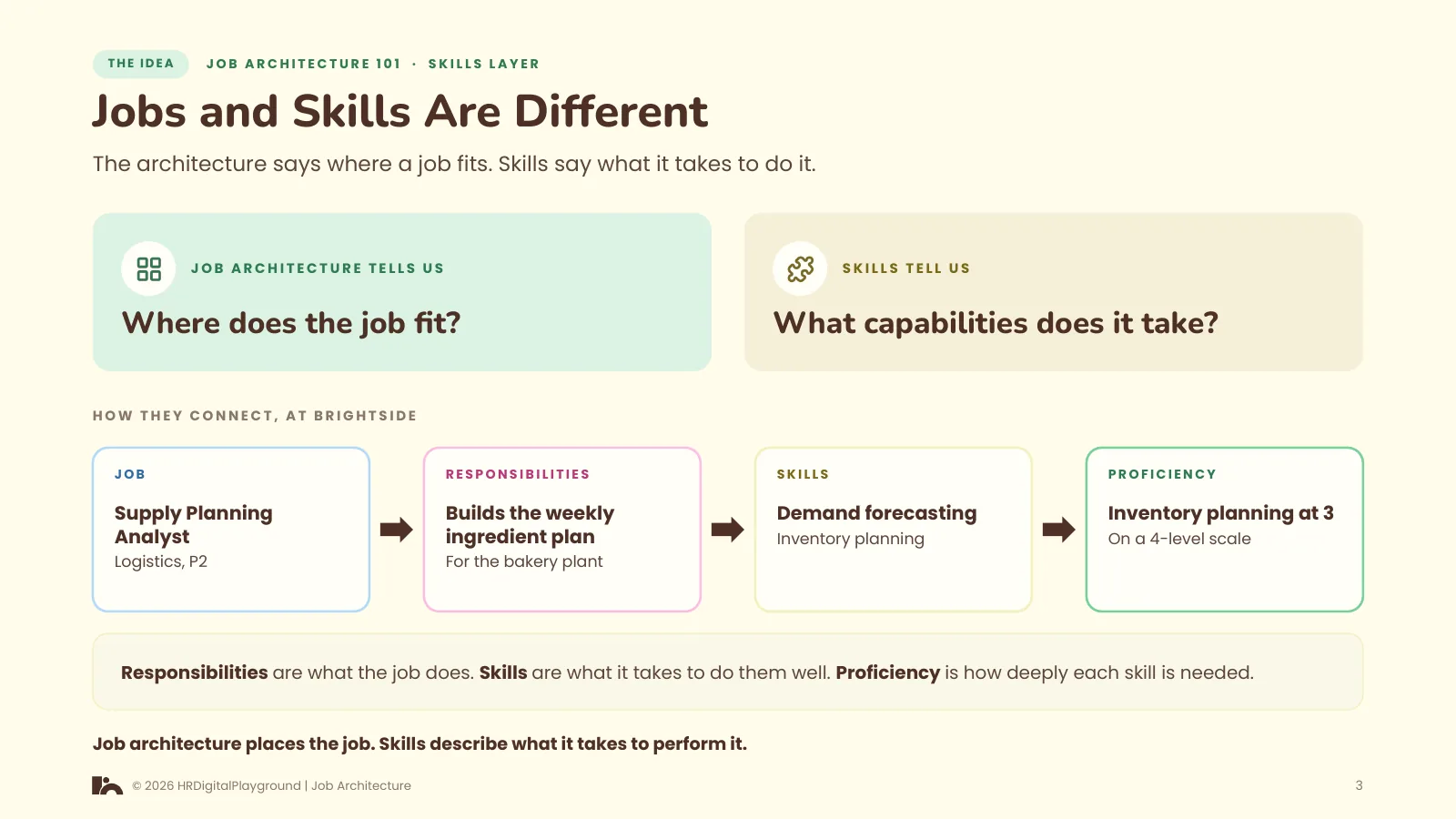
Jobs and skills answer different questions. The job architecture answers where the job fits: its family, track, and level. Skills answer what capabilities are required to perform it. The two connect through the work. A job has responsibilities. Doing those responsibilities takes skills. And each skill has an expected proficiency, how deeply it must be applied in this job. At Brightside, the Supply Planning Analyst builds the weekly ingredient plan for the plant. That responsibility takes demand forecasting and inventory planning, and inventory planning is needed at an advanced level because it is the core of the job. The architecture tells you the job is a Professional P2 job in Logistics. The skills tell you what someone needs to be good at it.
Page 4 Skills Sit On Top of the Architecture
Read the explanation
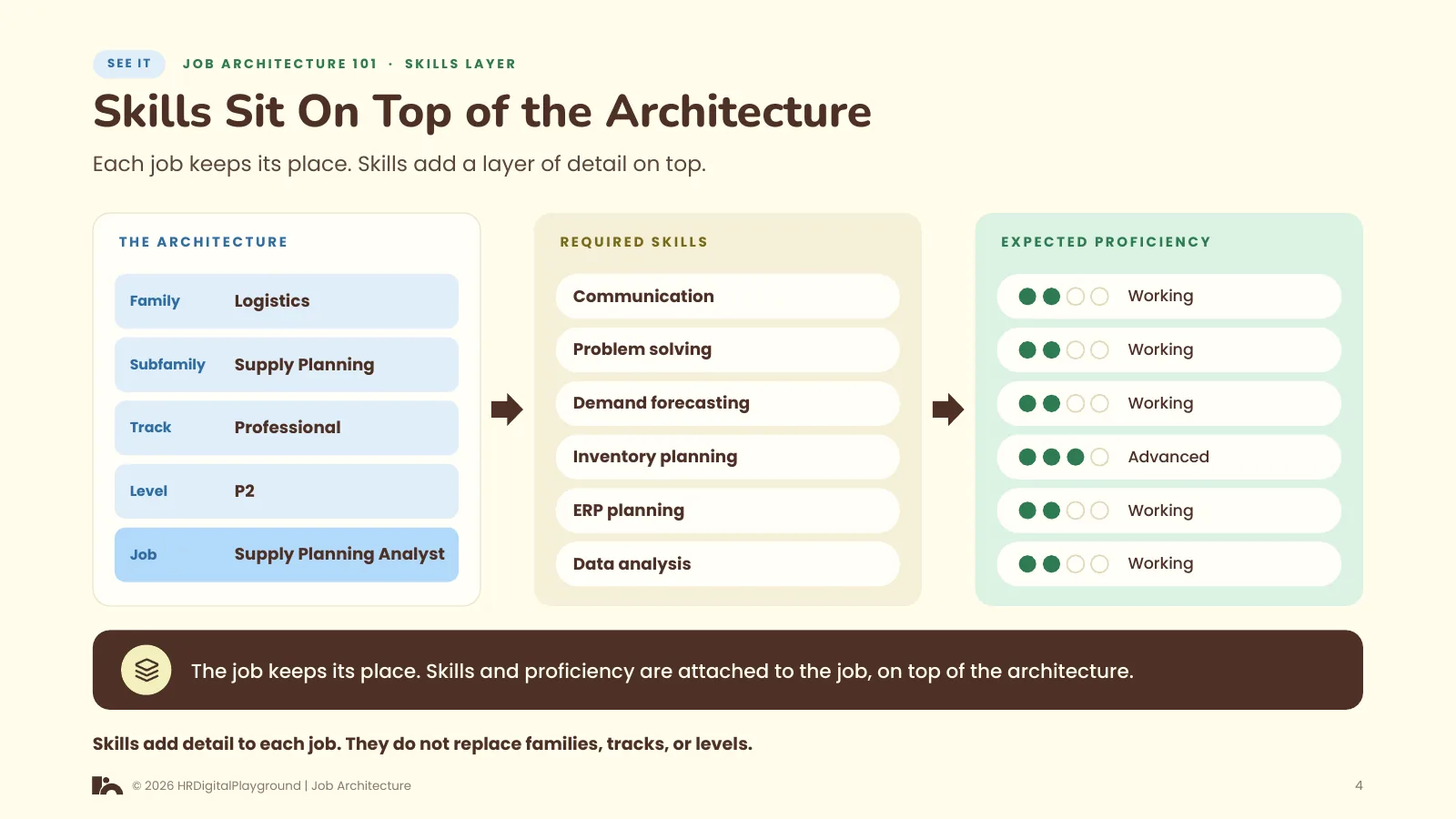
A common worry is that skills will replace job architecture. They do not. The architecture still places each job in a family and subfamily, on a track, at a level. Skills sit on top of that structure. For each job, the company lists the skills the job requires and the proficiency expected for each one. The Supply Planning Analyst job keeps its place: Logistics family, Supply Planning subfamily, Professional track, level P2. On top of that place sit its required skills, such as demand forecasting, inventory planning, ERP planning, and data analysis, and the expected proficiency for each. Because skills attach to jobs, they inherit the architecture's structure. That makes it possible to compare skills across jobs in a family, see how proficiency grows up the levels, and connect skills to careers and pay without rebuilding everything.
Page 5 Four Types of Skills
Read the explanation
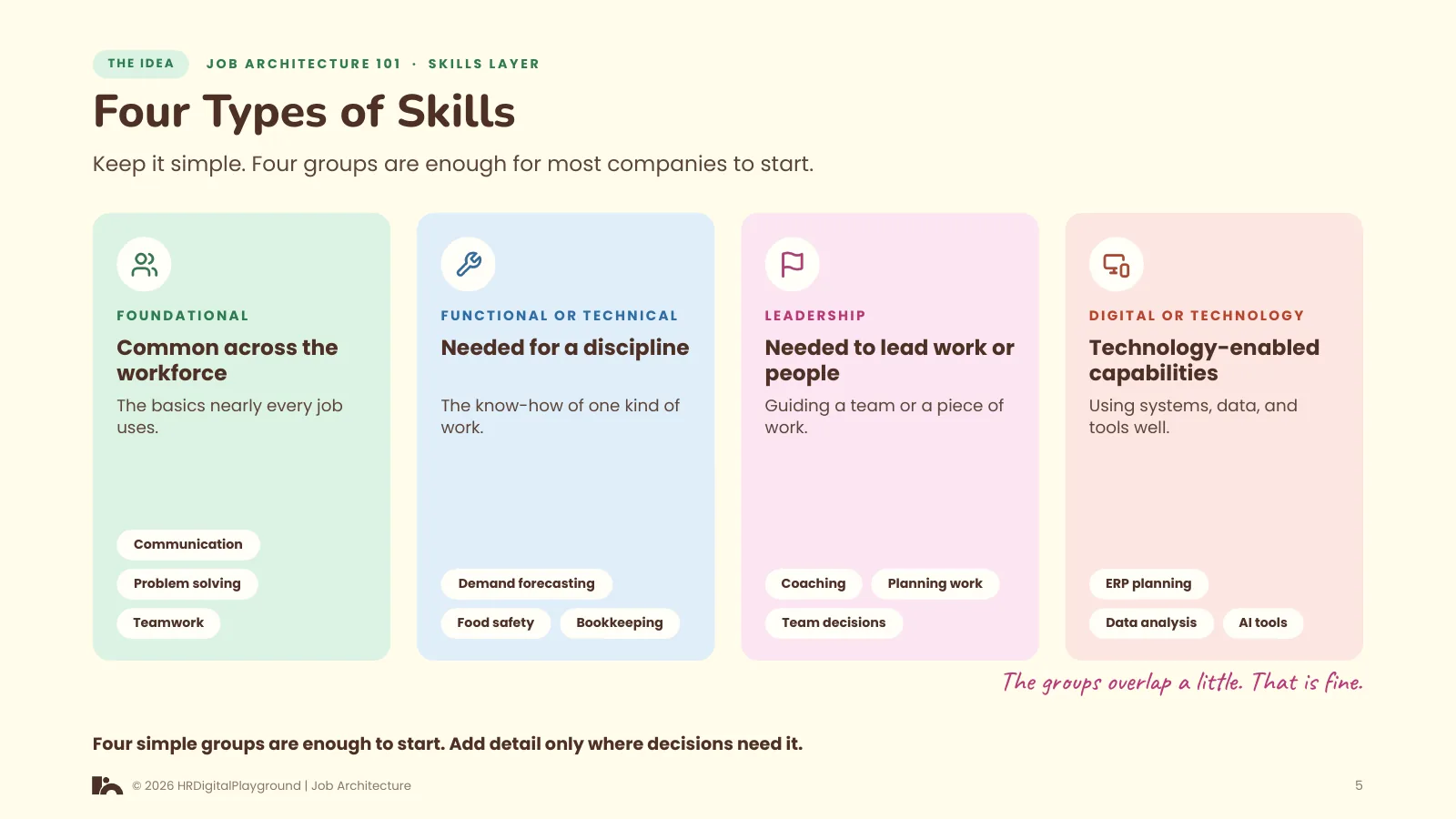
Skills libraries can grow into huge taxonomies with thousands of entries. For a first skills layer, four simple groups are enough. Foundational skills are common across the workforce, such as communication, problem solving, and working with others. Functional or technical skills are needed for a particular discipline, such as demand forecasting, food safety, or bookkeeping. Leadership skills are needed to lead work or people, such as coaching, planning work for others, and making decisions for a team. Digital or technology skills are technology-enabled capabilities, such as using the ERP system, analyzing data, or working with AI tools. The groups overlap at the edges, and that is fine. The point is to give people a shared, simple way to talk about capabilities, then add detail only where a decision such as hiring, development, or pay needs it.
Page 6 Skill vs Proficiency
Illustrative numbers, fictional company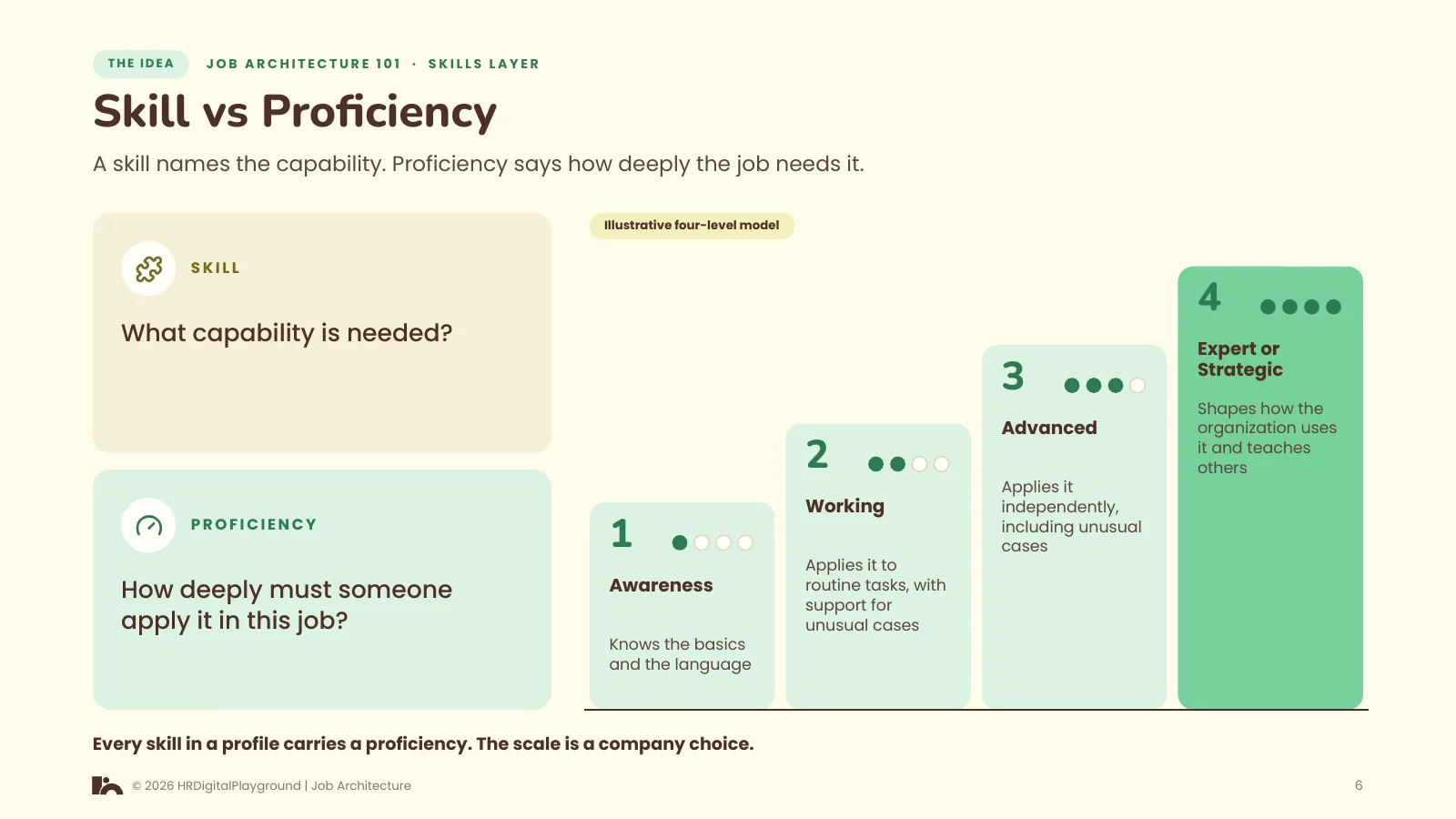
Read the explanation
A skill answers what capability is needed. Proficiency answers how deeply someone must apply it in this job. Two jobs can need the same skill at very different depths. A simple beginner model has four levels, shown here as an illustration. Level 1, Awareness: knows the basics and the language. Level 2, Working: applies it to routine tasks, with support for unusual cases. Level 3, Advanced: applies it independently, including unusual cases. Level 4, Expert or Strategic: shapes how the organization uses it and teaches others. Companies use different scales, often with four or five levels and their own names. What matters is that each level is described clearly enough that two people would rate the same work the same way.
Page 7 Proficiency Is Contextual
Illustrative numbers, fictional company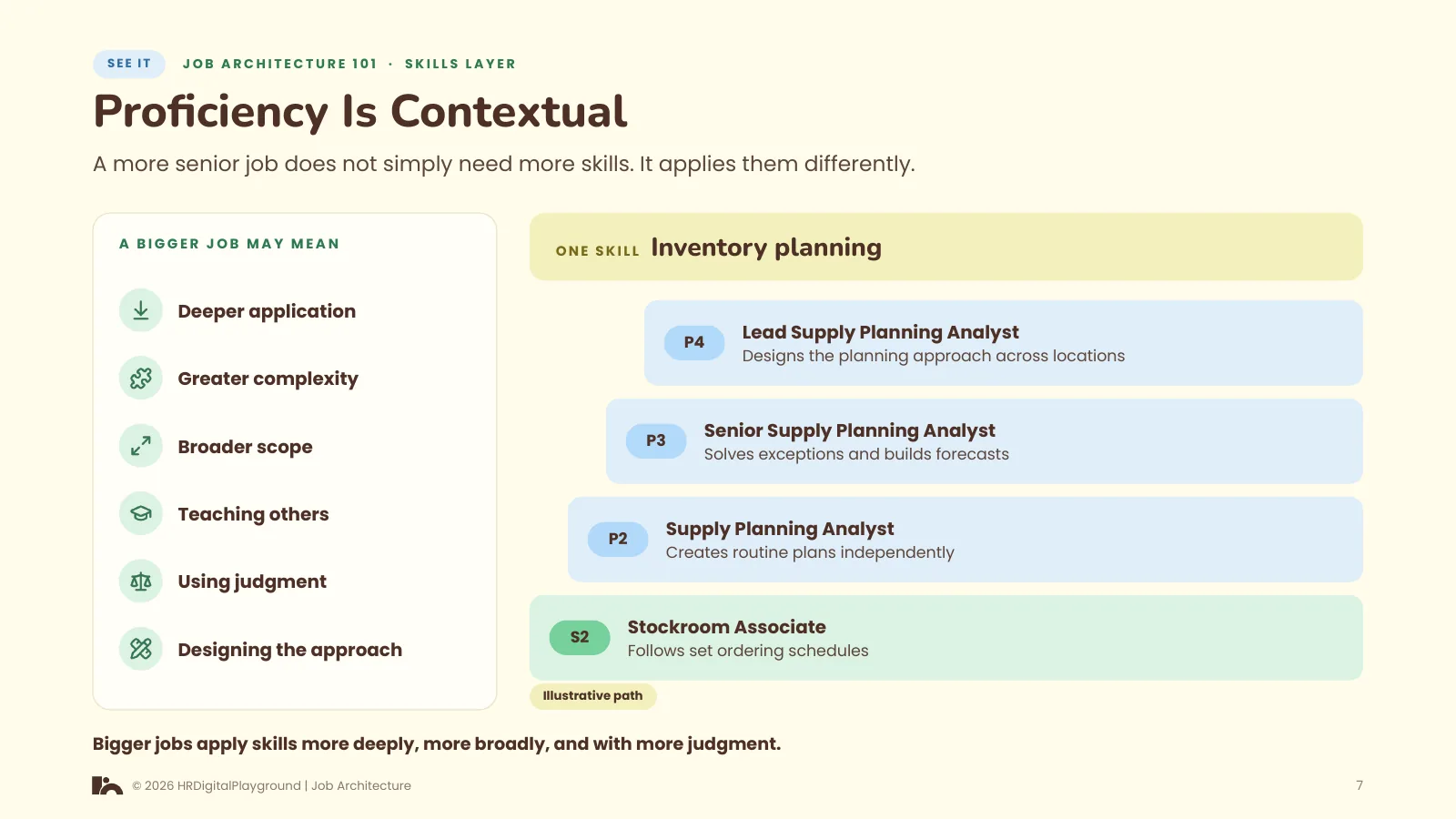
Read the explanation
It is tempting to think a more senior job simply has a longer list of skills. Usually it does not. A bigger job applies the same skills more deeply, to more complex problems, across a broader scope, by teaching others, with more judgment, or by designing the approach others follow. Take one Brightside skill, inventory planning, across four jobs. In the plant stockroom at S2, the job follows set ordering schedules. The Supply Planning Analyst at P2 creates routine plans independently. A Senior Supply Planning Analyst at P3 solves exceptions and builds forecasts when the pattern breaks. A Lead Supply Planning Analyst at P4 designs the planning approach used across locations. The skill name stays the same. What changes is how it is applied. The Senior and Lead jobs show where the path could lead as the team grows.
Page 8 Build a Role Skill Profile
Read the explanation
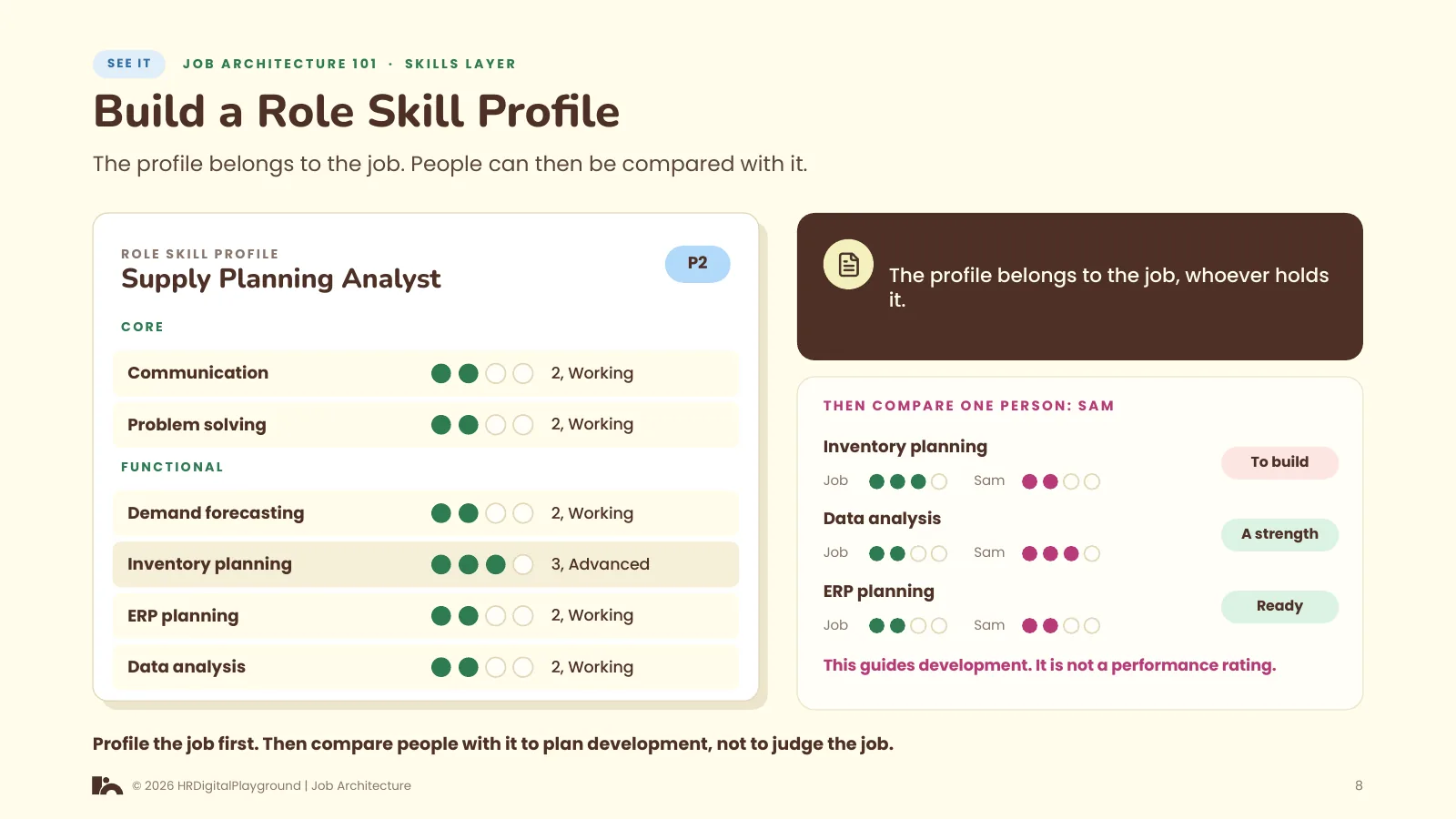
A role skill profile lists the skills a job needs and the proficiency expected for each. It belongs to the job, not to any person in it, so it stays the same whoever holds the job. Here is Brightside's Supply Planning Analyst at P2. Its core skills are communication at 2 and problem solving at 2. Its functional skills are demand forecasting at 2, inventory planning at 3, ERP planning at 2, and data analysis at 2. Inventory planning is at 3 even though this is a P2 job, because it is the heart of the work. Proficiency follows what the job needs, not the level number. Once the profile exists, individuals can be compared with it. Sam, who is interested in the job, has strong data analysis and needs to build inventory planning. That comparison supports a development conversation. It does not change the job, and it is not a performance rating.
Page 9 Where Skills Come From
Read the explanation
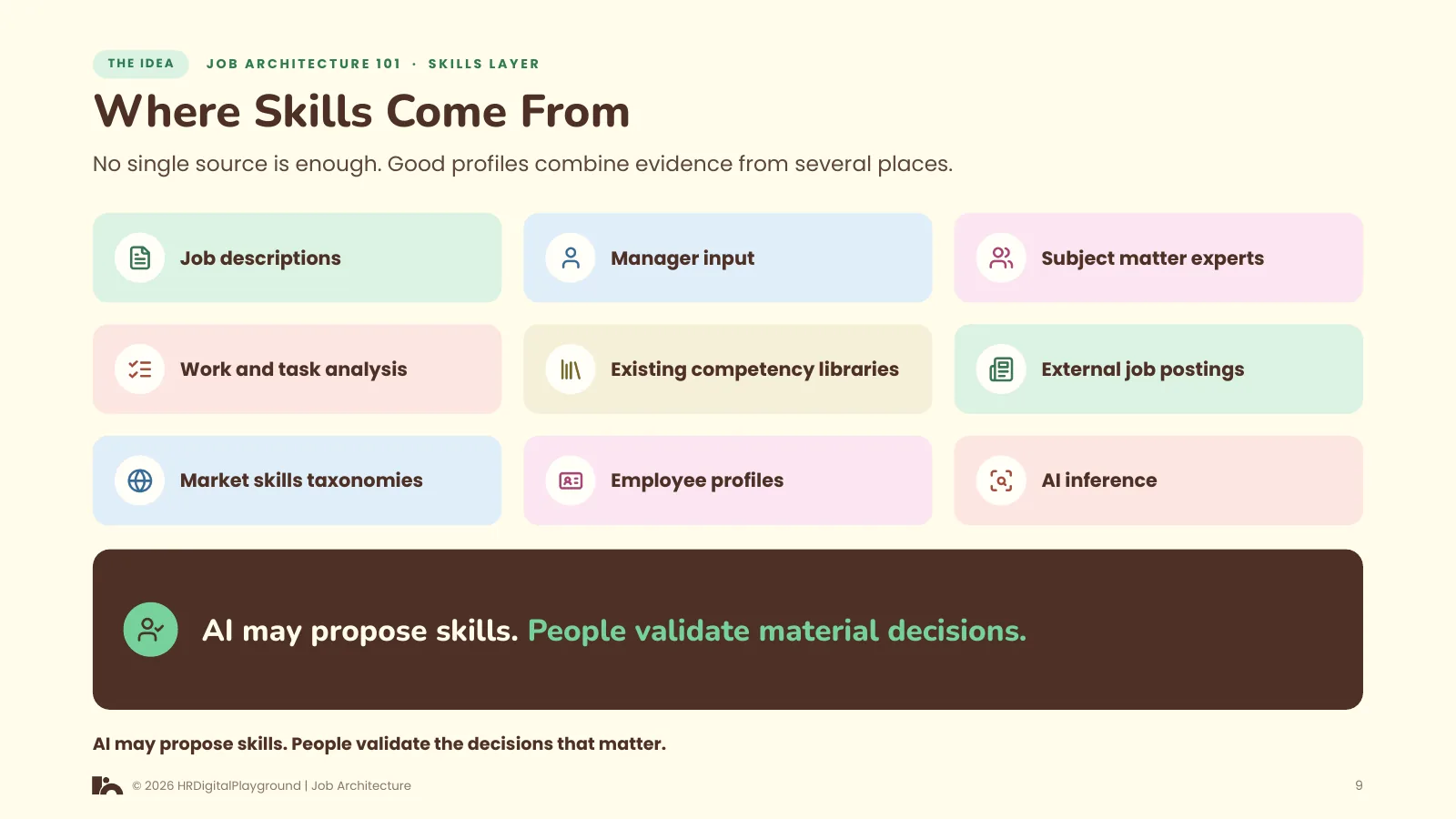
Skills profiles are built from evidence, and no single source is enough. Job descriptions are a starting point but often list duties rather than skills. Managers and subject matter experts know what the work really takes. Work and task analysis breaks jobs into tasks and the skills behind them. Existing competency libraries give a vocabulary to build on. External job postings and market skills taxonomies show how other employers describe similar work. Employee profiles show which skills people already have. And AI can infer likely skills from all of this text quickly, which is useful at scale. The important rule is simple: AI may propose skills, but people validate material decisions. A proposed skill that will shape hiring, development, or pay should be checked by someone who knows the work.
Page 10 Skills and Careers
Read the explanation
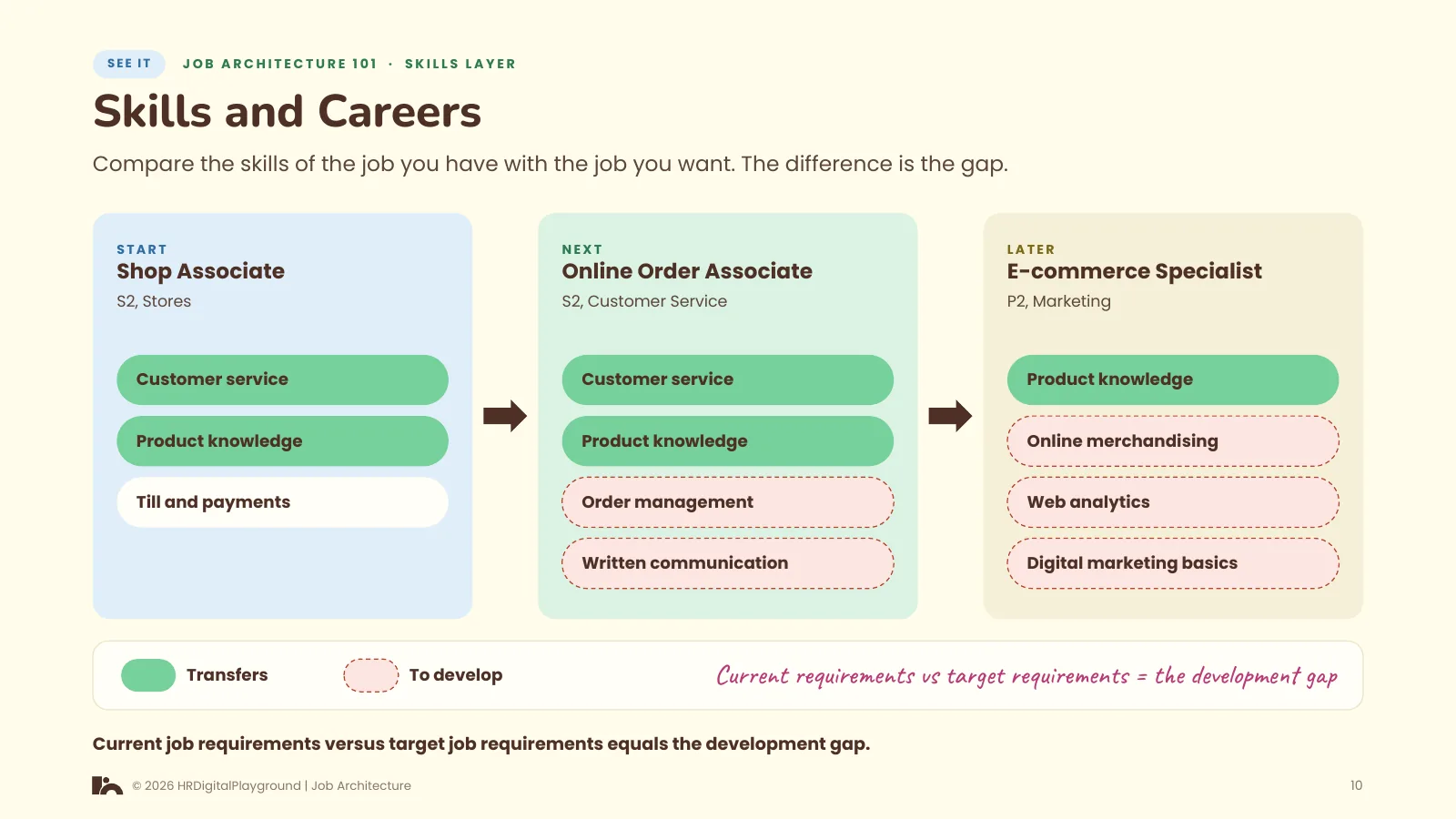
Skills make career paths concrete. Compare the skills of the job someone has with the skills of the job they want, and the difference is the development gap. At Brightside, the move into online ordering is a good example. A Shop Associate at S2 in Stores can move sideways to Online Order Associate at S2 in Customer Service, and later grow into E-commerce Specialist at P2 in Marketing. Customer service and product knowledge transfer at every step. Order management and written communication need building for the first move. Online merchandising and web analytics need building for the second. Because the gaps are visible, the employee and manager can plan training, projects, or shadowing, and the company can fill new jobs from inside. The comparison is between job requirements, so it applies to anyone in the starting job.
Page 11 Skills and the Market
Read the explanation
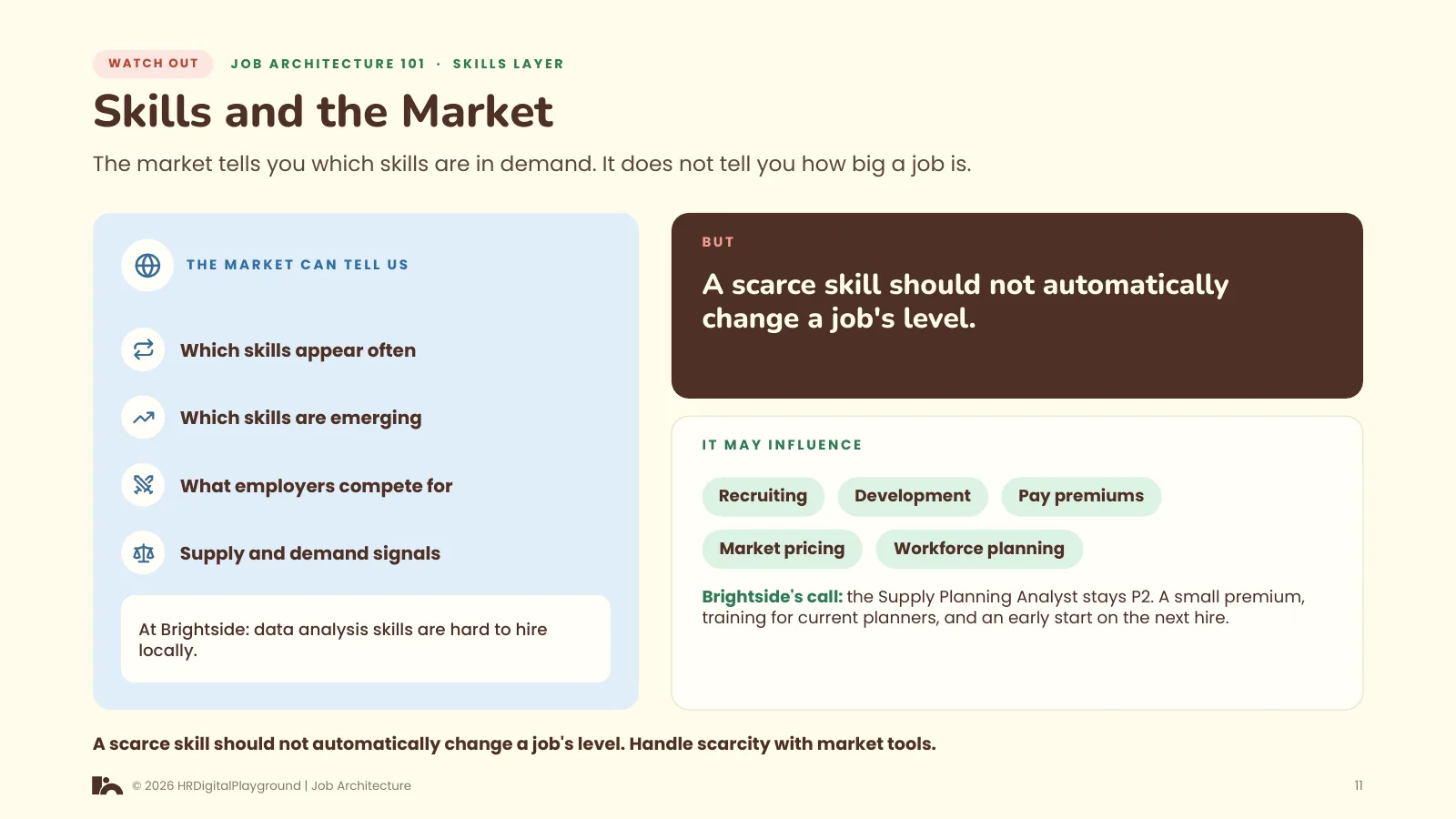
External skills data is useful. It can show which skills appear frequently in job postings, which skills are emerging, which capabilities employers are competing for, and signals of skill supply and demand. But this distinction matters: a scarce skill should not automatically change a job's architecture level. The level measures the size of the job, and scarcity does not make the job bigger. Scarcity affects the price of the skill and how hard it is to find. So it may influence recruiting, development, pay premiums, market pricing, and workforce planning. At Brightside, data analysis skills are hard to hire locally. The Supply Planning Analyst job stays at P2. Brightside adds a small market premium for the skill, trains current planners, and plans ahead for the next hire.
Page 12 Changing Work Moves Skills First
Read the explanation
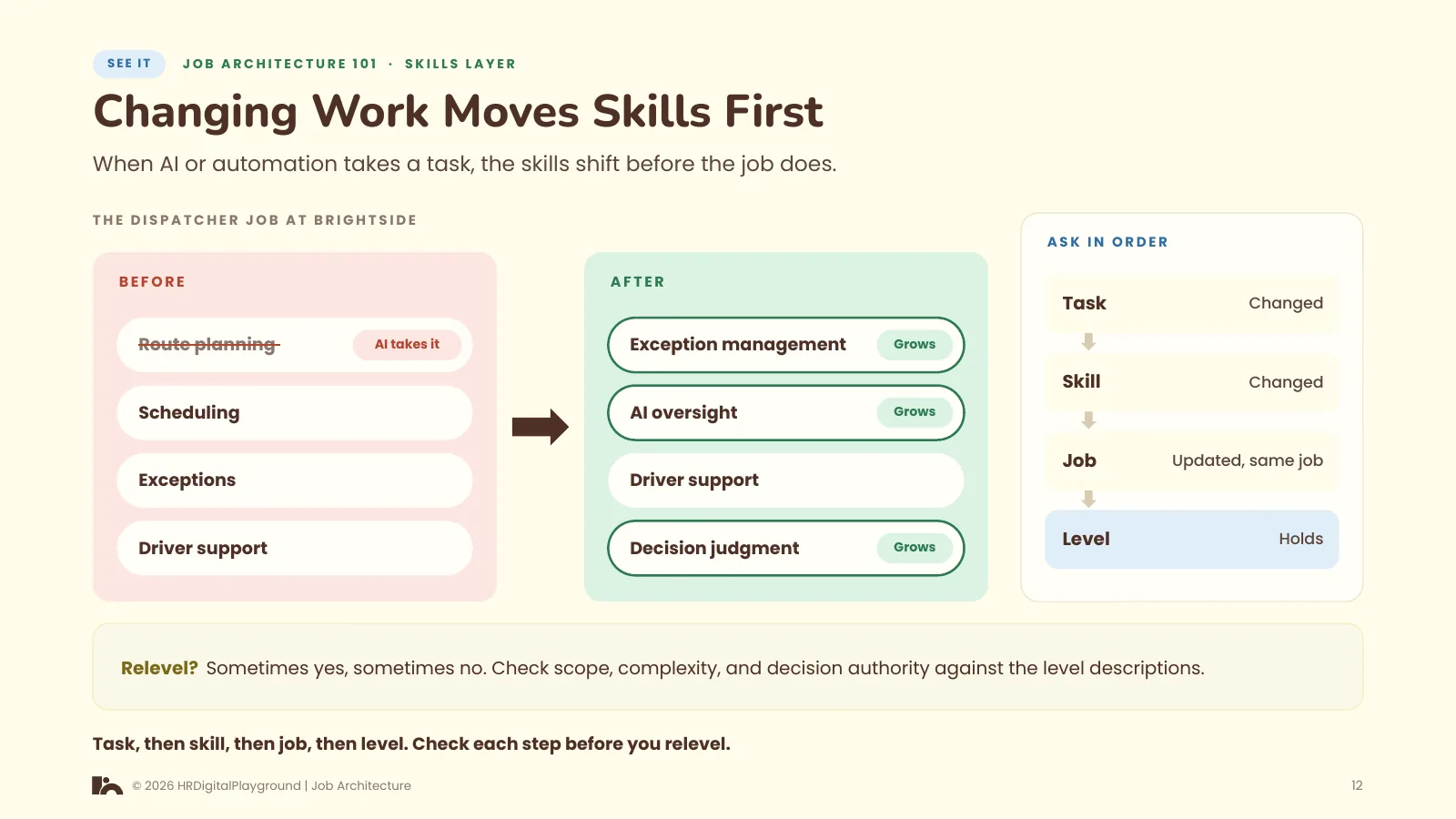
When AI or automation takes over a task, the skills a job needs shift first, and the job and its level may or may not follow. At Brightside, AI route planning takes over the Dispatcher's route planning. Before, the job was route planning, scheduling, handling exceptions, and supporting drivers. After, it is exception management, overseeing the AI's route suggestions, supporting drivers, and making judgment calls when the plan and reality disagree. Route planning shrinks, AI oversight and decision judgment grow, and driver support stays. Then the chain of questions: the tasks changed, so did the skills change? Yes. Did the job as a whole change enough to be a different job or a different size? Sometimes yes, sometimes no. Here, Brightside checks the job against its level descriptions. The scope, complexity, and decision authority are about the same, so the level holds, while the description and skill profile are updated.
Page 13 Keeping Skills Current
Illustrative numbers, fictional company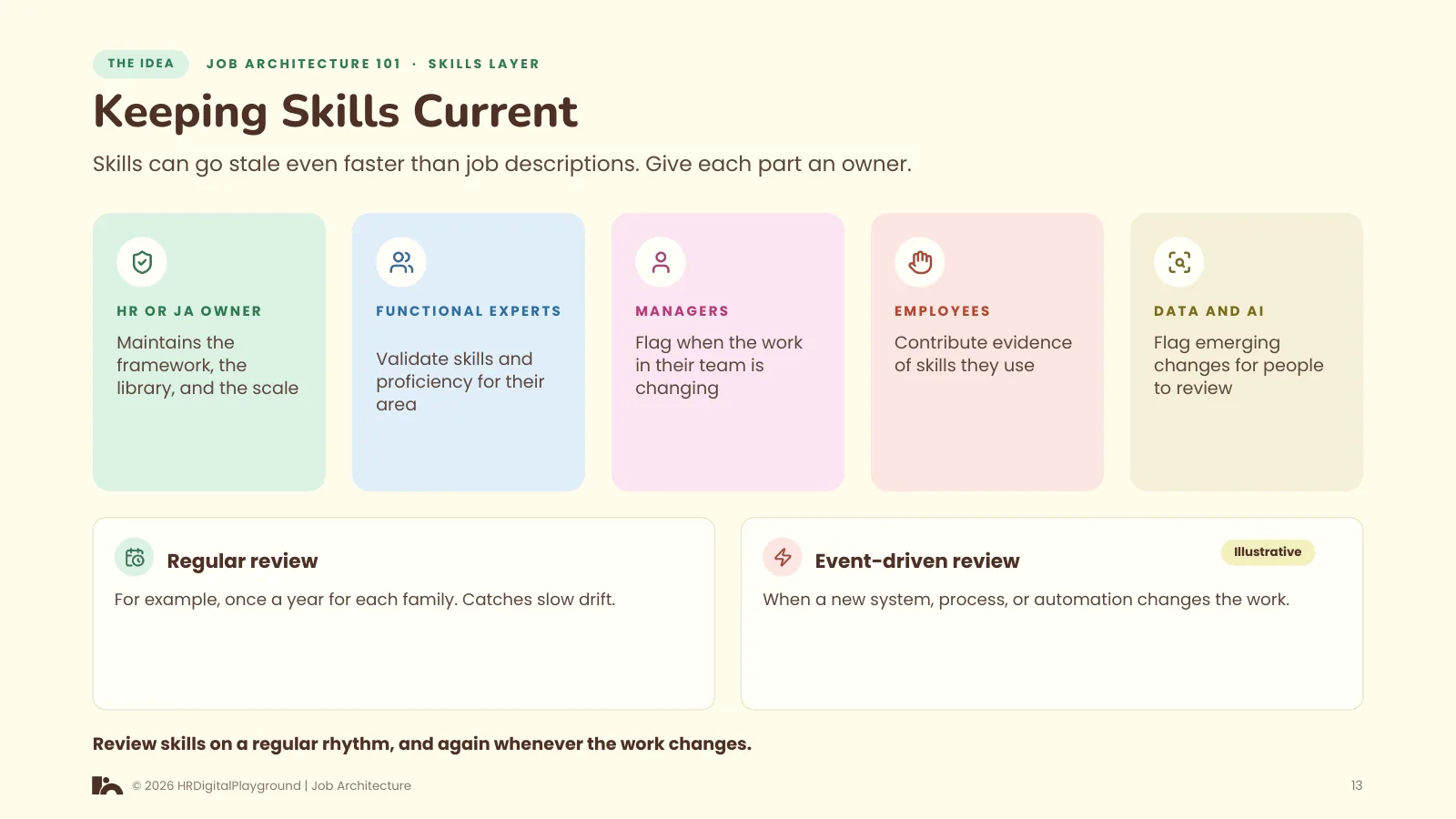
Read the explanation
Skills go stale even faster than job descriptions, because tools and methods change quickly. Simple ownership keeps them current. The HR or job architecture owner maintains the framework: the skills library, the proficiency scale, and the rules. Functional experts validate the skills and proficiency for jobs in their area. Managers flag when the work in their team is changing. Employees can contribute evidence, such as new skills they are using or skills that no longer matter. Data and AI tools can flag emerging changes, such as a skill appearing more often in job postings or project records. Use two kinds of review. A regular review, for example once a year for each family, catches slow drift. An event-driven review happens when something changes the work: a new system, a new process, automation, or a reorganization. The rhythm shown is illustrative. The real test is whether each profile still reflects the work being done.
Page 14 Try It: AI-Assisted Forecasting
Read the explanation
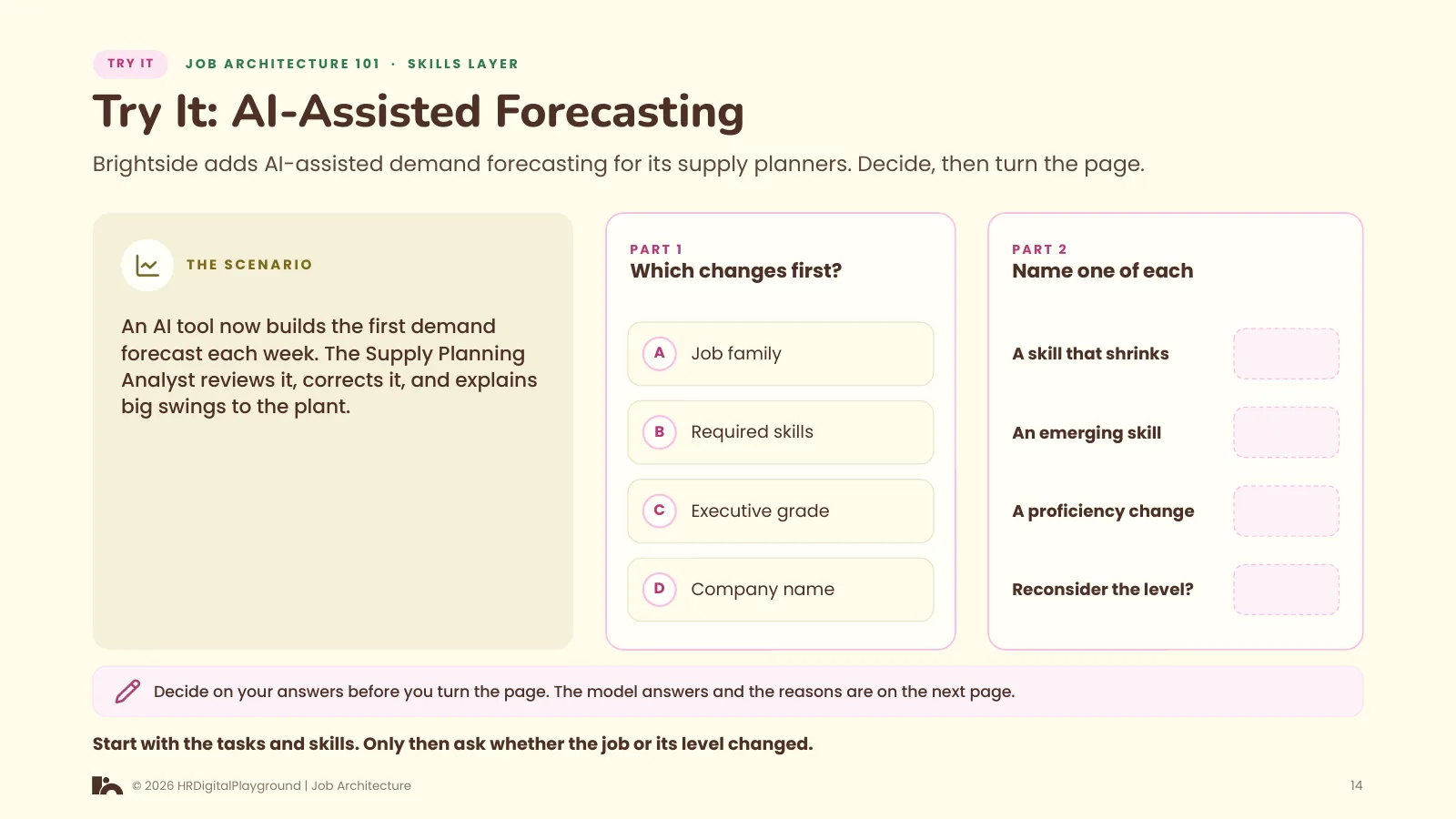
This scenario practices the chain from task to skill to job to level. Brightside introduces AI-assisted demand forecasting. The tool now produces a first forecast each week, and the Supply Planning Analyst reviews it, corrects it, and explains big changes. First, decide which changes first: the job family, the required skills, the executive grade, or the company name. Then name one skill that shrinks or is removed, one emerging skill, one proficiency change, and whether the level should be reconsidered. Write your answers before turning the page.
Page 15 AI-Assisted Forecasting: Model Answers
Read the explanation
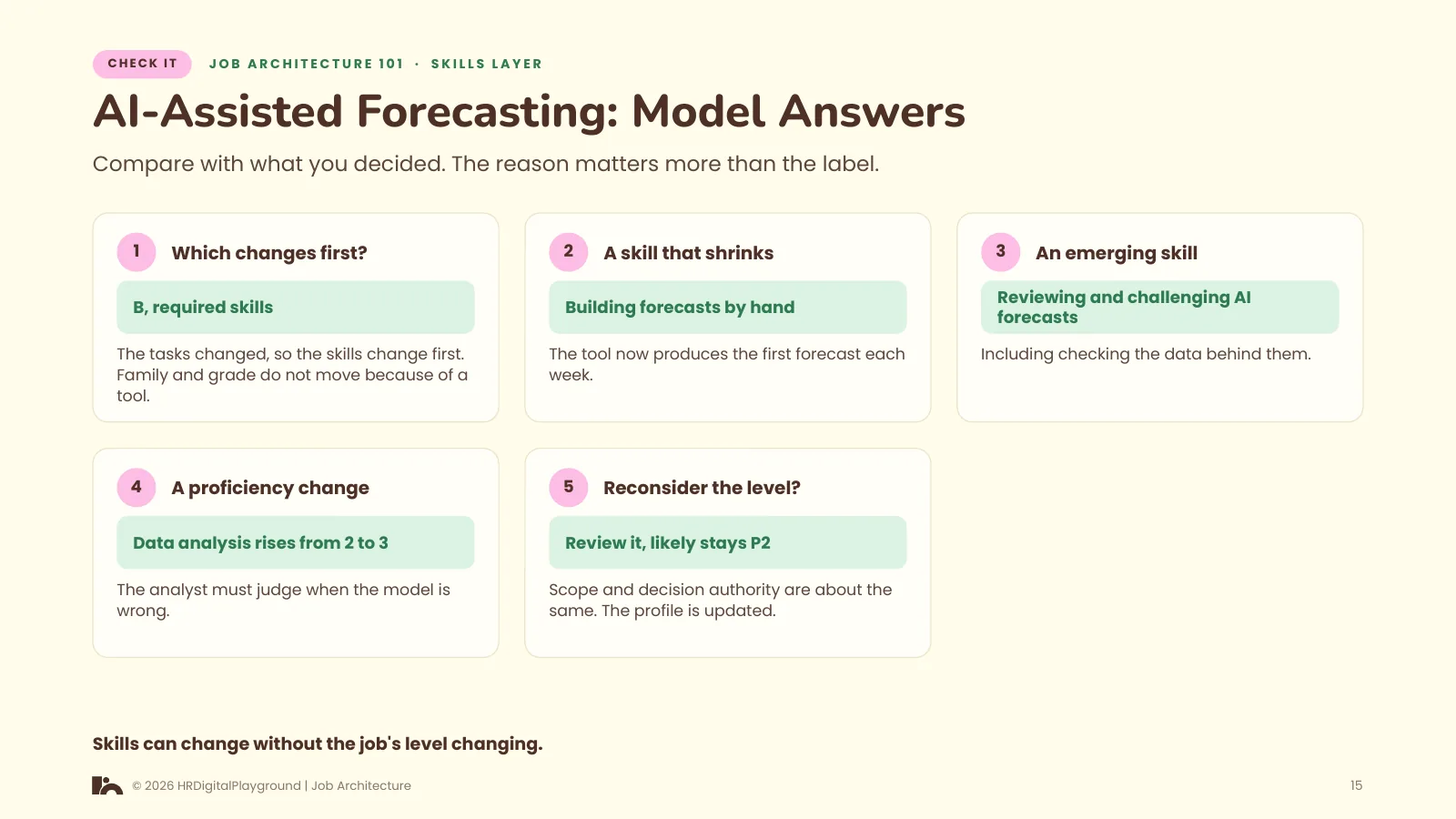
Model answers. Part one: B, the required skills change first, because the tasks changed. The family, grade, and company name do not change because of a new tool. Part two: the skill that shrinks is building forecasts by hand in spreadsheets. The emerging skill is reviewing and challenging AI forecasts, including checking the data behind them. The proficiency change is data analysis, which rises from 2 to 3, because the analyst now has to judge when the model is wrong. The level should be reviewed, not assumed. The scope, complexity, and decision authority are about the same, so the job most likely stays at P2 with an updated skill profile. If the job took on forecasting across all locations with authority to set plans, that would be a reason to re-evaluate the level.
Page 16 Quick Check
Read the explanation
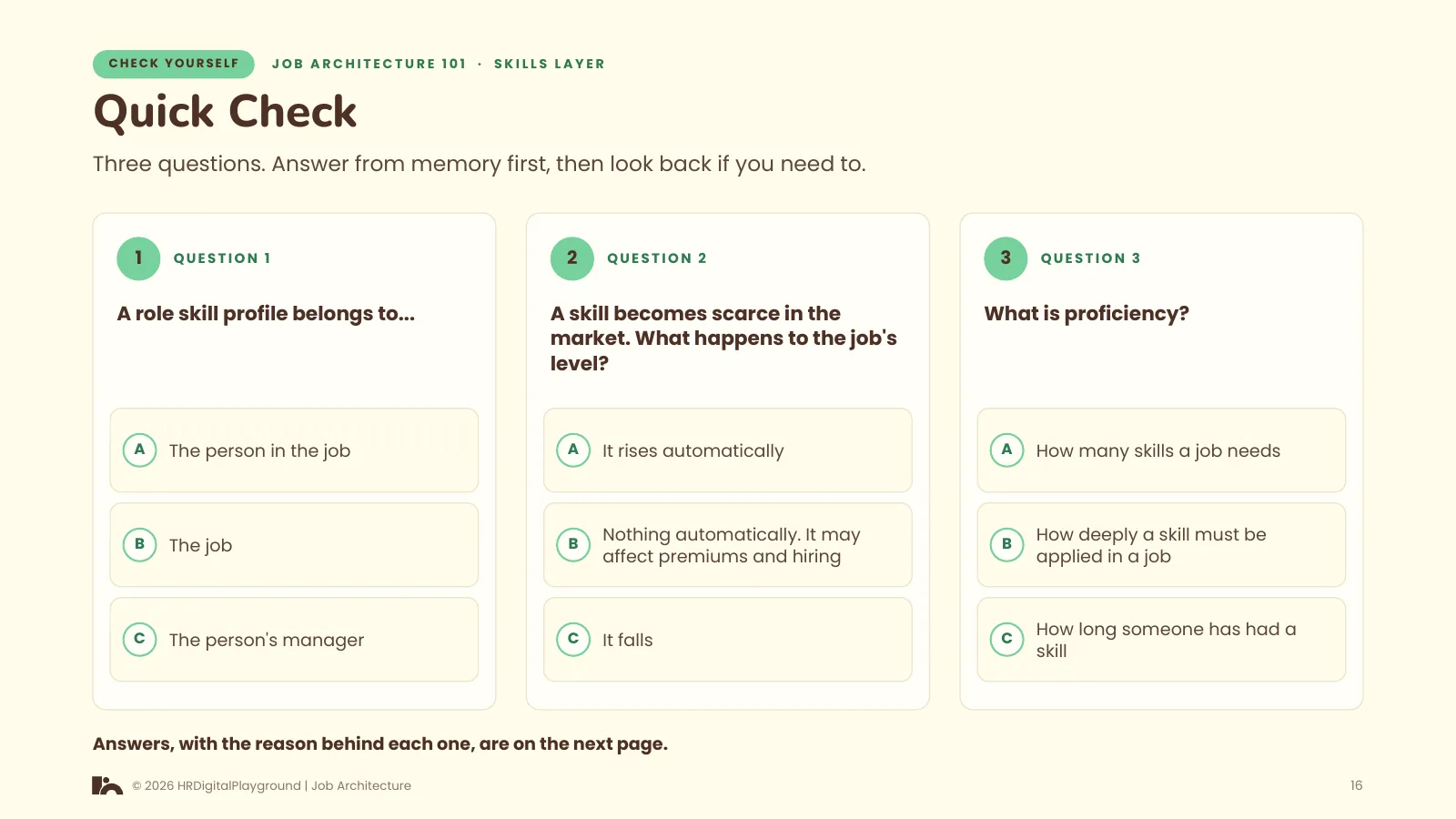
Three questions on the skills layer. Question 1 checks that a skill profile belongs to the job. Question 2 checks that a scarce skill does not automatically change a level. Question 3 checks the meaning of proficiency.
Page 17 Remember
Read the explanation
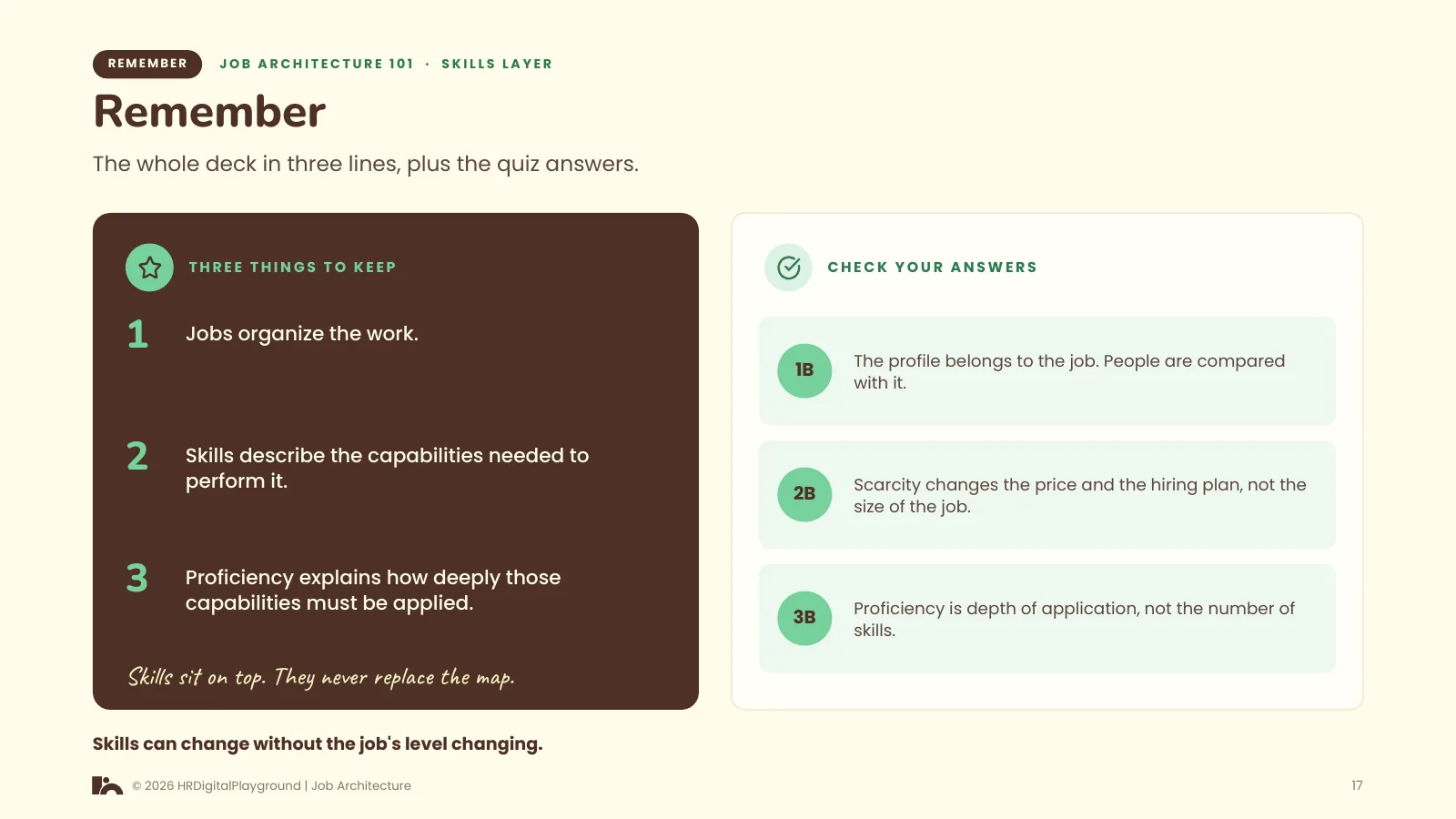
The recap keeps three principles. Jobs organize the work. Skills describe the capabilities needed to perform it. Proficiency explains how deeply those capabilities must be applied. And one more idea to carry: skills can change without the job's level changing. Quiz answers: 1 is B, the profile belongs to the job. 2 is B, a scarce skill may affect premiums, recruiting, and development, but it does not automatically change the level. 3 is B, proficiency is how deeply a skill must be applied in the job.
Page 18 Copyright and Notices
Illustrative numbers, fictional company
Read the explanation
Job Architecture 101: The Skills Layer. Copyright 2026 HRDigitalPlayground | Job Architecture. Published September 2026. Brightside Bakery is a fictional company and all examples are illustrative. The material is general education, not legal, tax, or financial advice.