Levels
What makes one job bigger than another?

Page 1 Levels
Read the explanation
This deck answers: what makes one job bigger than another? Levels are the heart of job architecture. The deck starts with the core principle that we level jobs, not people, shows what a level is and is not, introduces common leveling factors and what makes level criteria good, walks through the Professional, Support, and Management ladders, shows how ladders line up across tracks, separates level from grade, salary range, and market data, and explains how leveling, job evaluation, and market pricing differ. It ends with a comparison activity and its model answers, three quick questions, and a recap.
Page 2 Before You Start
Read the explanation
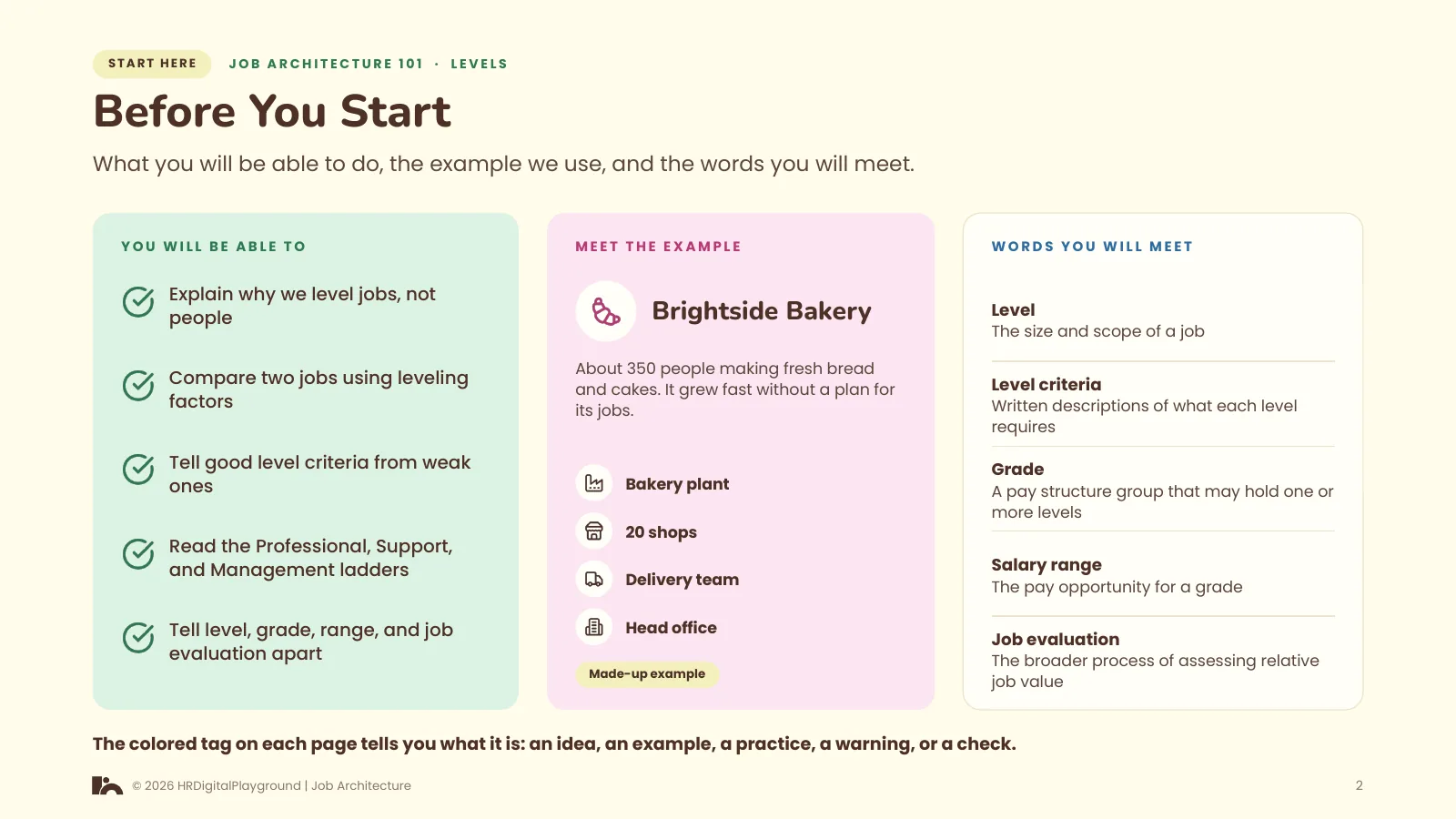
This deck covers levels. It is written for someone with no background in HR, compensation, or organization design, and it follows adult learning principles: why before what, one realistic example throughout, practice with answers, a short quiz, and a one-page recap. The example is Brightside Bakery, a made-up company of about 350 people with a bakery plant, twenty shops, a delivery team, and a head office. It grew fast without a plan for its jobs, so it has far more titles than real jobs and no shared way to compare them. The words on this page are defined again where they first appear.
Page 3 We Level Jobs, Not People
Read the explanation
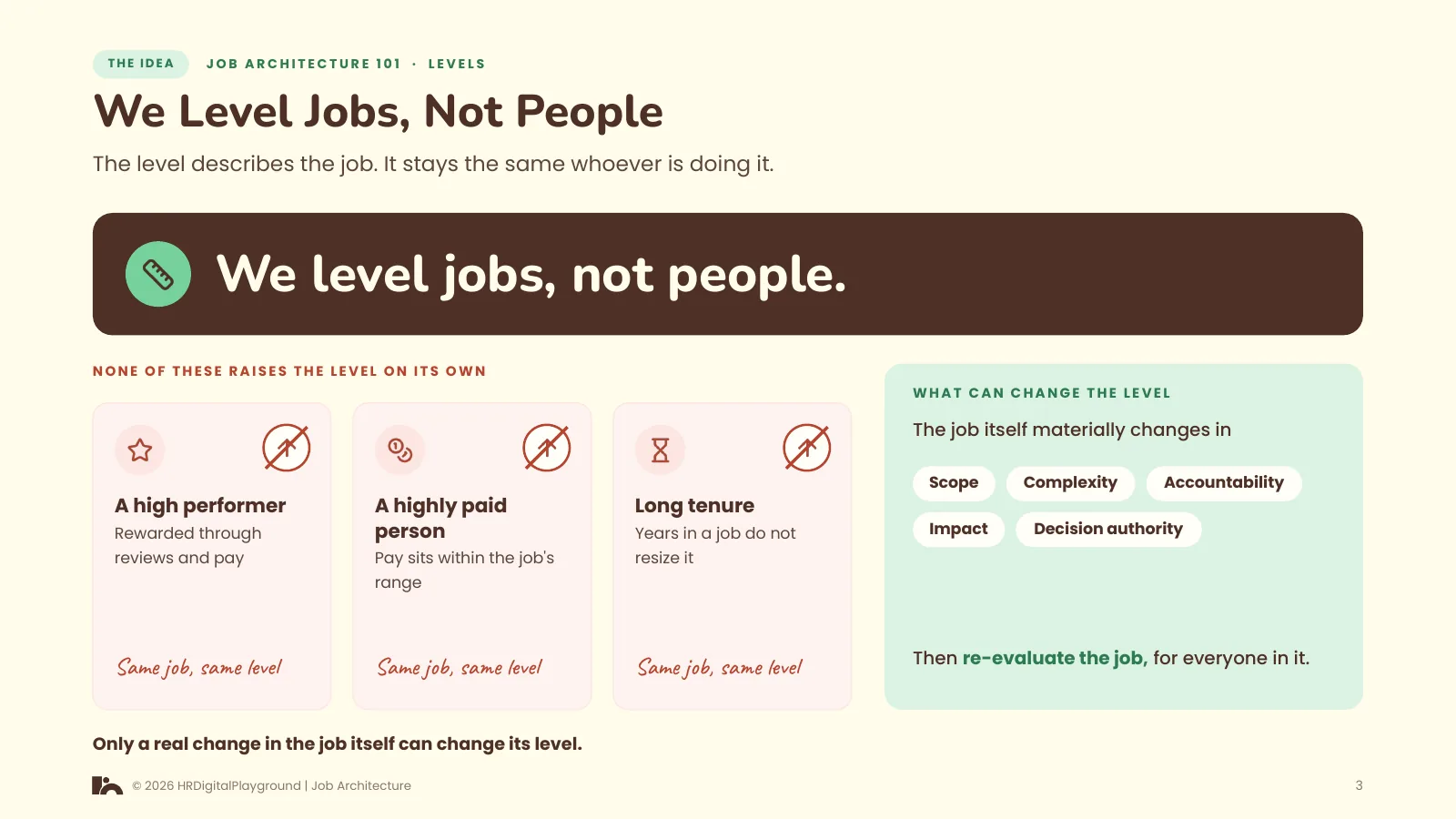
This is the most important principle in leveling, so it is worth remembering word for word: we level jobs, not people. A level represents the size and scope of the job. It does not represent the tenure, performance, age, salary, or title prestige of the person in it. A high-performing employee does not automatically make the job a higher level. A highly paid employee does not automatically make the job a higher level. A long-tenured employee does not automatically make the job a higher level. Each of those is real and matters, but each is handled somewhere else: performance in reviews and rewards, pay within the range, and tenure in the person's own history. The level changes only when the job itself materially changes, in its scope, its complexity, its accountability, its impact, or its decision authority. When that happens, the job should be re-evaluated. The re-evaluation is about the job, and everyone in that job is affected in the same way.
Page 4 Same Job, Same Level
Read the explanation
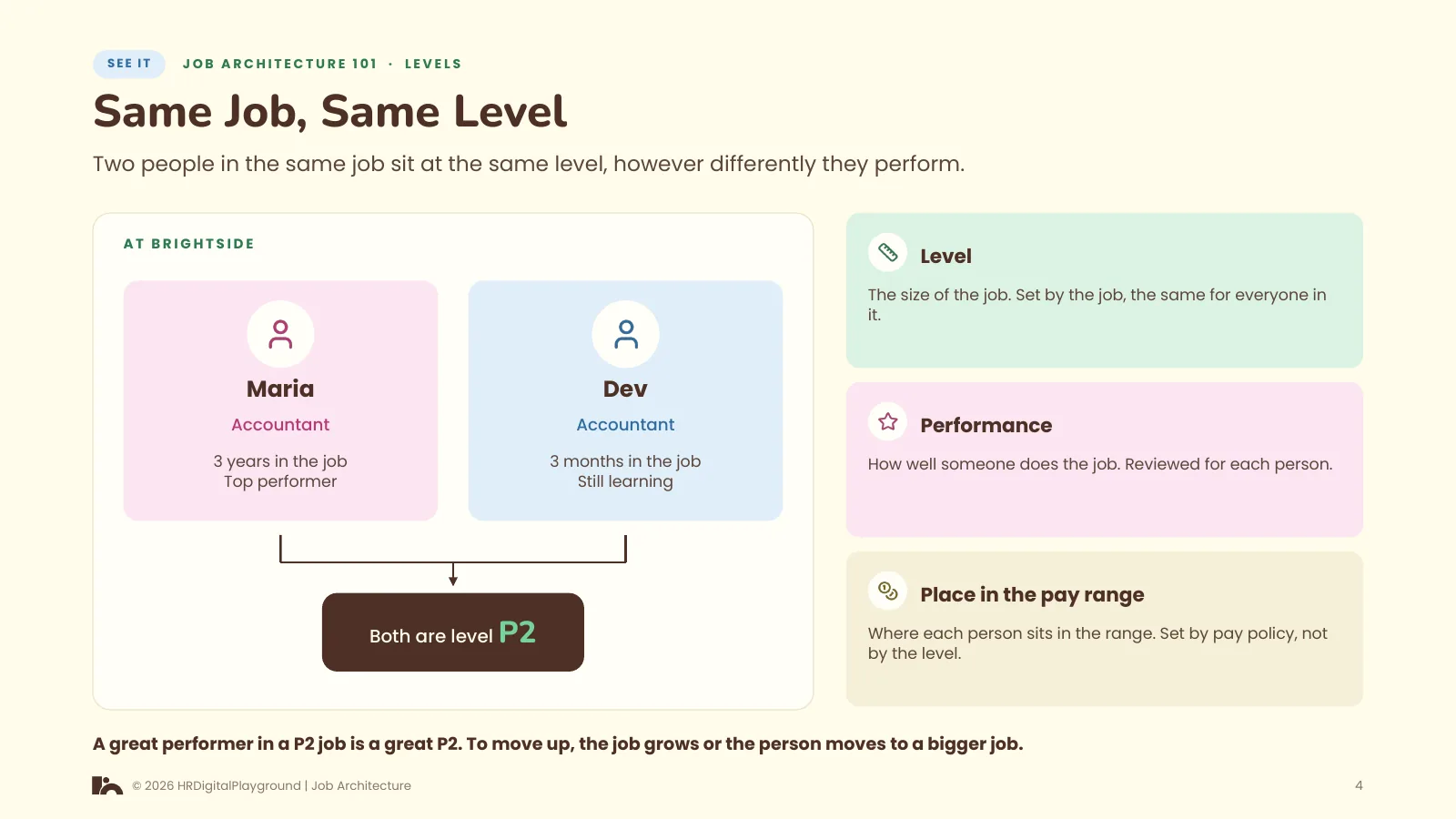
Here is the principle at Brightside. Maria and Dev are both Accountants. Maria has been in the job three years and is excellent. Dev joined three months ago and is still learning. Their job is the same, so their level is the same, P2. Their performance differs, and that shows up elsewhere: in performance reviews, in rewards, and possibly in where each sits within the pay range, depending on Brightside's pay policy. Keeping level and performance separate is what makes levels fair and comparable. If the Accountant job grows until it is really bigger, it is re-evaluated. If Maria moves to a bigger job, such as Senior Accountant, she takes on that job's level. A great year alone does not change the size of the job.
Page 5 What Makes a Job Bigger
Read the explanation
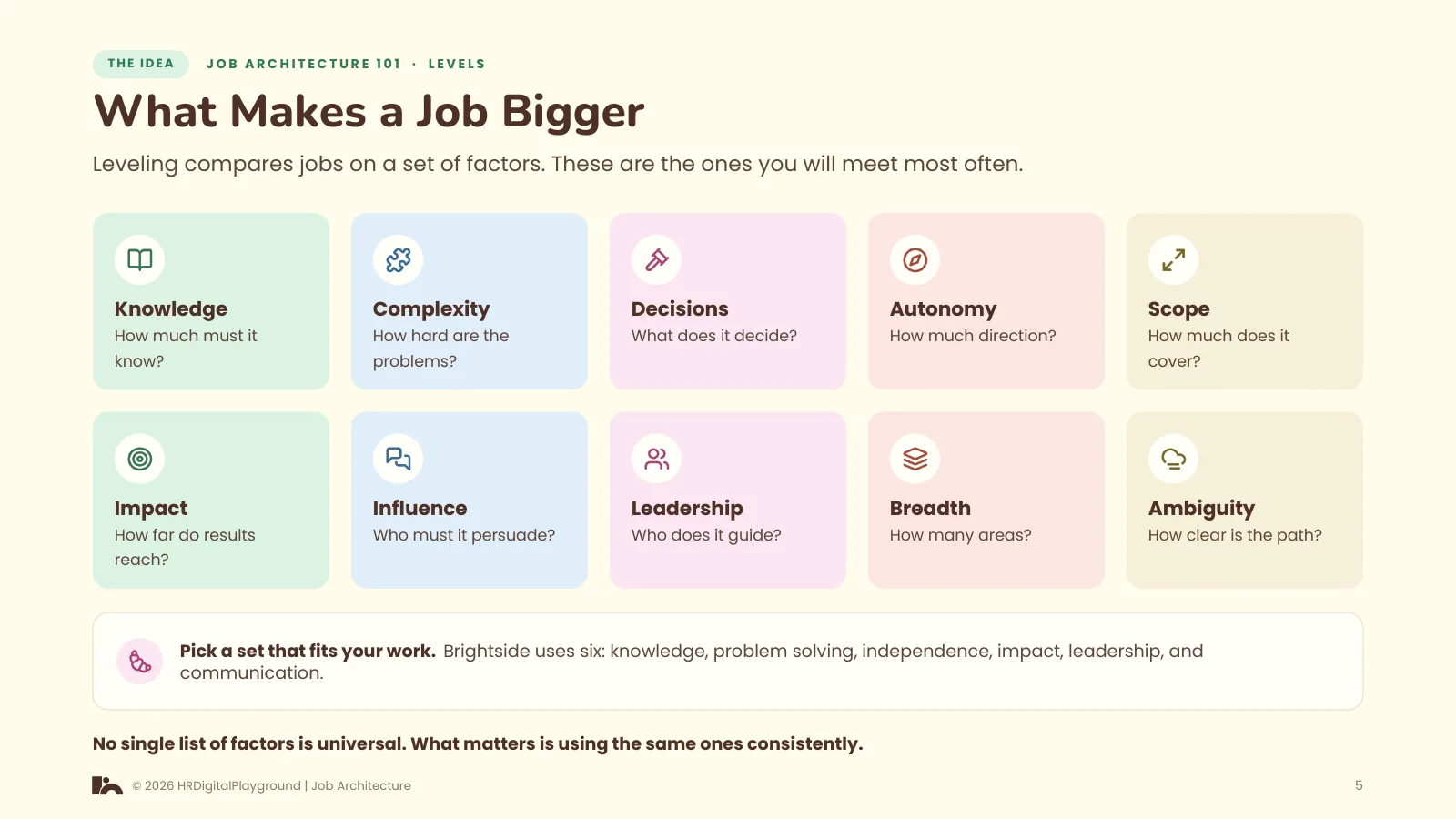
To decide how big a job is, organizations compare jobs on a set of factors. There is no single universal list, and every method names them a little differently, but these ten appear again and again. Knowledge and expertise: how much the job needs to know. Problem complexity: how hard the problems are. Decision making: what the job decides, and how much those decisions matter. Autonomy: how much direction the job receives. Scope: how much of the organization the job covers. Impact: how far the job's results reach. Influence: who the job must persuade, inside and outside. Leadership accountability: responsibility for guiding others or a team. Breadth: how many areas or disciplines the job spans. Ambiguity: how clear or unclear the situations are. Most organizations choose a smaller set that fits their work, often combining several of these. Brightside, for example, writes its level descriptions using six: knowledge, problem solving, independence, impact, leadership, and communication. A job does not need to score high on every factor to be big. Level descriptions blend the factors into one picture of each step.
Page 6 What Good Level Criteria Look Like
Read the explanation
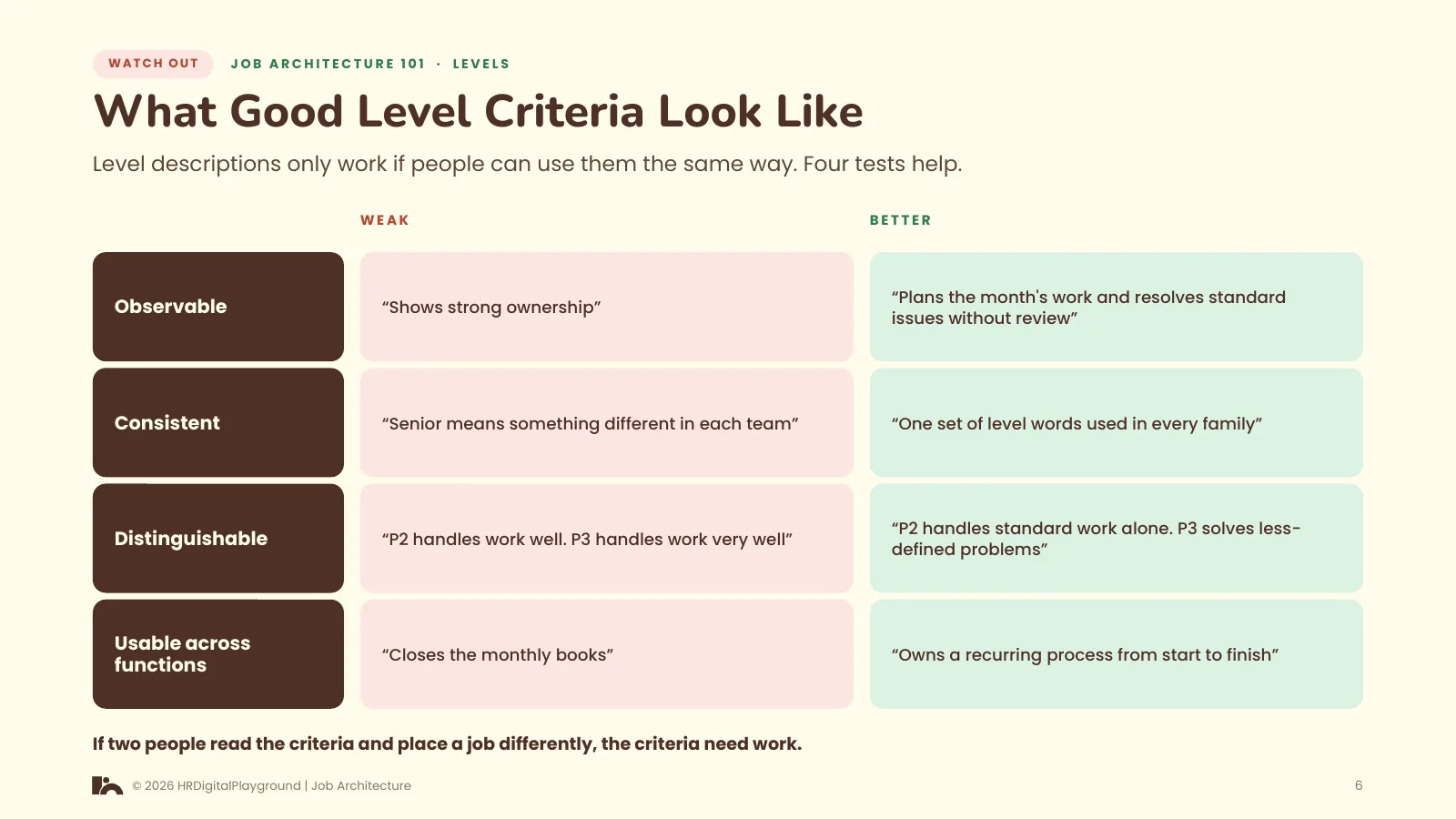
Level criteria are the written descriptions of what each level requires. They are only useful if different people can read them and reach the same answer. Four tests help. First, criteria should be observable: they describe things you can see in the work, not personality traits. Shows strong ownership is hard to observe. Plans the month's work and resolves standard issues without review is observable. Second, they should be applied consistently: the same words mean the same thing in every family. Third, adjacent levels should be distinguishable. If P2 says handles work well and P3 says handles work very well, nobody can tell them apart. P2 handles standard work independently and P3 solves less-defined problems is a real difference. Fourth, criteria should be usable across functions where practical. Closes the monthly books only works in Accounting. Owns a recurring process from start to finish works in any family. Some functions will always need a few specific examples, which is fine, as long as the core criteria are shared.
Page 7 The Professional Ladder
Illustrative numbers, fictional company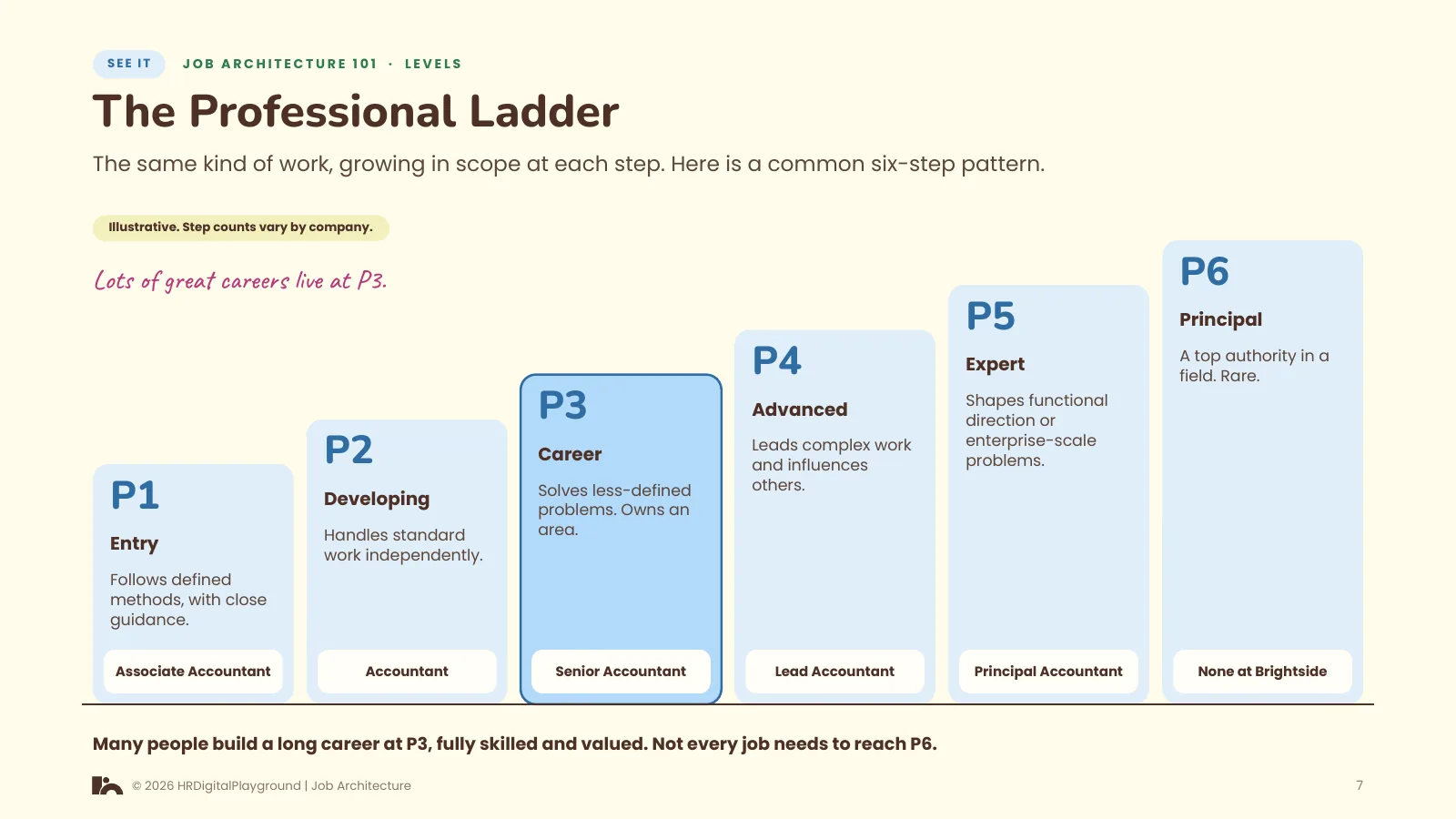
Read the explanation
The Professional ladder in this common pattern has six steps, and each step describes the same kind of work growing in scope. P1, Entry: follows defined methods and learns with close guidance, typical of a first professional job. P2, Developing: independently handles standard work. P3, Career: solves less-defined problems and owns an area of work. This is the level many professionals reach and stay at for years, and that is healthy. P4, Advanced: leads complex work and influences others beyond their own tasks. P5, Expert: shapes functional direction or solves enterprise-scale problems. P6, Principal: a top authority in a field. P6 jobs are rare, and many companies, including Brightside, have none. The example titles follow Brightside's title formula: Associate for P1, no level word for P2, Senior for P3, Lead for P4, and Principal for P5. Brightside is small, so it has no Lead or Principal Accountant today, but the steps are ready if the work grows. The number of steps varies by company. What matters is that each step is described by the work, so anyone can see what the next step asks for.
Page 8 The Support and Management Ladders
Read the explanation
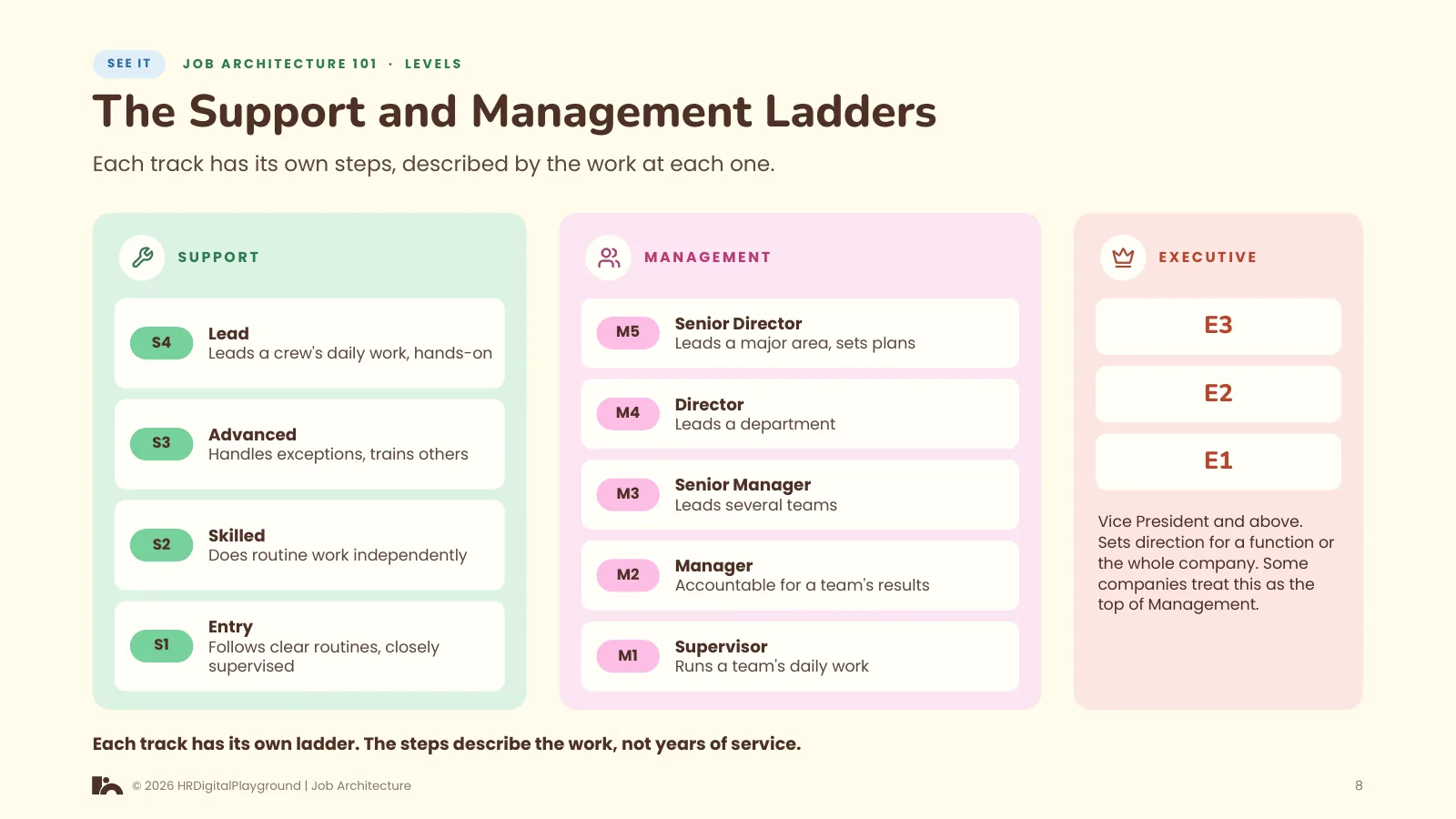
The Support ladder in this common pattern has four steps. S1, Entry: follows clear routines under close supervision. S2, Skilled: does routine work independently. S3, Advanced: handles exceptions and trains new colleagues. S4, Lead: leads the daily work of a crew while staying hands-on, without formal accountability for the team. The Management ladder has five steps. M1, Supervisor: runs a team's daily work. M2, Manager: accountable for a team's results and development. M3, Senior Manager: leads several teams, often through other managers. M4, Director: leads a department or a large area of a function. M5, Senior Director: leads a major part of a function and sets its plans. Above them sit Executive levels, usually two or three, for Vice Presidents and above, who set direction for a function or the whole company. Some companies treat these as the top of the Management ladder rather than a separate track. As with the Professional ladder, companies vary the count, but each step should describe the work so people can see what the next step asks for.
Page 9 Lining Up the Ladders
Illustrative numbers, fictional company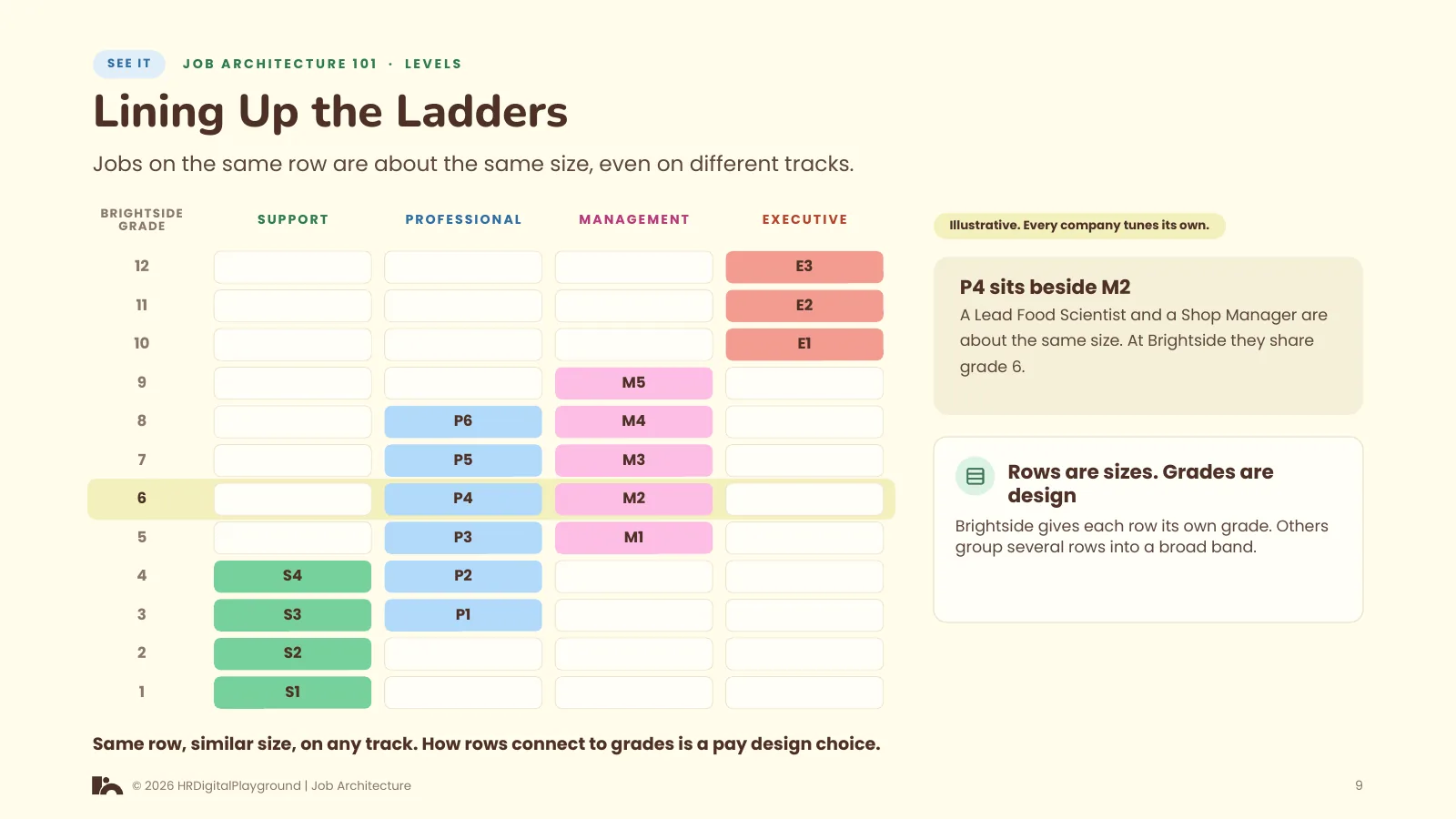
Read the explanation
Once each track has its steps, the ladders are lined up so that jobs of about the same size share a row. In this illustrative pattern, S3 sits beside P1, P3 beside M1, and P4 beside M2. So a Lead Food Scientist at P4 and a Shop Manager at M2 are about the same size, even though one leads through expertise and the other leads a team. That alignment is what makes the dual career ladder real. How the rows connect to pay is a separate design decision. Brightside gives each row its own grade, numbered 1 to 12, so the Lead Food Scientist and the Shop Manager share grade 6 and one salary range. Other companies group several rows into one broad band, or run more than one pay structure. The alignment of the ladders is job architecture. The grades on top are pay design.
Page 10 Level, Grade, and Range Are Different
Read the explanation
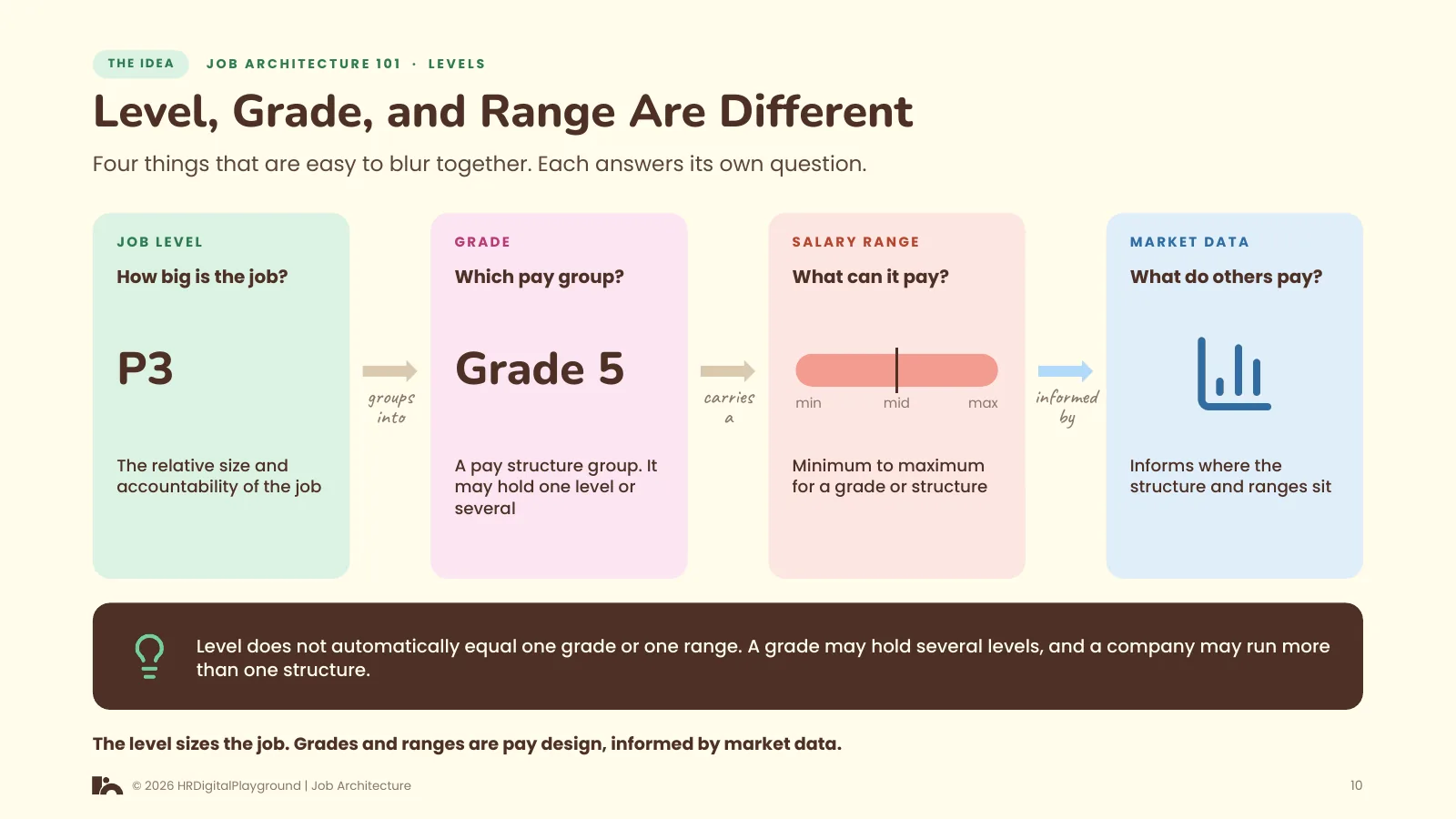
Four ideas are easy to blur, so it helps to separate them. The job level describes the relative size and accountability of the job, for example P3. A grade is a grouping in the pay structure. Depending on the design, a grade may hold one level or several. At Brightside, grade 5 holds P3 and M1. A salary range is the pay opportunity attached to a grade or structure: a minimum, a midpoint, and a maximum. Market data is information about what other employers pay for comparable work, and it informs where the structure and its ranges are positioned. It is tempting to think level automatically equals one grade, which automatically equals one range. That is one common design, but not the only one. Some companies place several levels in one broad band. Some run separate structures for different locations, employee groups, sales roles, or executives. The level stays the same in all of these. It is the pay design on top that changes.
Page 11 Leveling, Job Evaluation, and Market Pricing
Read the explanation
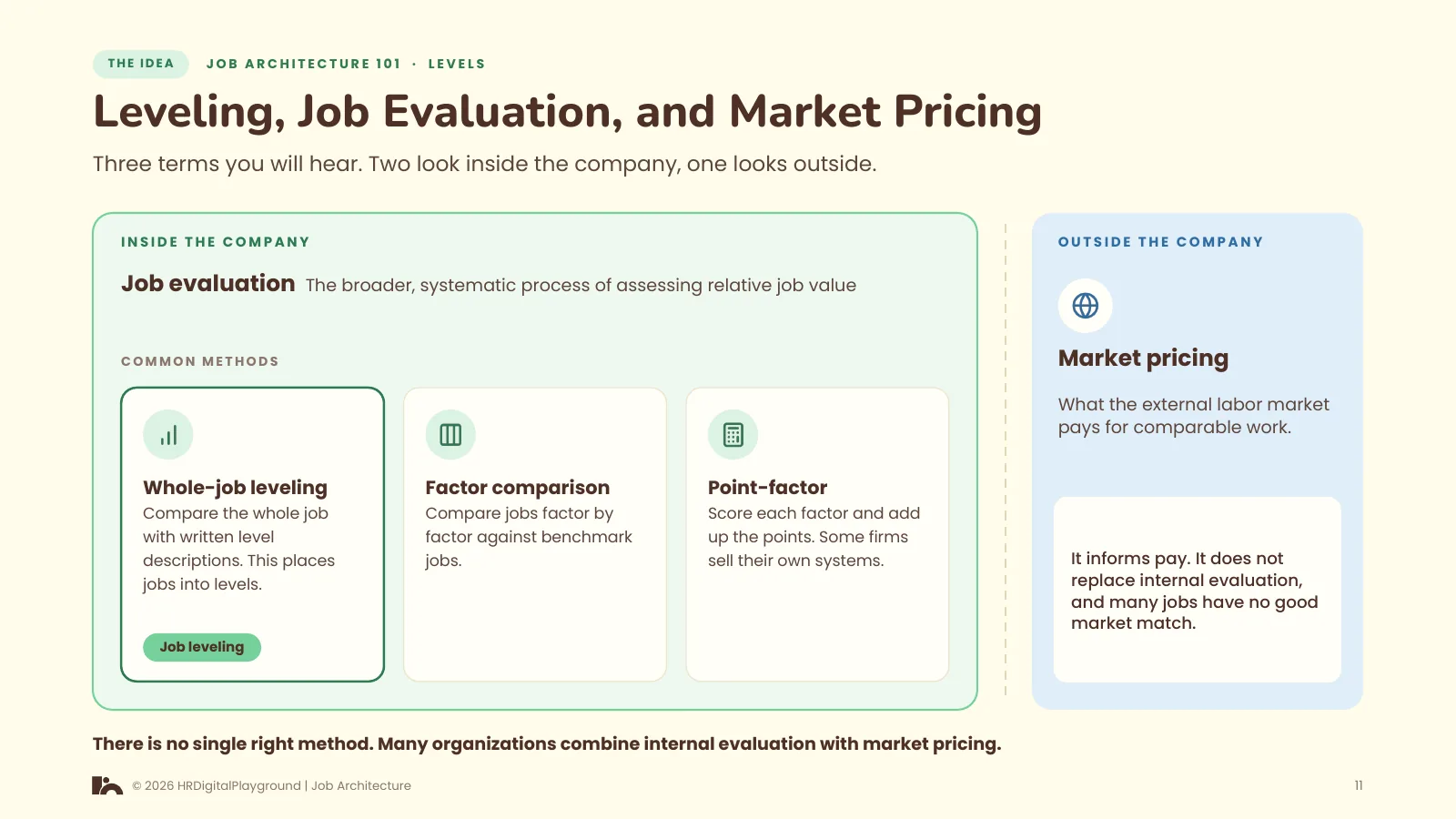
You will hear these three terms, often used loosely. Job leveling places jobs into relative levels using defined scope criteria, such as the level descriptions in this deck. Job evaluation is the broader, systematic process of assessing the relative value of jobs inside an organization. Leveling is one way to do it. Common job evaluation methods include three families. In whole-job leveling, the whole job is compared with written level descriptions or with other jobs. In factor comparison, jobs are compared factor by factor against benchmark jobs. In point-factor approaches, each factor is scored and the points are added up. Several consulting firms offer their own proprietary point-factor systems. Market pricing is different in kind. It looks outside, at what the external labor market pays for comparable work. It informs pay, but it is not a replacement for internal job evaluation, because it cannot tell you how your own jobs compare in size, and many jobs have no good market match. Organizations use different combinations of these methods, and there is no single legitimate one.
Page 12 Four Leveling Myths
Read the explanation
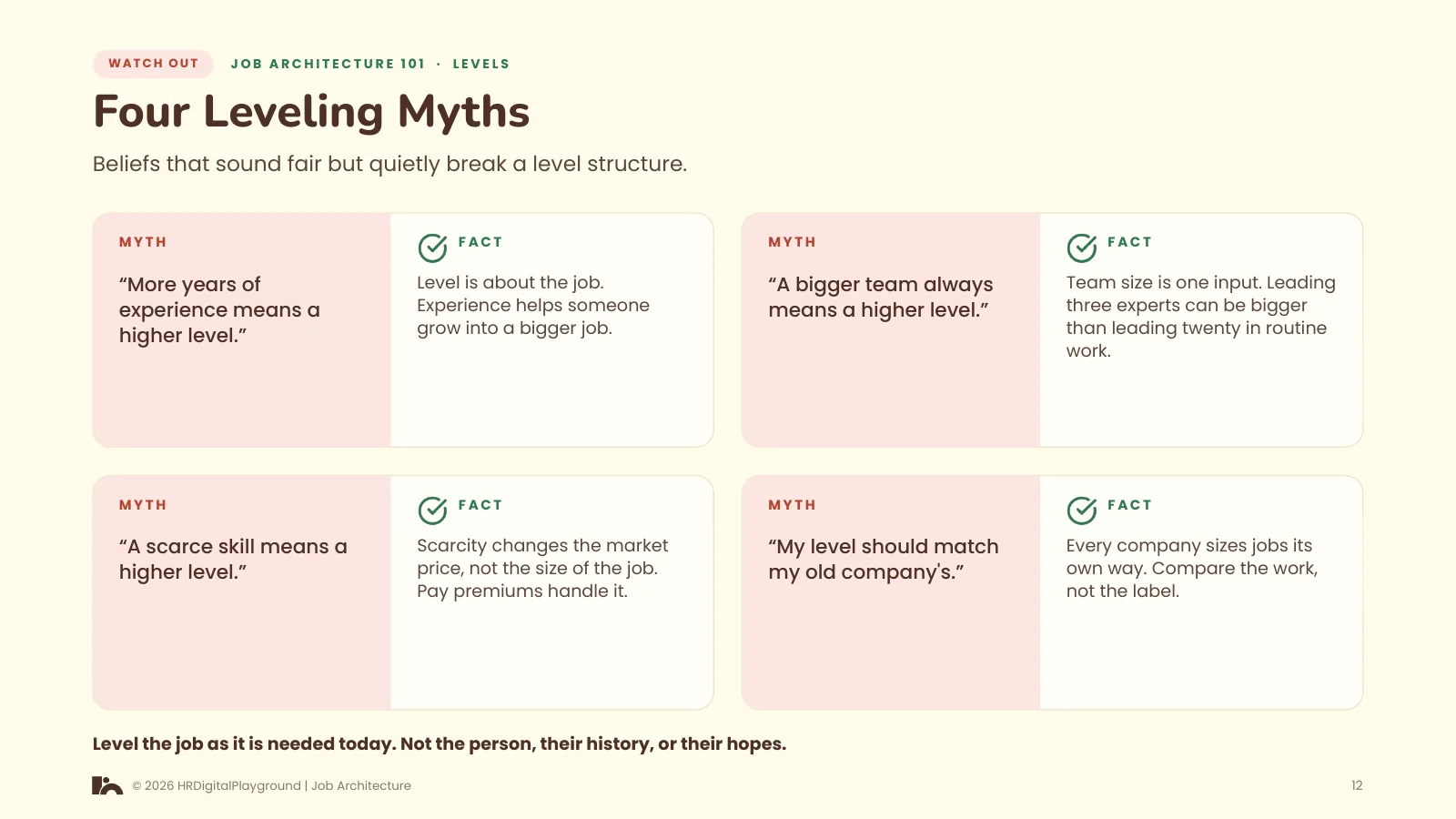
Four beliefs cause many leveling mistakes. First, that more years of experience means a higher level. Experience helps someone grow into a bigger job, but level describes the job, so ten years in a P2 job is still a P2 job. Second, that bigger teams always mean a higher level. Team size is one input to leadership, but a manager of three senior experts can have a bigger job than a manager of twenty people doing routine work. Third, that a scarce or in-demand skill means a higher level. Scarcity affects what the market pays for the skill, not the size of the job. It is usually handled through market pricing or a pay premium, not by raising the level. Fourth, that a level should match the one at a previous employer. Every company sizes jobs its own way, so a Senior title or a level number elsewhere means little. Compare the work instead.
Page 13 Which Job Is Bigger?
Read the explanation
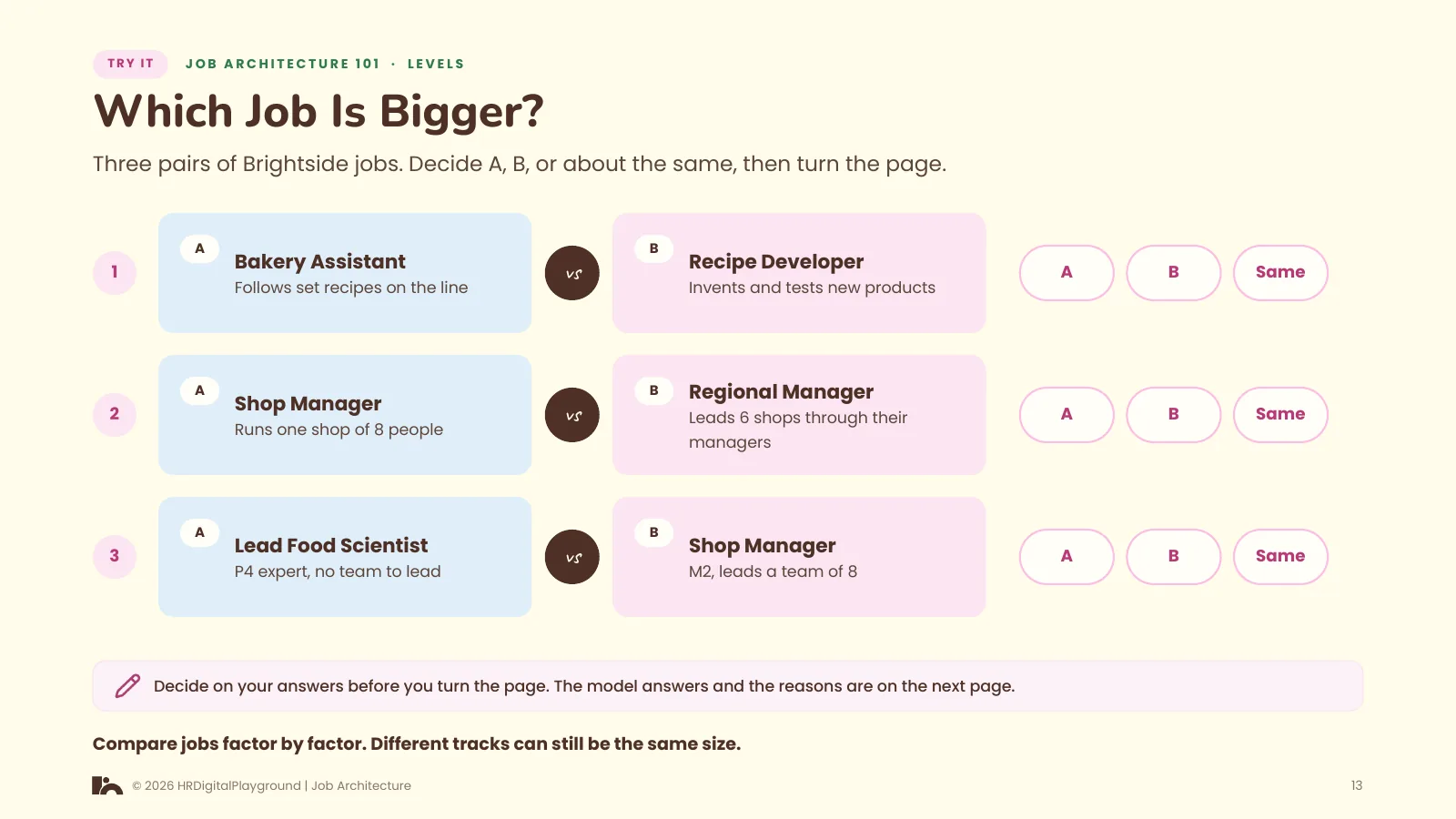
This activity practices comparing job size with leveling factors. For each pair, decide whether job A is bigger, job B is bigger, or they are about the same, and note which factors decided it. The model answers are on the next page.
Page 14 Which Job Is Bigger: Model Answers
Read the explanation
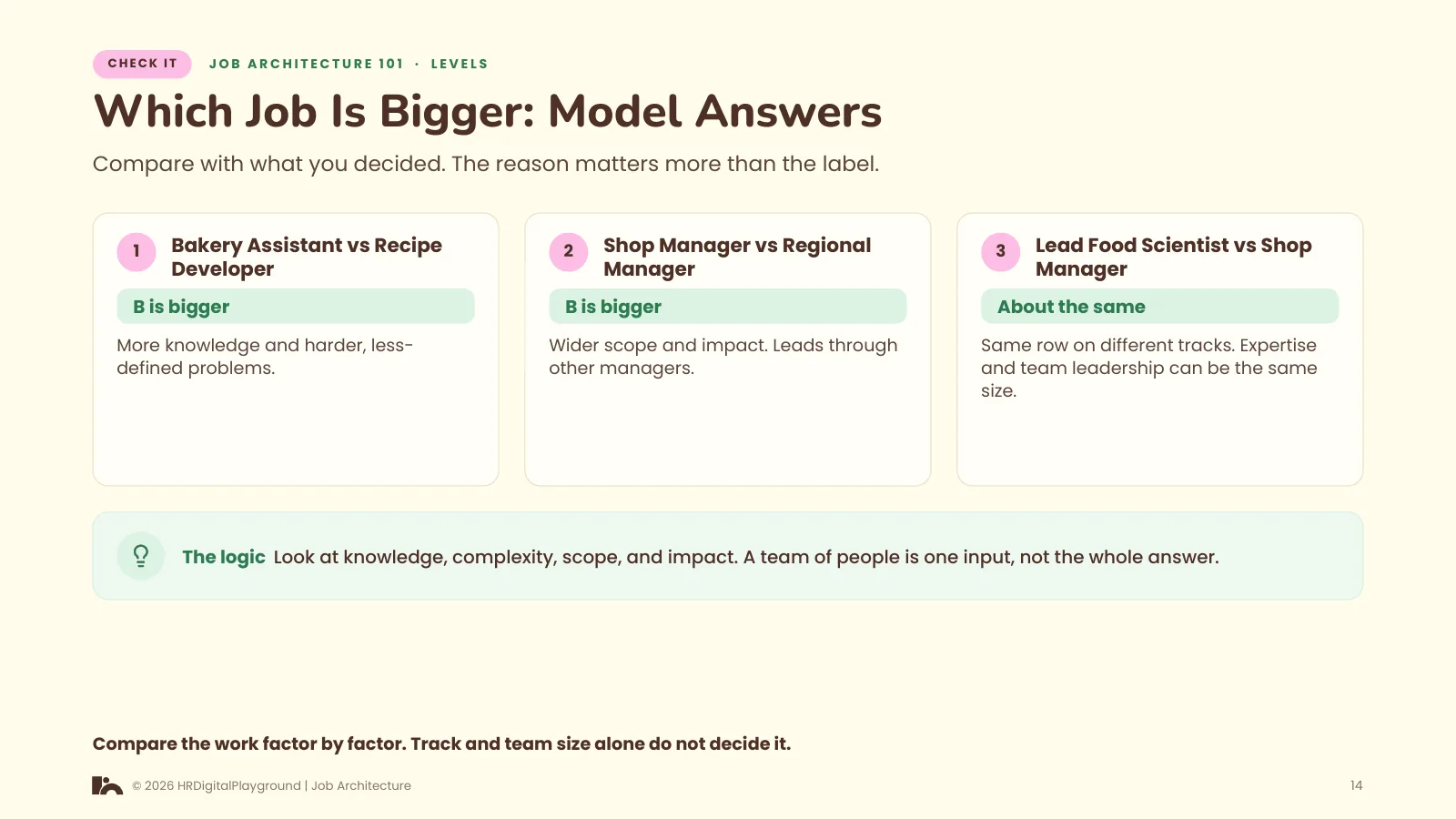
Model answers. Pair one: the Bakery Assistant follows set recipes, while the Recipe Developer invents and tests new products. The Recipe Developer needs more knowledge and solves harder, less-defined problems, so B is bigger. Pair two: the Shop Manager runs one shop of eight people, while the Regional Manager leads six shops through their managers. The Regional Manager has wider scope and impact and leads through other managers, so B is bigger. Pair three: the Lead Food Scientist at P4 and the Shop Manager at M2 are on different tracks, one leading through expertise and one leading a team, but they sit on the same row. They are about the same size. That is the dual ladder at work.
Page 15 Quick Check
Read the explanation
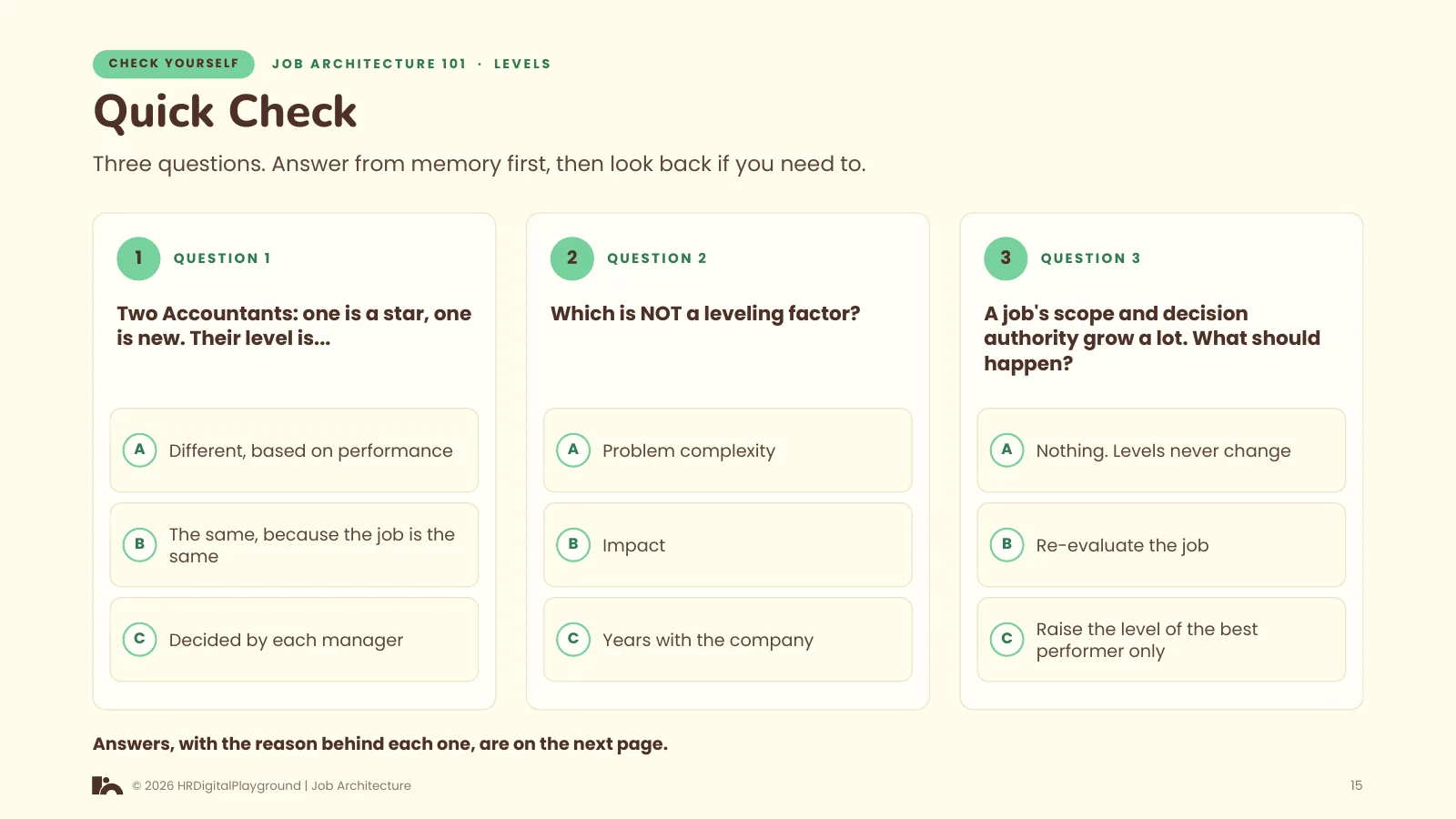
Three questions on levels. Question 1 checks that level describes the job, not the person. Question 2 checks the leveling factors: years with the company is not one of them. Question 3 checks what can change a level: a material change in the job itself.
Page 16 Remember
Read the explanation
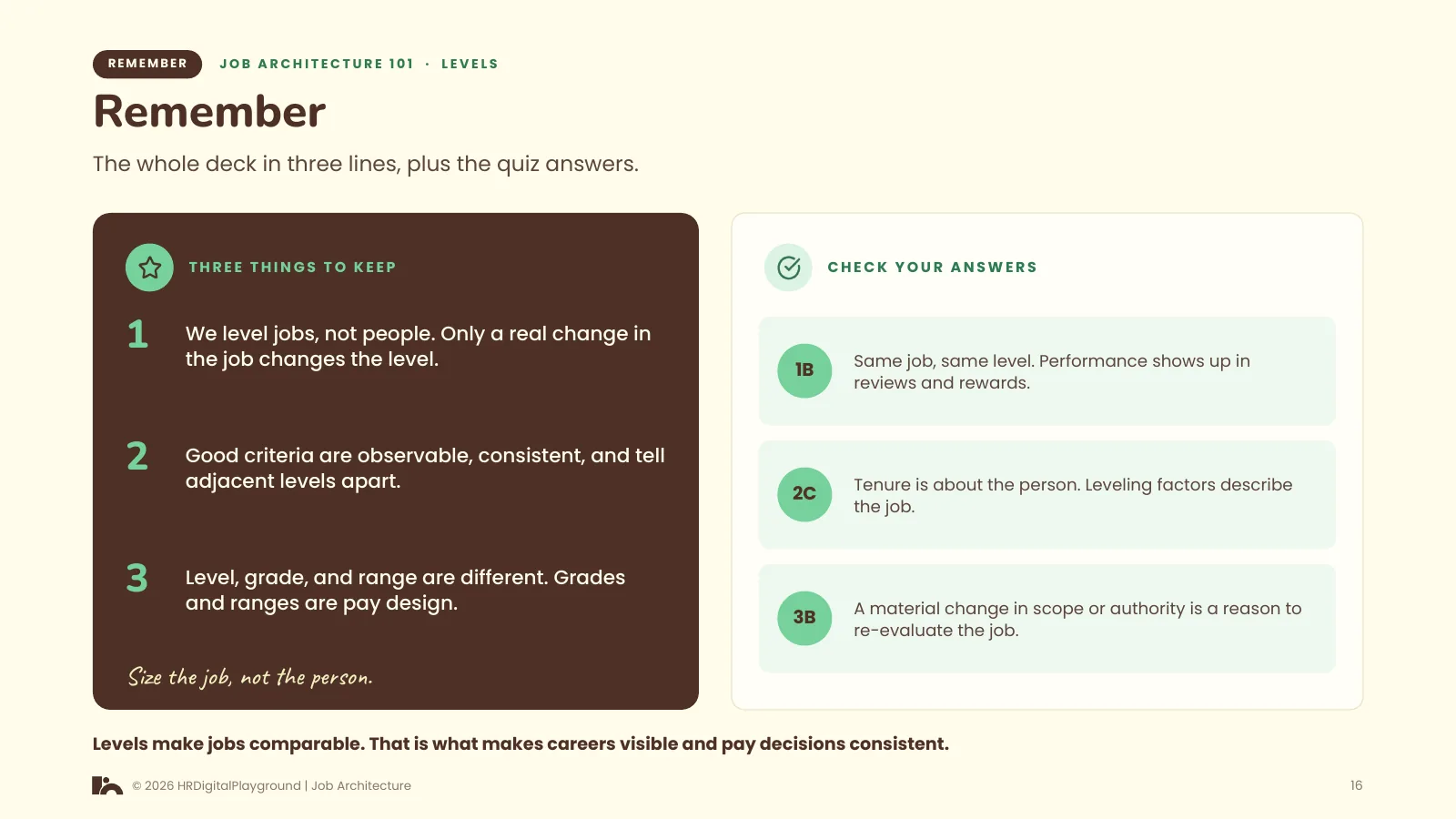
The recap keeps three ideas. We level jobs, not people, and only a material change in the job changes its level. Levels rest on observable criteria built from factors such as knowledge, complexity, scope, and impact, and the exact factors vary by company. And level, grade, and salary range are different: the level sizes the job, while grades and ranges are pay design informed by market data. Quiz answers: 1 is B, the same level because the job is the same. 2 is C, years with the company is not a factor. 3 is B, re-evaluate the job, because the job itself has materially changed.
Page 17 Copyright and Notices
Illustrative numbers, fictional company
Read the explanation
Job Architecture 101: Levels. Copyright 2026 HRDigitalPlayground | Job Architecture. Published September 2026. Brightside Bakery is a fictional company and all examples are illustrative. The material is general education, not legal, tax, or financial advice.