Laws and Regulations
How does it support compliance?
General education, not legal advice. Legal pages in this guide were last verified September 26, 2026.
Page 1 Laws and Regulations
Read the explanation
This deck answers: which rules touch job architecture, and how can a good architecture support compliance? A job architecture does not guarantee compliance, but a documented, consistent one gives employers useful evidence and infrastructure. The deck separates legal requirements from recommended practice, then covers pay transparency in the US and abroad, equal pay, pay gap and pay data reporting, overtime classification, and hiring rules including the use of AI, and shows which parts of the architecture each area leans on. Each page names its jurisdictions and sources, with the date they were last verified. It is general education written as of September 2026, not legal advice. Rules change often and differ by location, so check current requirements with counsel before acting.
Page 2 Before You Start
Read the explanation
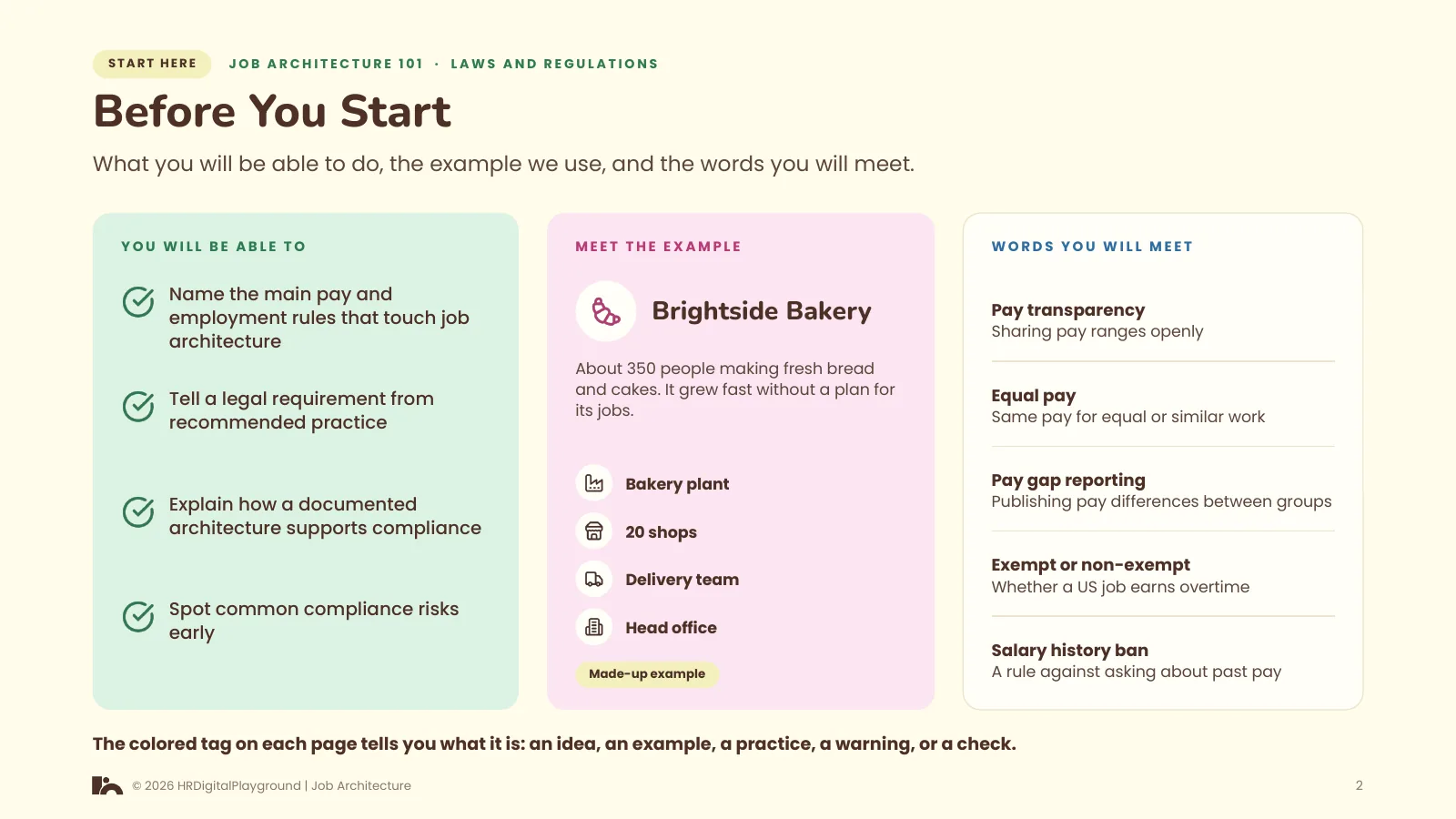
This deck covers laws and regulations. It is written for someone with no background in HR, compensation, or organization design, and it follows adult learning principles: why before what, one realistic example throughout, practice with answers, a short quiz, and a one-page recap. The example is Brightside Bakery, a made-up company of about 350 people with a bakery plant, twenty shops, a delivery team, and a head office. It grew fast without a plan for its jobs, so it has far more titles than real jobs and no shared way to compare them. The words on this page are defined again where they first appear.
Page 3 Why Laws Care About Job Architecture
Read the explanation
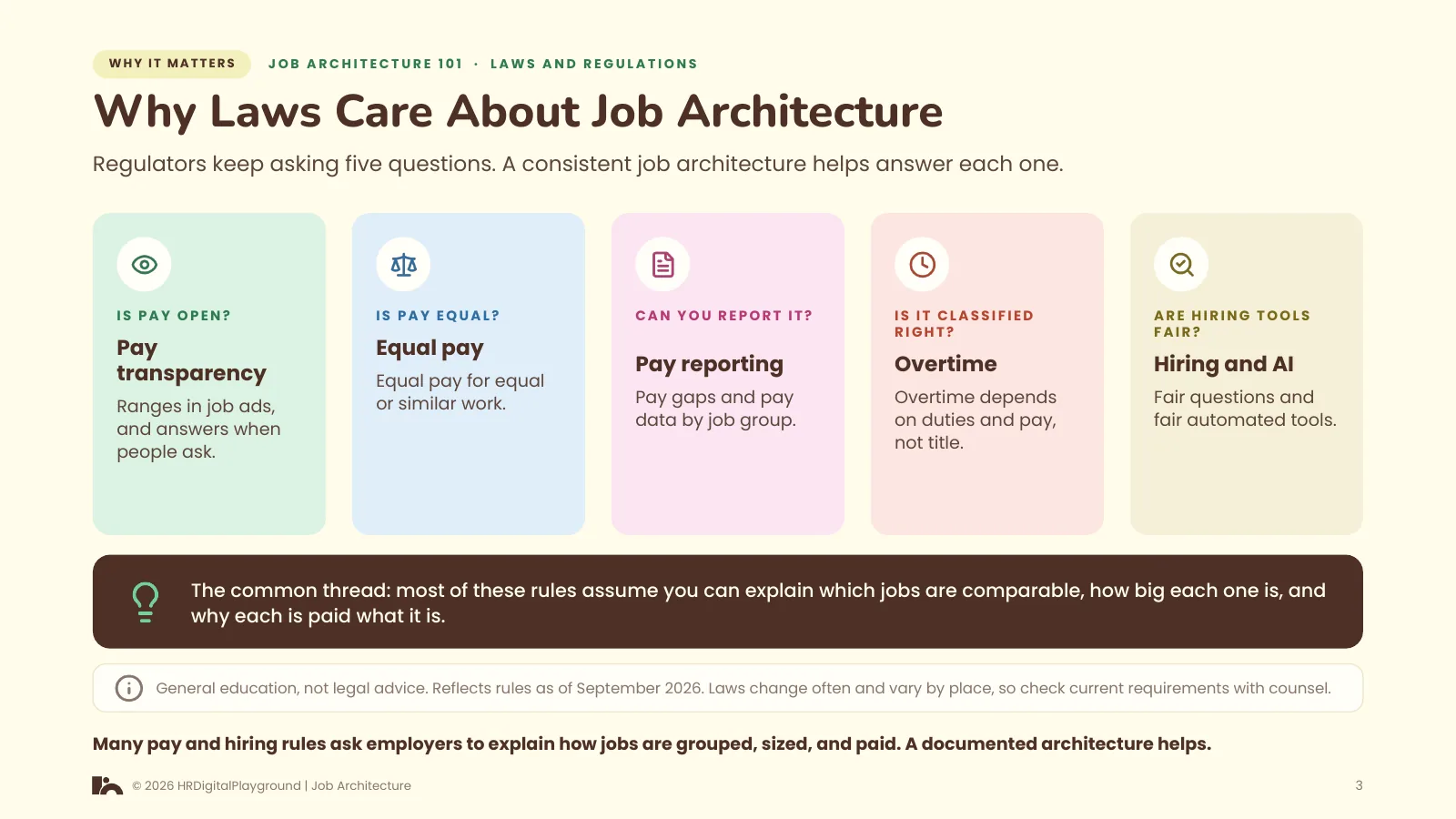
Many modern pay and hiring rules ask employers to explain their jobs, although they rarely use the words job architecture. Pay transparency rules ask for honest pay ranges, which are easier to set consistently from defined jobs and grades. Equal pay rules ask whether people doing equal or similar work are paid the same, which requires a consistent way to decide which work is similar. Reporting rules ask for pay and workforce data by job group. Overtime rules in the US turn on each job's duties and pay. Hiring rules, including new rules on AI tools, ask whether job requirements and screening are fair. A company with a sound job architecture can answer many of these questions from one source. The architecture does not guarantee compliance. It provides evidence and infrastructure that counsel and HR can use. This deck is general education as of September 2026, not legal advice.
Page 4 Legal Requirement or Good Practice?
Verified September 26, 2026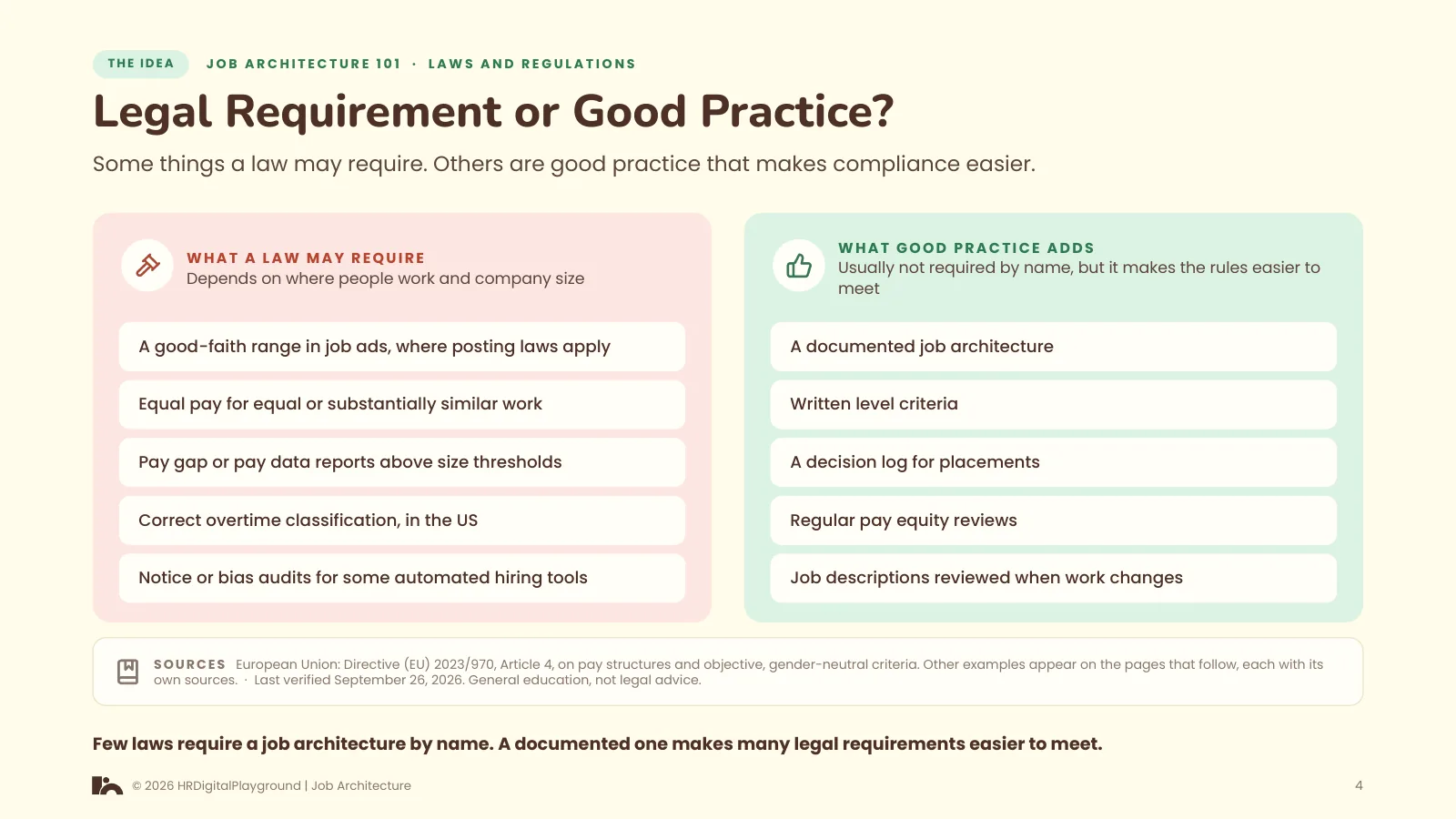
Read the explanation
It helps to separate what the law may require from what is simply good practice. Depending on the jurisdiction and the employer's size, laws may require a good-faith pay range in job postings, equal pay for equal or substantially similar work, pay gap or pay data reports above certain size thresholds, correct overtime classification in the United States, and notices or bias audits for some automated hiring tools. Most laws do not require a job architecture by name. The EU Pay Transparency Directive comes closest, because it requires pay structures that let employers assess work of equal value using objective, gender-neutral criteria. Good practice adds the things that make those requirements easier to meet and defend: a documented job architecture, written level criteria, a decision log for placements, regular pay equity reviews, and job descriptions that are reviewed when the work changes. The line between the two varies by place and changes over time, which is why each page in this deck names its jurisdictions and sources.
Page 5 Pay Transparency in the US
Verified September 26, 2026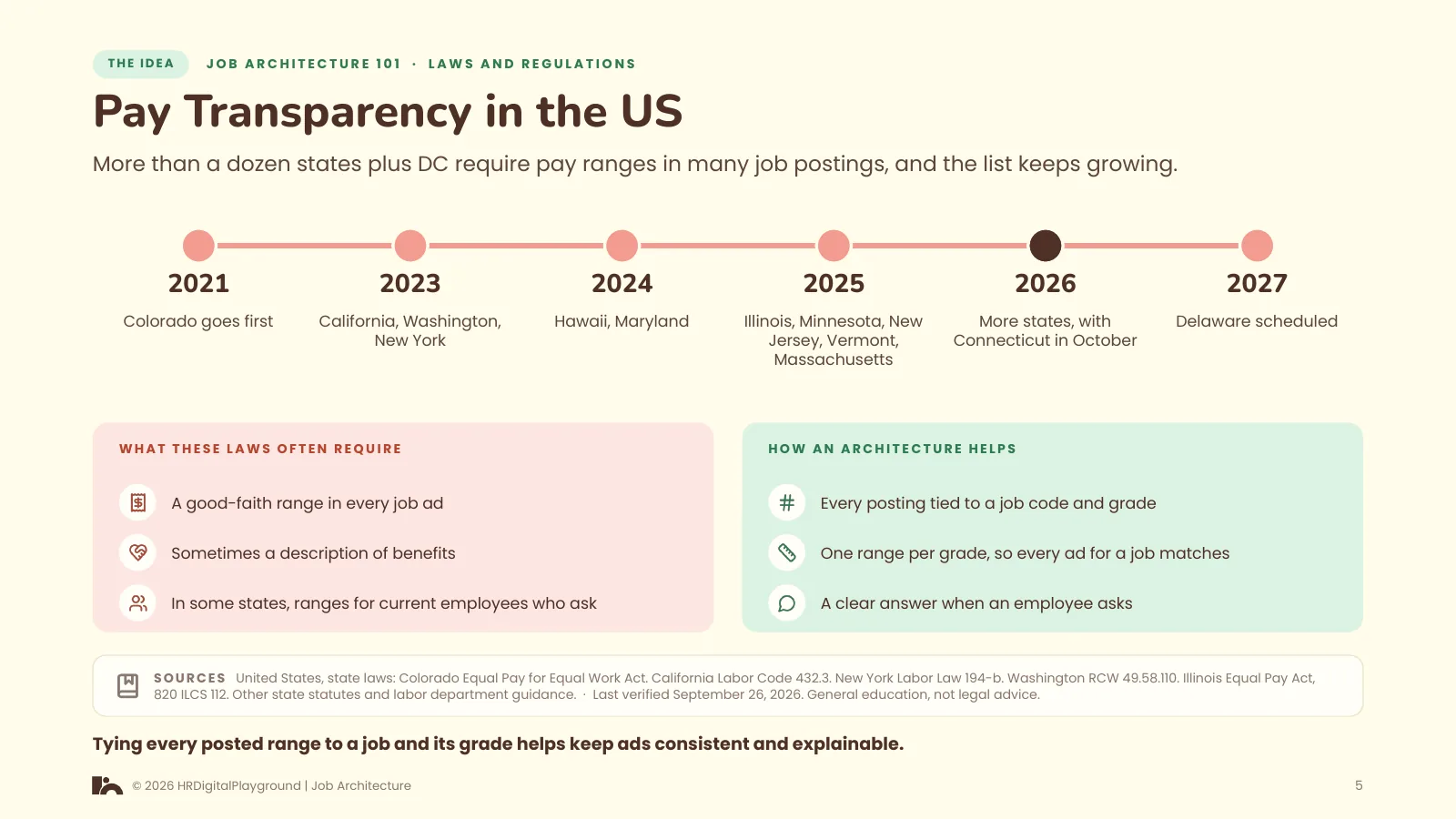
Read the explanation
Colorado was the first state to require pay ranges in job postings, starting in 2021. California, Washington, and New York followed in 2023, and more states joined each year after. As of September 2026, more than a dozen states plus the District of Columbia require pay ranges in job postings, Connecticut's posting requirement starts on October 1, 2026, and Delaware's is scheduled for 2027. Several cities have their own rules too. The details differ, but common themes are clear. The range must be a good-faith estimate of what the employer expects to pay. Some laws also require a description of benefits. Some cover remote jobs that could be filled by someone living in the state. And some give current employees rights too, such as asking for the range of their own job or seeing ranges when promotion opportunities are posted, as in California and Colorado. The laws require the range, not a job architecture. An architecture helps by tying every posting to a job code and grade, so ranges are consistent and easy to explain. Check each state's current rules, because they change often. Sources, last verified September 26, 2026: Colorado Equal Pay for Equal Work Act, California Labor Code section 432.3, New York Labor Law section 194-b, Washington RCW 49.58.110, Illinois Equal Pay Act of 2003, 820 ILCS 112, and other state statutes and labor department guidance.
Page 6 Pay Transparency Beyond the US
Verified September 26, 2026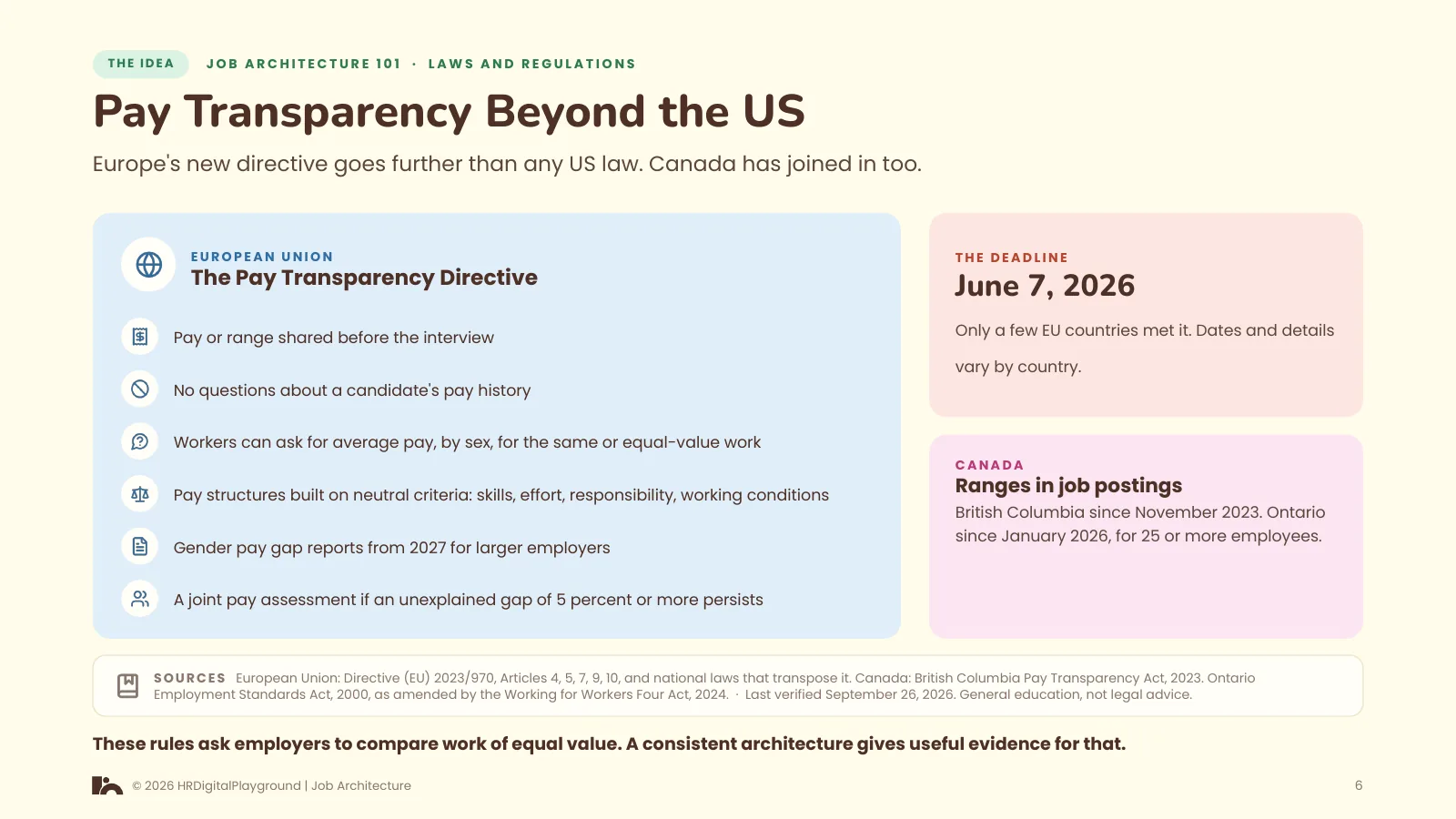
Read the explanation
The EU Pay Transparency Directive is the most far-reaching pay transparency law so far. EU member states had until June 7, 2026 to turn it into national law. Only a few met that deadline, and the rest are working through it, so dates and details vary by country. Its core rules: candidates must be told the starting pay or range before the interview, employers may not ask candidates about their pay history, and workers can ask for their own pay and the average pay, by sex, of people doing the same work or work of equal value. Pay structures must use objective, gender-neutral criteria, and the directive names skills, effort, responsibility, and working conditions. Employers with 150 or more workers report gender pay gaps, starting in 2027, and those with 100 to 149 workers from 2031. Where an unexplained gap of 5 percent or more persists in a category of workers, the employer must run a joint pay assessment with worker representatives. In Canada, British Columbia has required pay ranges in job postings since November 2023, and Ontario since January 2026 for employers with 25 or more employees. Each of these rules assumes the employer can compare jobs of equal value. A consistent job architecture gives employers a practical way to do that, although the legal test is always applied to the actual work. Sources, last verified September 26, 2026: Directive (EU) 2023/970 of the European Parliament and of the Council, Articles 4, 5, 7, 9, and 10. British Columbia Pay Transparency Act, 2023. Ontario Employment Standards Act, 2000, as amended by the Working for Workers Four Act, 2024.
Page 7 Equal Pay for Equal Work
Verified September 26, 2026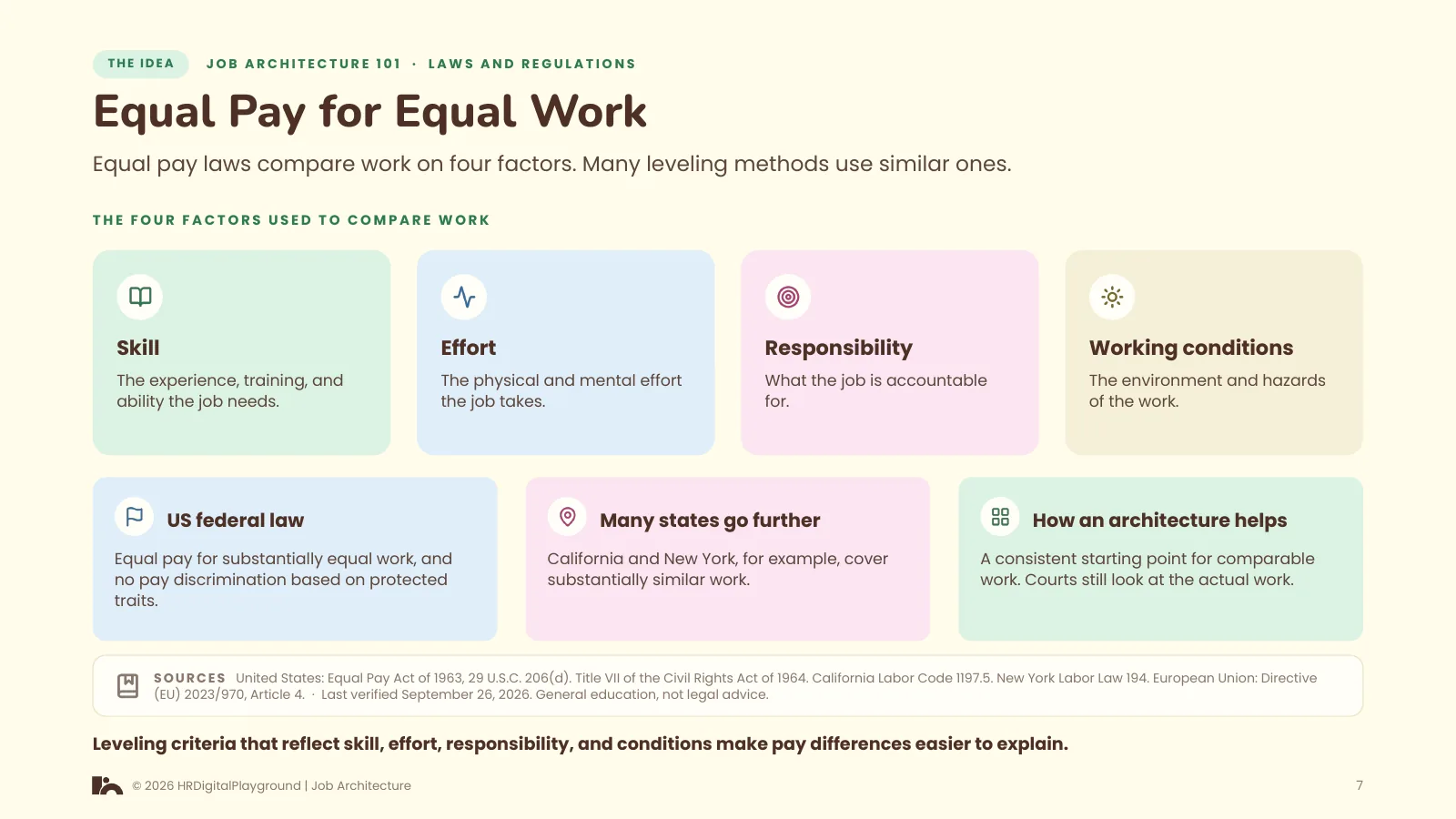
Read the explanation
In the US, the Equal Pay Act of 1963 requires equal pay for men and women doing substantially equal work in the same establishment, judged on four factors: skill, effort, responsibility, and similar working conditions. Title VII of the Civil Rights Act also bars pay discrimination based on race, color, religion, sex, and national origin, and other federal laws cover age and disability. Many states go further. California, for example, requires equal pay for substantially similar work and covers more protected groups, and New York has a similar standard. The EU directive uses nearly the same four factors to define work of equal value. Differences in pay are allowed when they rest on legitimate, job-related reasons, such as seniority, merit, or the quantity or quality of work, applied consistently. This is where a job architecture can help most. Families and levels give a consistent starting point for which work is comparable, neutral leveling criteria reflect the legal factors, and a decision log records why jobs are placed where they are. One caution: courts and regulators look at the actual work, not at the employer's labels, so the architecture is supporting evidence, not the final word. Sources, last verified September 26, 2026: Equal Pay Act of 1963, 29 U.S.C. 206(d). Title VII of the Civil Rights Act of 1964. California Labor Code section 1197.5. New York Labor Law section 194. Directive (EU) 2023/970, Article 4.
Page 8 Pay Gap and Pay Data Reporting
Verified September 26, 2026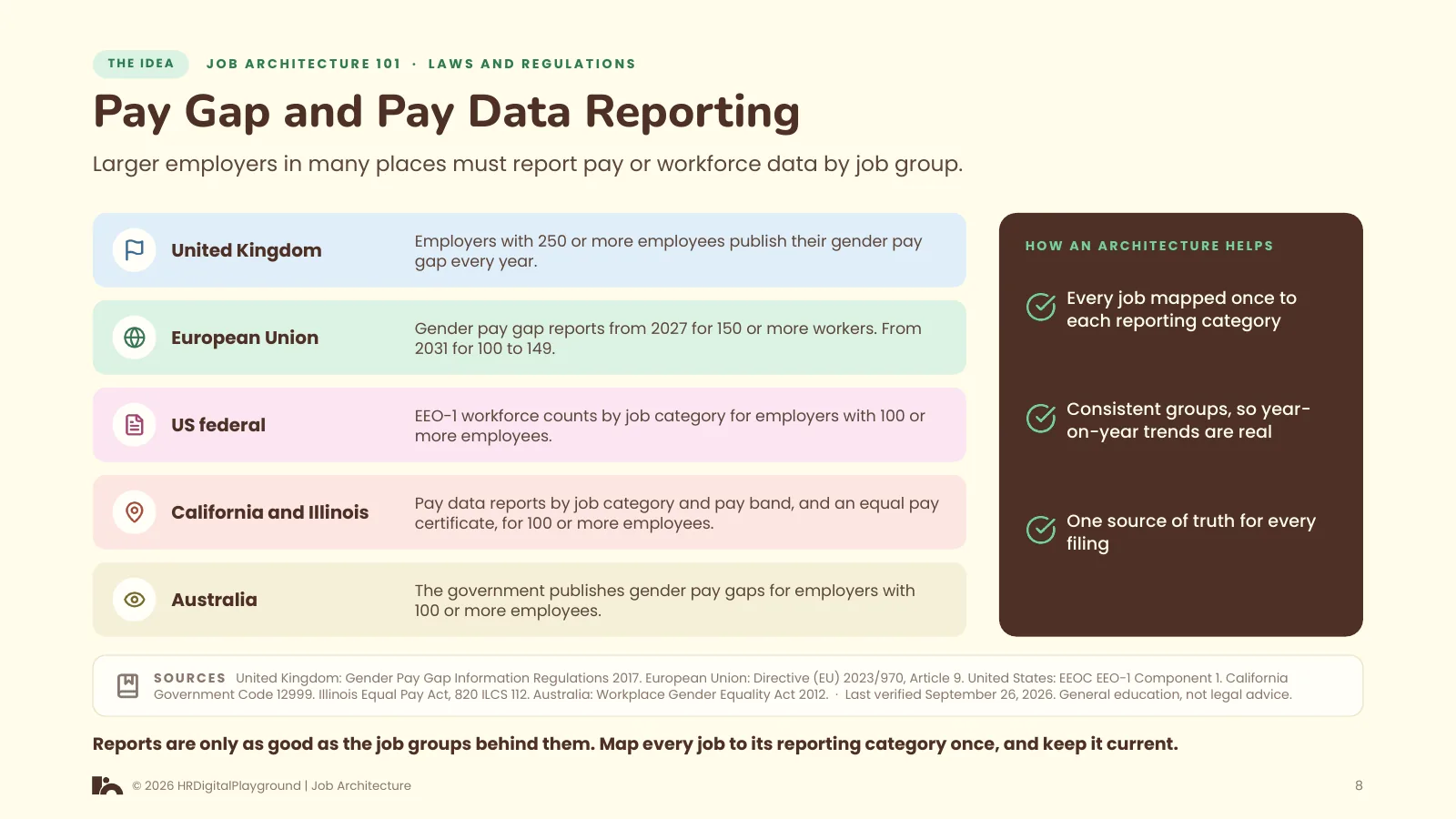
Read the explanation
Reporting rules ask employers to publish or file pay and workforce data grouped by job. In the UK, employers with 250 or more employees publish their gender pay gap every year. Under the EU directive, employers with 150 or more workers start reporting gender pay gaps in 2027, yearly for those with 250 or more and every three years for those with 150 to 249, and employers with 100 to 149 workers start in 2031. In the US, private employers with 100 or more employees file the EEO-1 report, which counts the workforce by job category. California requires employers with 100 or more employees to file annual pay data reports by job category and pay band, and Illinois requires employers with 100 or more employees to hold an equal pay registration certificate. In Australia, the government publishes the gender pay gaps of employers with 100 or more employees. Each report depends on mapping every job to the right category. A job architecture makes that mapping a one-time task stored in the job record, rather than a scramble every reporting season. Thresholds and dates change, so confirm current rules. Sources, last verified September 26, 2026: Equality Act 2010 (Gender Pay Gap Information) Regulations 2017, United Kingdom. Directive (EU) 2023/970, Article 9. EEOC EEO-1 Component 1 data collection, United States. California Government Code section 12999. Illinois Equal Pay Act of 2003, 820 ILCS 112. Workplace Gender Equality Act 2012, Australia.
Page 9 Overtime and Job Classification
Verified September 26, 2026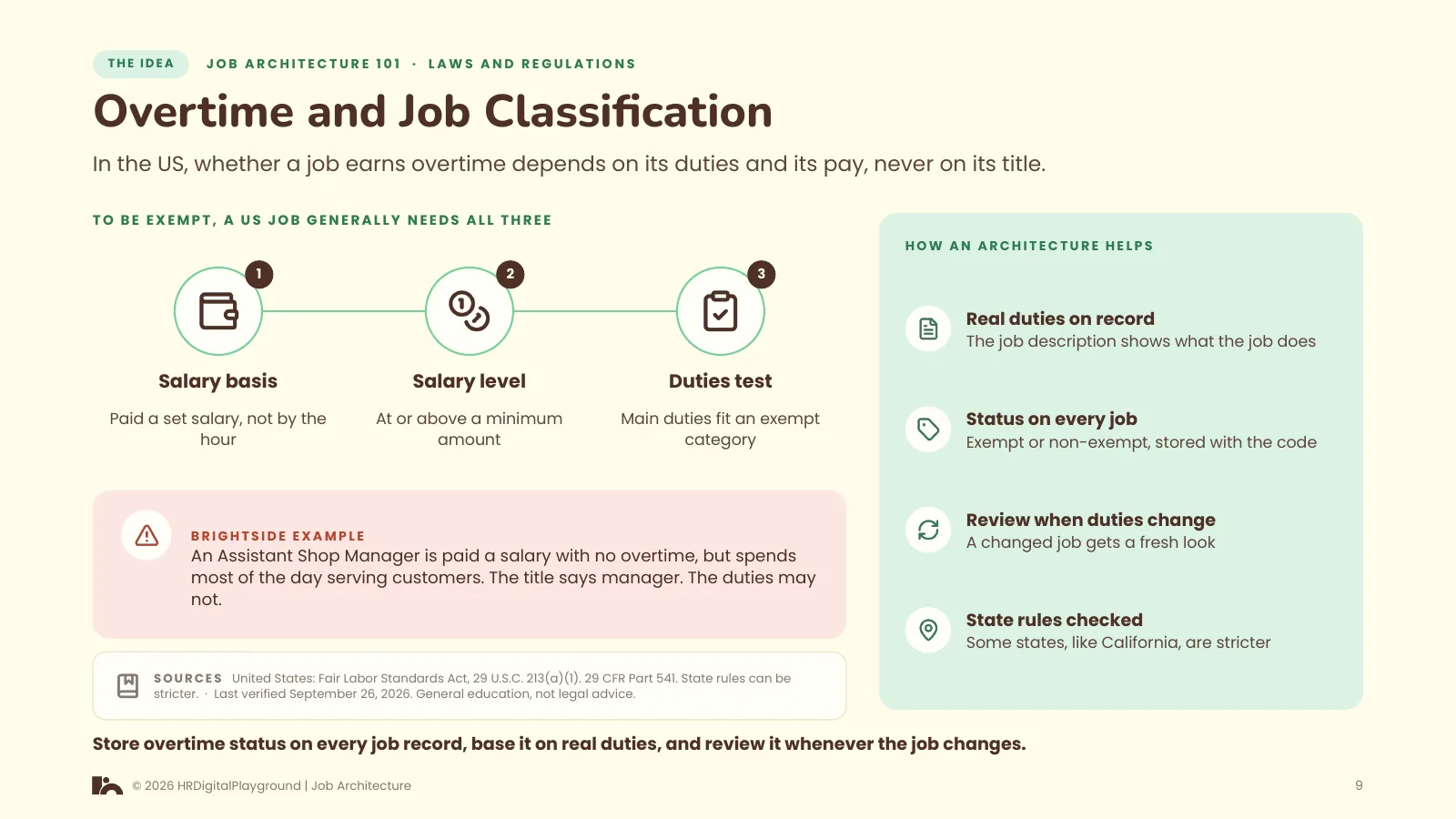
Read the explanation
Under the US Fair Labor Standards Act, every job is either non-exempt, meaning it earns overtime for hours over 40 in a week, or exempt. To be exempt, a job generally must pass three tests: the person is paid a salary rather than by the hour, the salary is at or above a minimum level, and the job's main duties fit an exemption category, such as executive, administrative, or professional work. The title does not decide it. An Assistant Shop Manager who spends most of the day serving customers and running the till may not meet the executive duties test, even with Manager in the title. Several states, such as California and New York, have stricter rules. A related question is whether someone is an employee or an independent contractor, which also turns on how the work is done. Job architecture helps because the job description documents the real duties, the overtime status is stored on each job record, and a change in duties triggers a review. Support track jobs are often non-exempt, but check each job on its own facts. Sources, last verified September 26, 2026: Fair Labor Standards Act, 29 U.S.C. 213(a)(1), and its regulations at 29 CFR Part 541. State rules, such as the California Labor Code and New York Labor Law, can be stricter.
Page 10 Hiring Rules and AI
Verified September 26, 2026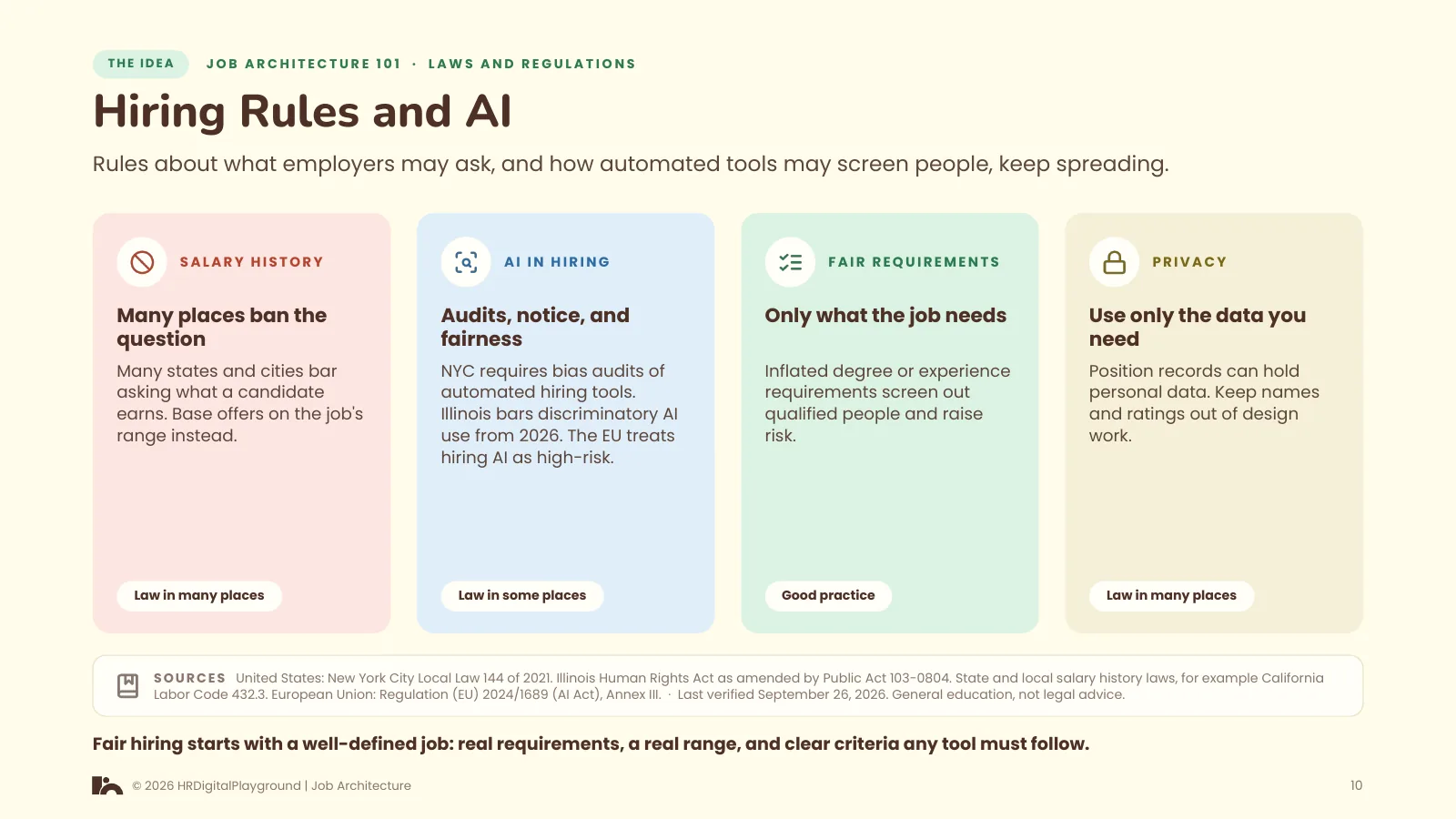
Read the explanation
Several kinds of hiring rules depend on well-defined jobs. Salary history bans, now in place in many states and cities, stop employers from asking candidates what they earn, so offers should come from the job's range instead. Rules on AI in hiring are spreading and changing fast. New York City requires bias audits and notices for automated employment decision tools. Illinois, since January 2026, bars employers from using AI in ways that discriminate in hiring and other employment decisions and requires notice. The EU AI Act treats AI used in recruitment and employment decisions as high-risk, and some of its deadlines have been adjusted, so check the current dates. Fair requirements matter too. Listing only what a job truly needs, rather than inflated degree or experience requirements, widens the pool and lowers legal risk. Finally, privacy rules cover personal data, and position records can contain it, so design work should use only the data it needs and keep names and ratings out. Some of these are legal requirements in some places, and some, such as fair requirements, are good practice that lowers legal risk. Each works best when the job itself is clearly defined. Sources, last verified September 26, 2026: New York City Local Law 144 of 2021. Illinois Human Rights Act as amended by Public Act 103-0804. State and local salary history laws, for example California Labor Code section 432.3. Regulation (EU) 2024/1689, the EU AI Act, Annex III.
Page 11 What the Rules Lean On
Read the explanation
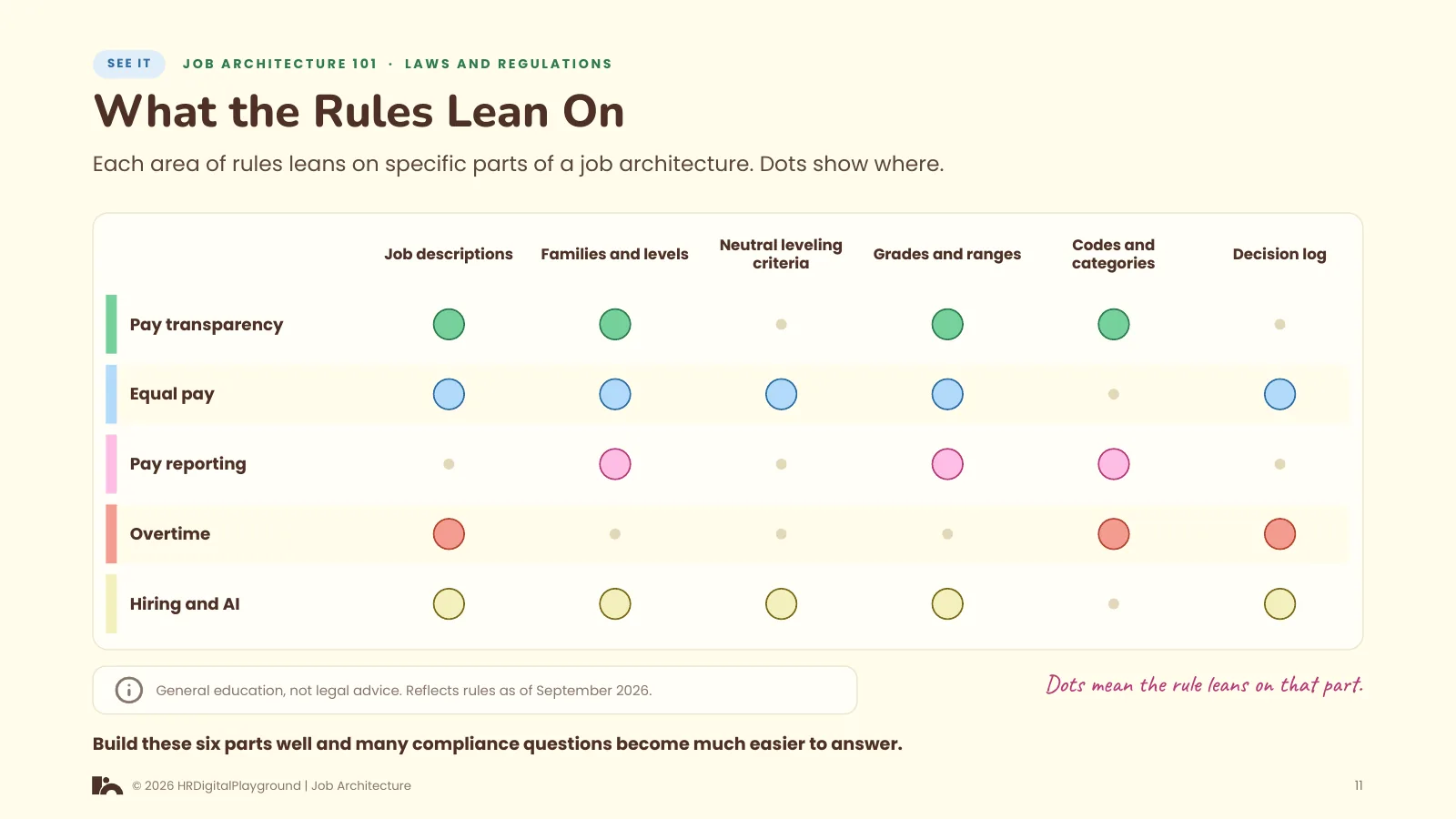
This matrix connects each family of rules to the parts of the job architecture it depends on. Pay transparency leans on job descriptions for postings, families and levels, grades and ranges, and job codes that tie each posting to its grade. Equal pay leans on descriptions, families and levels, neutral leveling criteria, grades and ranges, and the decision log that records why jobs sit where they do. Pay reporting leans on families and levels, pay bands, and job codes mapped to reporting categories. Overtime leans on descriptions that show real duties, the status stored with each code, and a log of reviews. Hiring and AI rules lean on descriptions with real requirements, families and levels, neutral criteria, ranges for offers, and a record of decisions. The six parts across the top are a practical checklist. They support compliance, but they do not replace legal review. This page is general education as of September 2026, not legal advice.
Page 12 Spot the Risk
Read the explanation
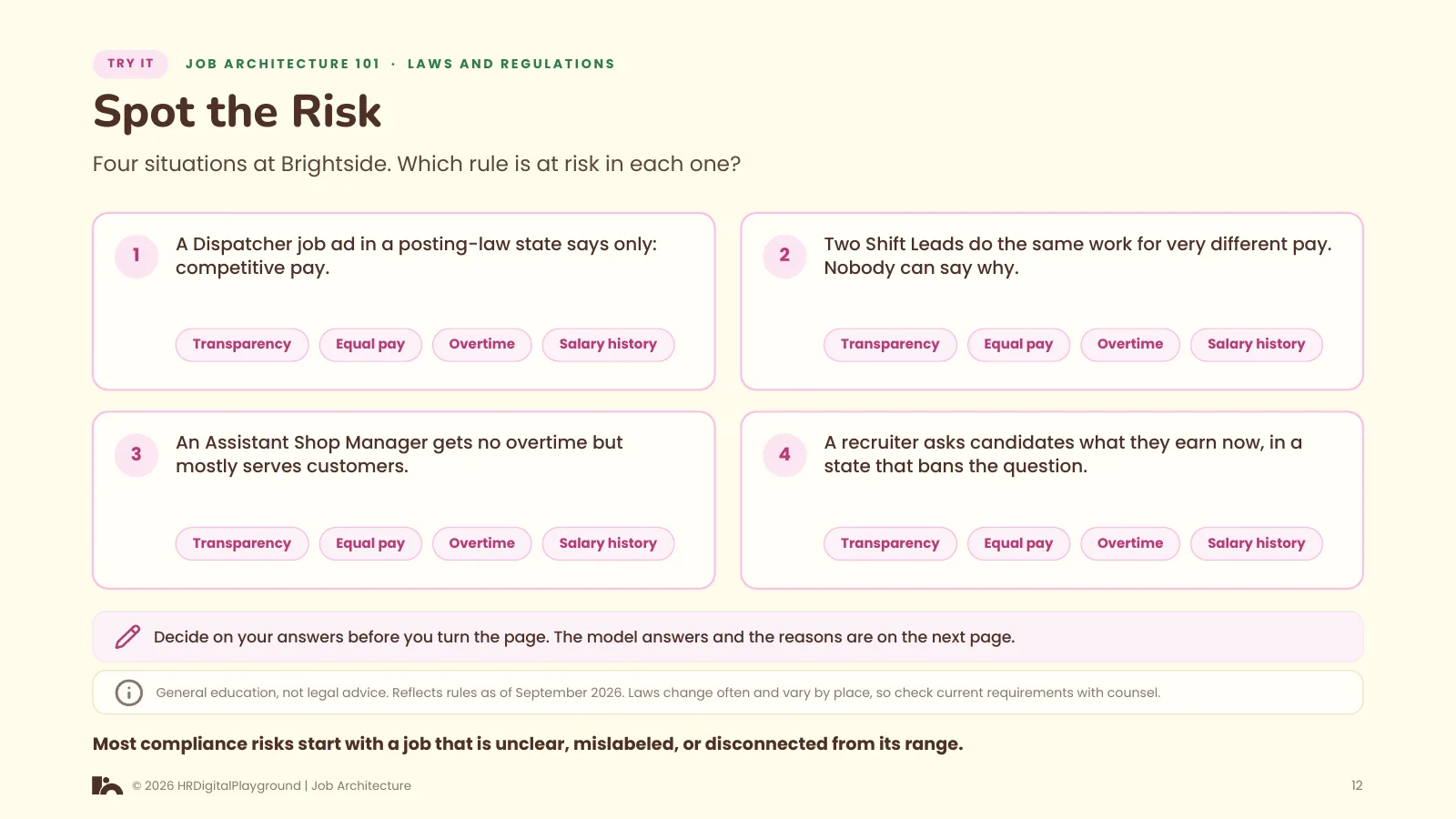
This activity practices spotting which rule a situation puts at risk. Read the four Brightside situations and decide which area each one risks: pay transparency, equal pay, overtime, or salary history. The model answers are on the next page. This is general education as of September 2026, not legal advice.
Page 13 Spot the Risk: Model Answers
Read the explanation
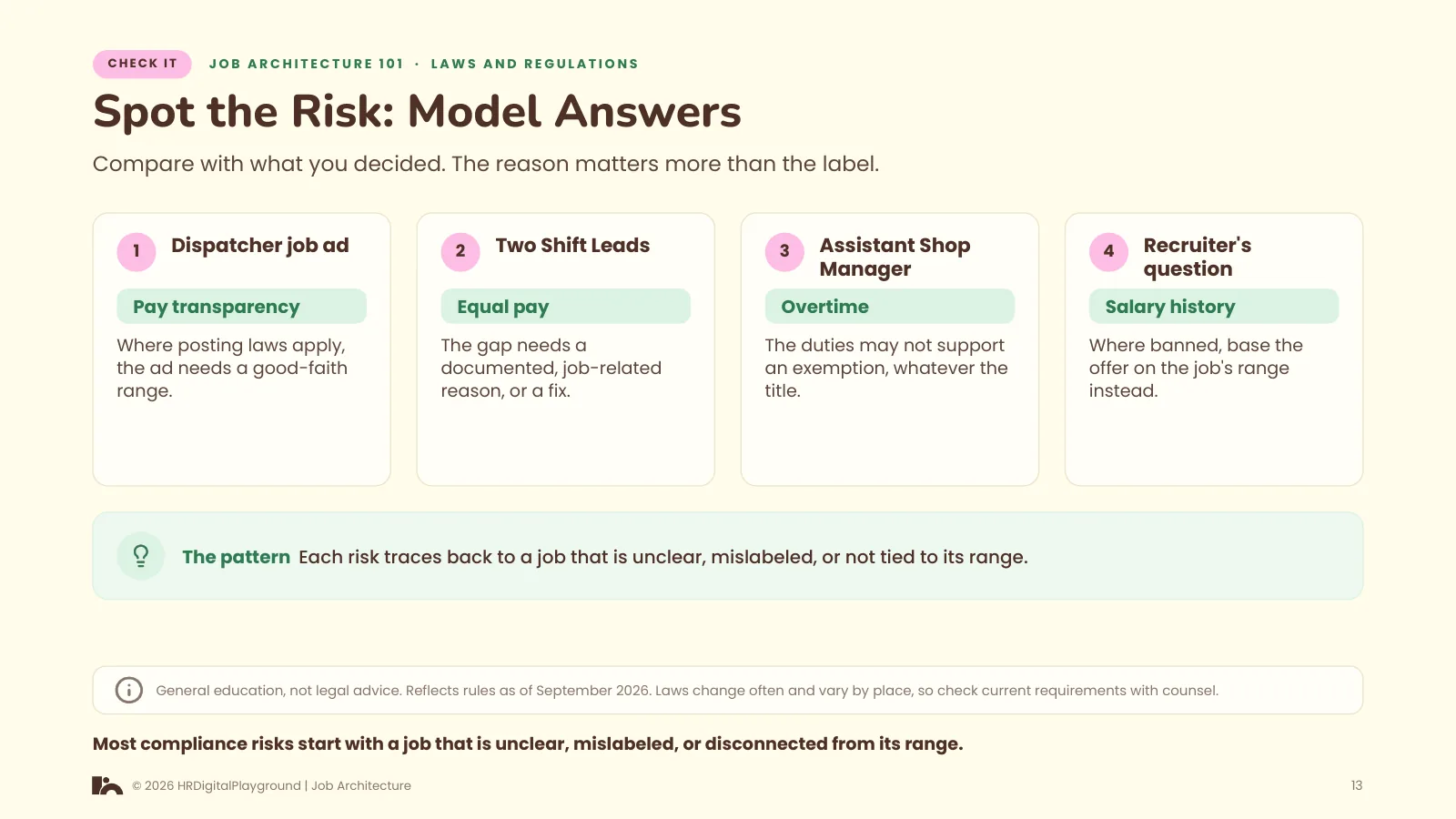
Model answers. Situation one risks pay transparency: a job ad in a state with a posting law needs a good-faith pay range, not only the words competitive pay. Situation two risks equal pay: two Shift Leads doing the same work for very different pay need a documented, job-related reason, or the gap should be fixed. Situation three risks overtime classification: the duties may not support an exemption even though the title says manager. Situation four risks a salary history ban, and the offer should come from the job's range instead. This is general education as of September 2026, not legal advice.
Page 14 Quick Check
Read the explanation
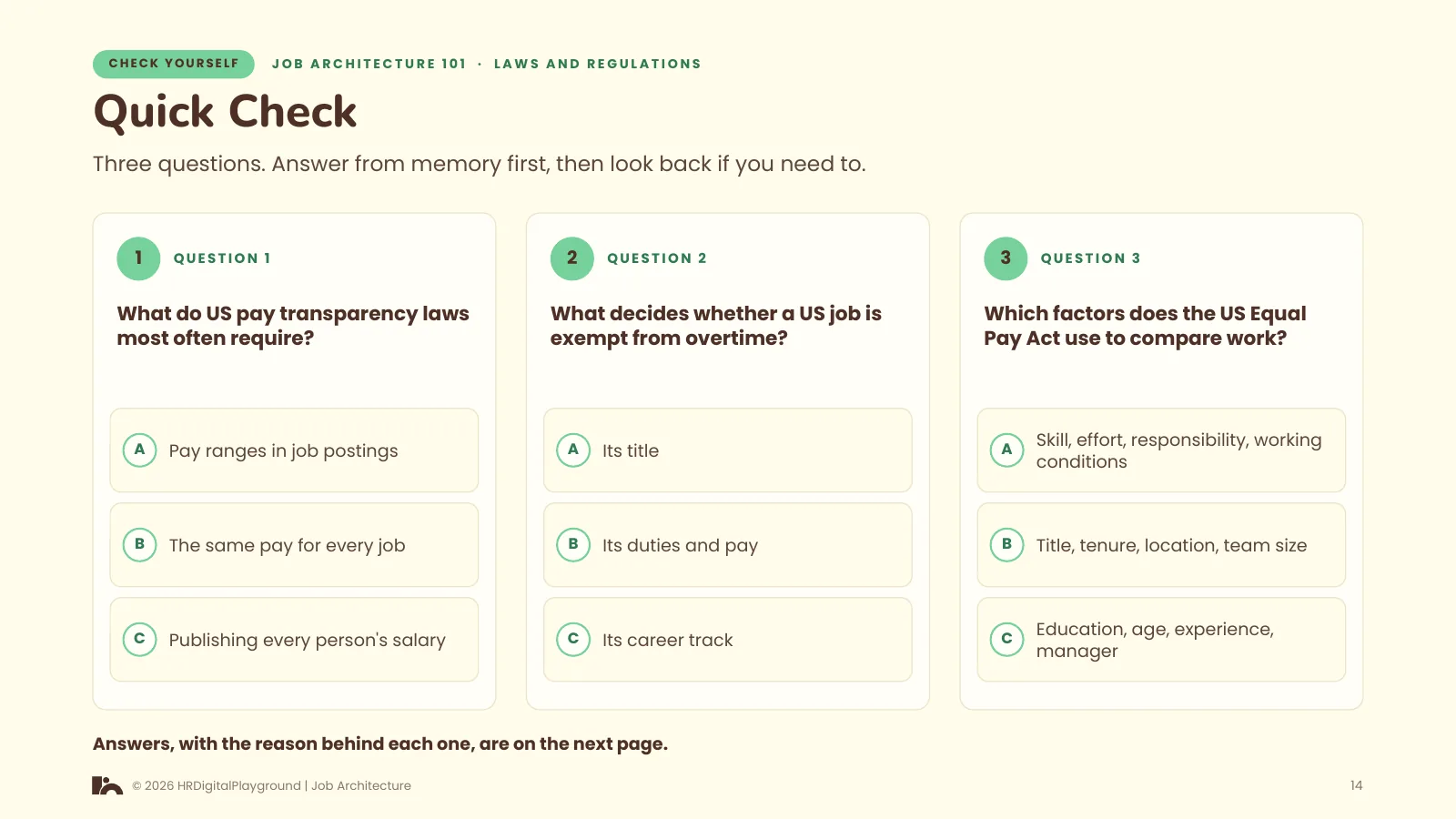
Three questions on the rules. Question 1 checks the most common US pay transparency requirement. Question 2 checks what decides overtime exemption. Question 3 checks the four factors used to compare work under the US Equal Pay Act.
Page 15 Remember
Read the explanation
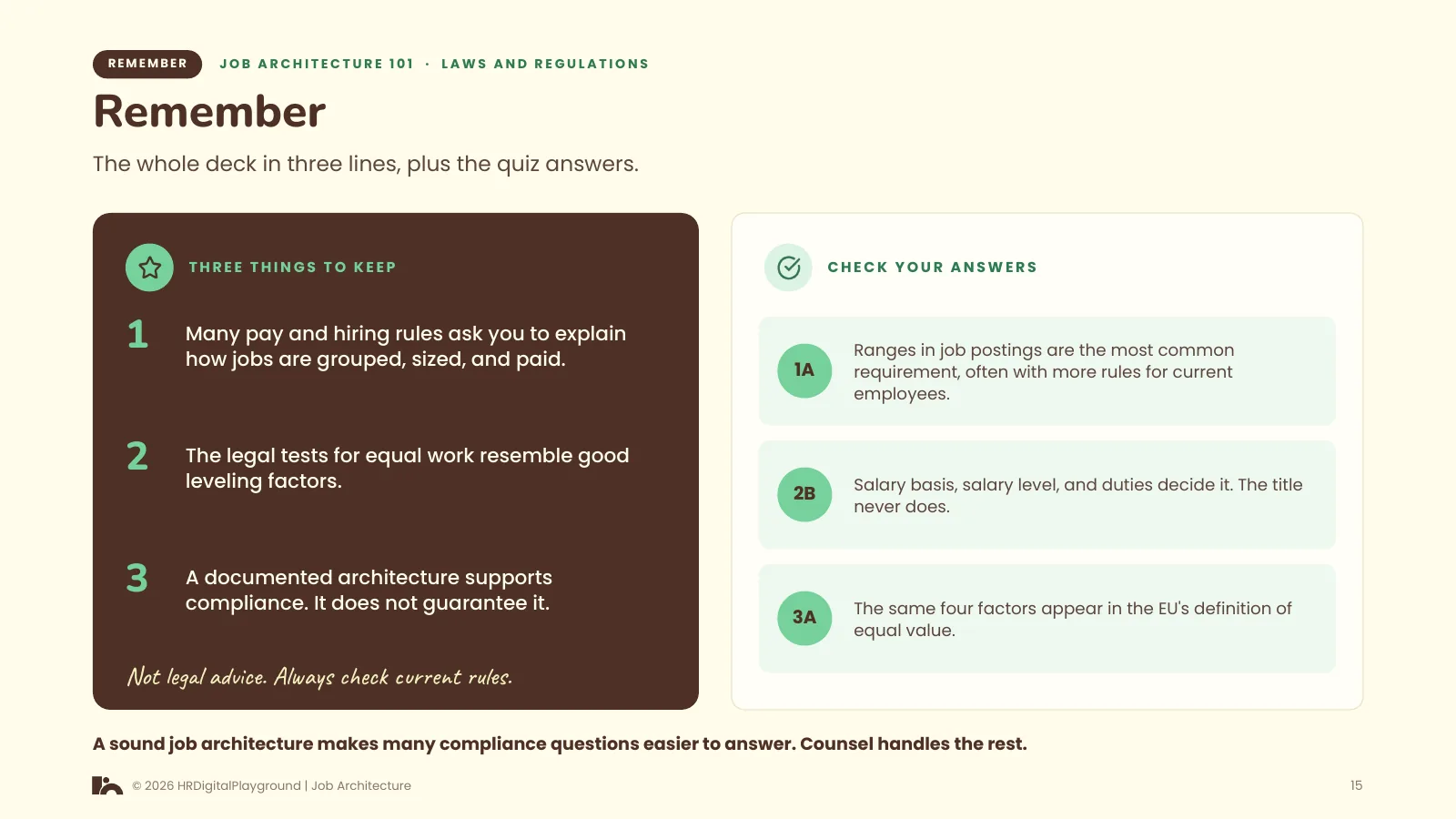
The recap keeps three ideas. Pay and hiring rules are spreading in the US and abroad, and many of them ask employers to explain how jobs are grouped, sized, and paid. The legal factors for comparing work are similar to good leveling factors, although the law is applied to the actual work. And a documented architecture supports compliance without guaranteeing it, so legal requirements and good practice should be kept distinct. Quiz answers: 1 is A, pay ranges in job postings. 2 is B, duties and pay. 3 is A, skill, effort, responsibility, and working conditions. This deck is general education as of September 2026, not legal advice.
Page 16 Copyright and Notices
Illustrative numbers, fictional company
Read the explanation
Job Architecture 101: Laws and Regulations. Copyright 2026 HRDigitalPlayground | Job Architecture. Published September 2026. Brightside Bakery is a fictional company and all examples are illustrative. The material is general education, not legal, tax, or financial advice.