Job Families
How do we group similar work?

Page 1 Job Families
Read the explanation
This deck answers: how do we group similar work? A job family is a major grouping of related work: jobs that share a purpose, a body of knowledge and skills, a talent market, and natural career links. The deck defines families, shows a typical set, explains why families follow the work rather than the org chart, covers when to add subfamilies and how many families a company usually needs, lists the common mistakes, and gives a four-question method for jobs that could fit two families. It ends with a placement activity, three quick questions, and a recap.
Page 2 Before You Start
Read the explanation
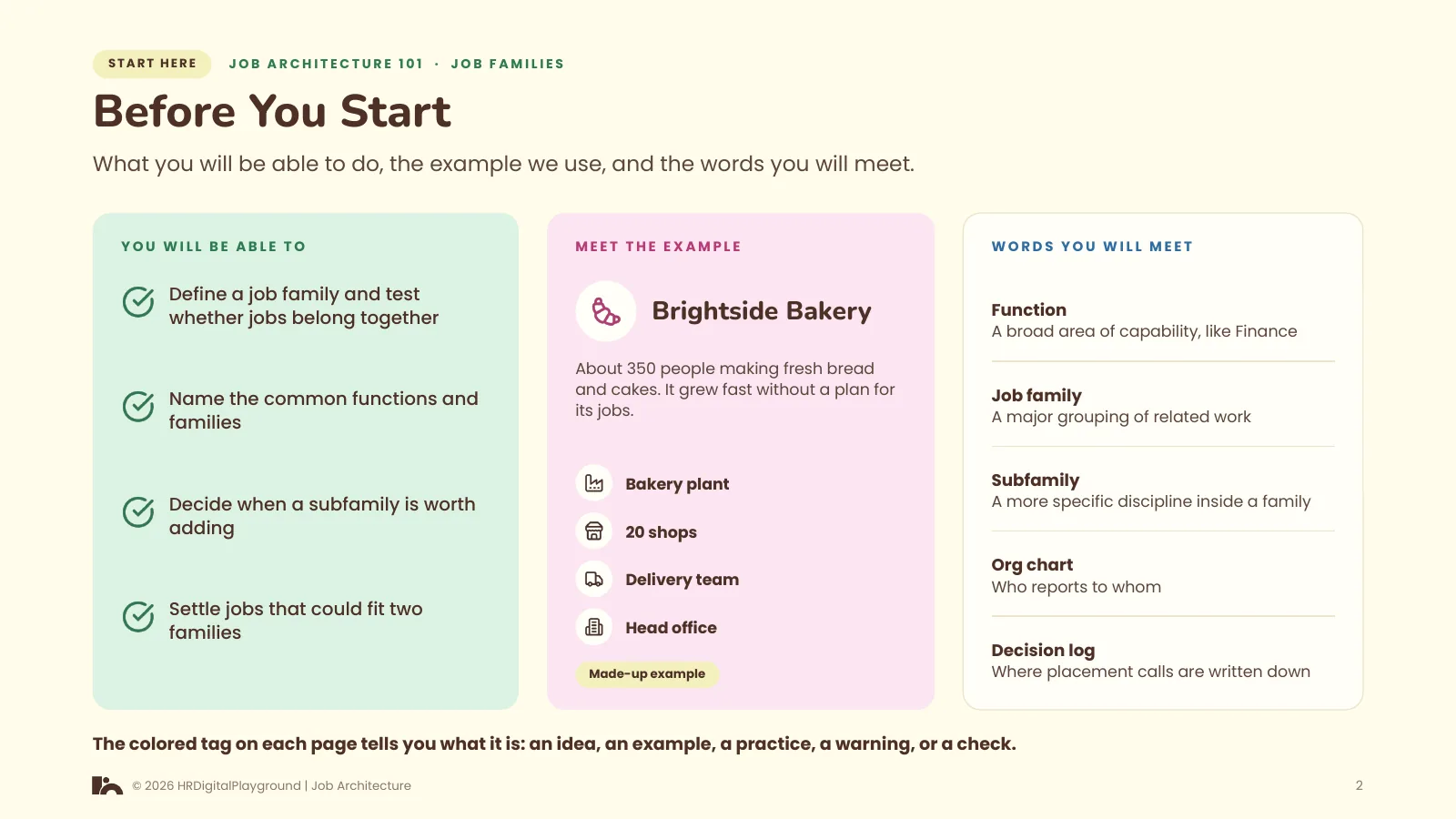
This deck covers job families. It is written for someone with no background in HR, compensation, or organization design, and it follows adult learning principles: why before what, one realistic example throughout, practice with answers, a short quiz, and a one-page recap. The example is Brightside Bakery, a made-up company of about 350 people with a bakery plant, twenty shops, a delivery team, and a head office. It grew fast without a plan for its jobs, so it has far more titles than real jobs and no shared way to compare them. The words on this page are defined again where they first appear.
Page 3 A Family Groups Related Work
Read the explanation
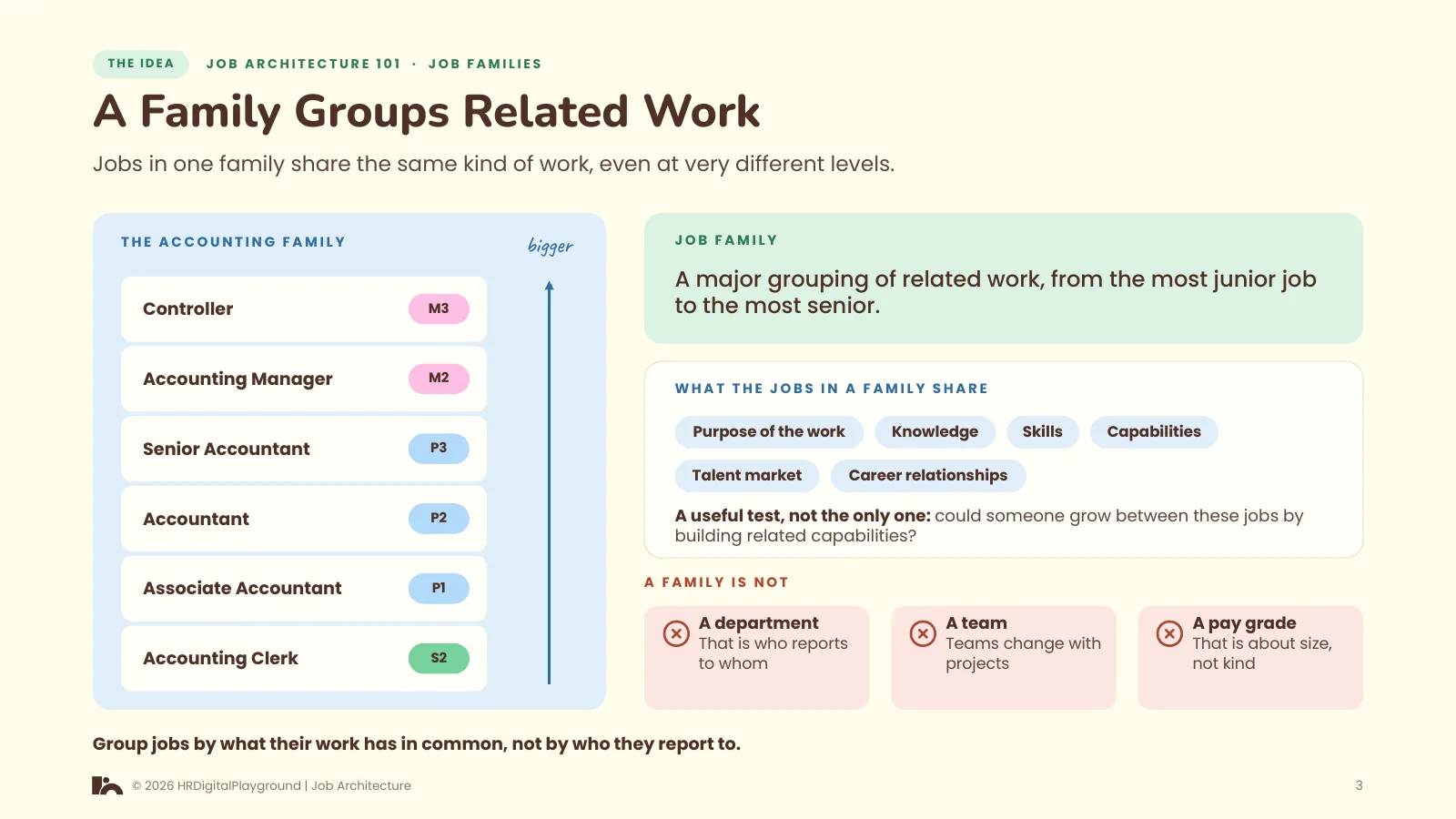
A job family is a major grouping of related work. The jobs in a family normally have meaningful things in common: the purpose of the work, the knowledge it needs, the skills and capabilities people use, the talent market they are hired from and priced against, and the career relationships between them. The Accounting family runs from an Accounting Clerk entering invoices to a Controller who owns the books for the whole company. The jobs differ hugely in size, but they share a purpose, accounting know-how, and a talent market, and someone can grow from one to the next by building related capabilities rather than starting over. That growth question is a useful test, but not the only one. Some families hold jobs that rarely move between each other yet clearly share purpose, knowledge, and market, and those still belong together. Notice that one family can hold jobs on different career tracks: clerks on the Support track, accountants on the Professional track, and supervisors and managers on the Management track. Families are not departments, teams, or pay grades. A department is how people are organized to report. A family is how the work is organized by kind.
Page 4 A Typical Company's Families
Read the explanation
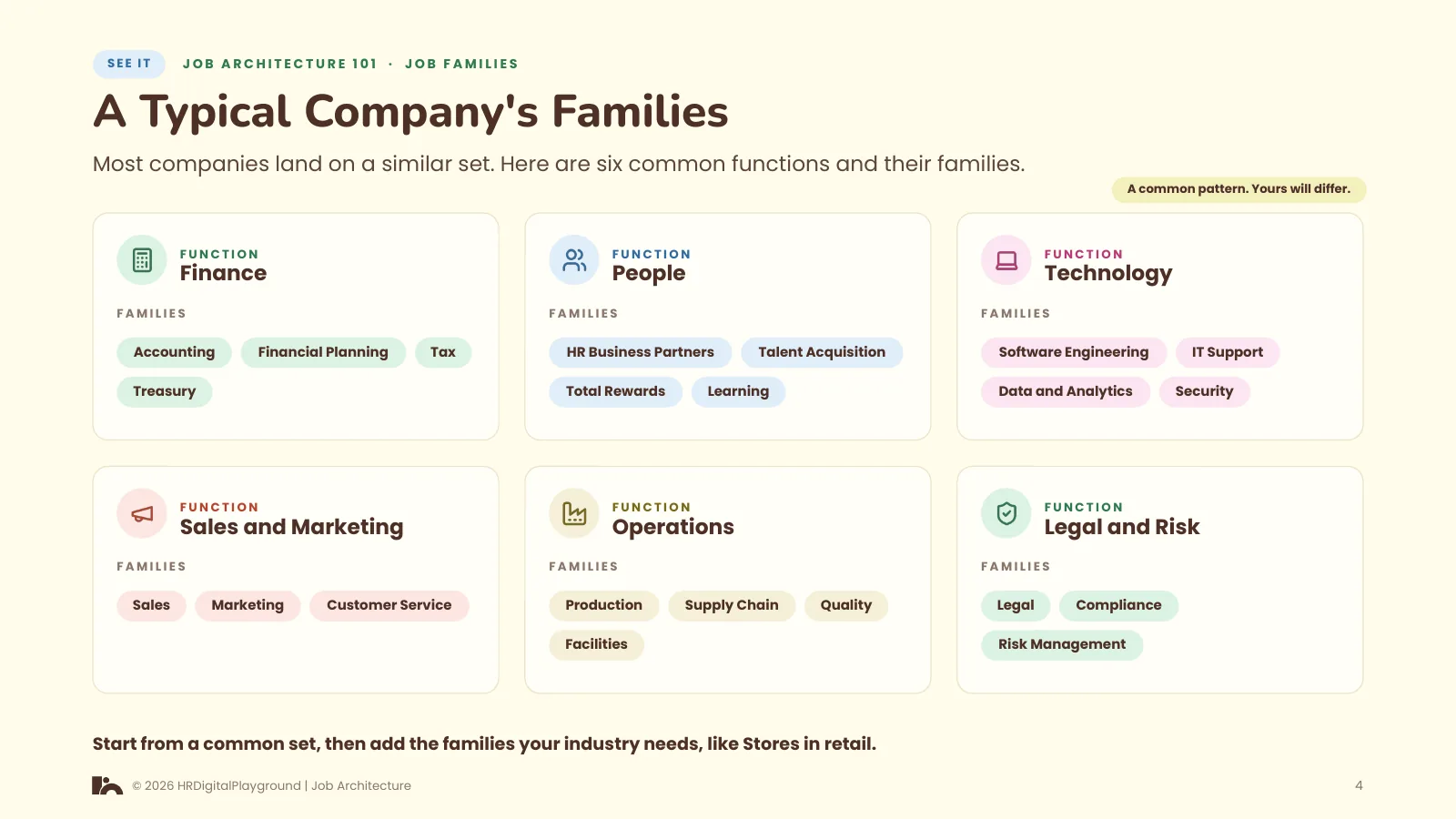
Most companies end up with a similar core set of functions and families, because the same kinds of work exist almost everywhere: keeping the books, hiring and paying people, running technology, selling and marketing, making and moving products, and managing legal risk. This page shows a common pattern, not a rule. Names vary. People may be called Human Resources, Technology may be called IT, and Sales and Marketing may be separate functions. What matters is that each family groups jobs that share know-how. Every industry also adds families of its own. A hospital adds Nursing and Clinical families, a bank adds Lending and Financial Crime, and a retailer like Brightside adds Stores for the jobs in its shops.
Page 5 Follow the Work, Not the Org Chart
Read the explanation
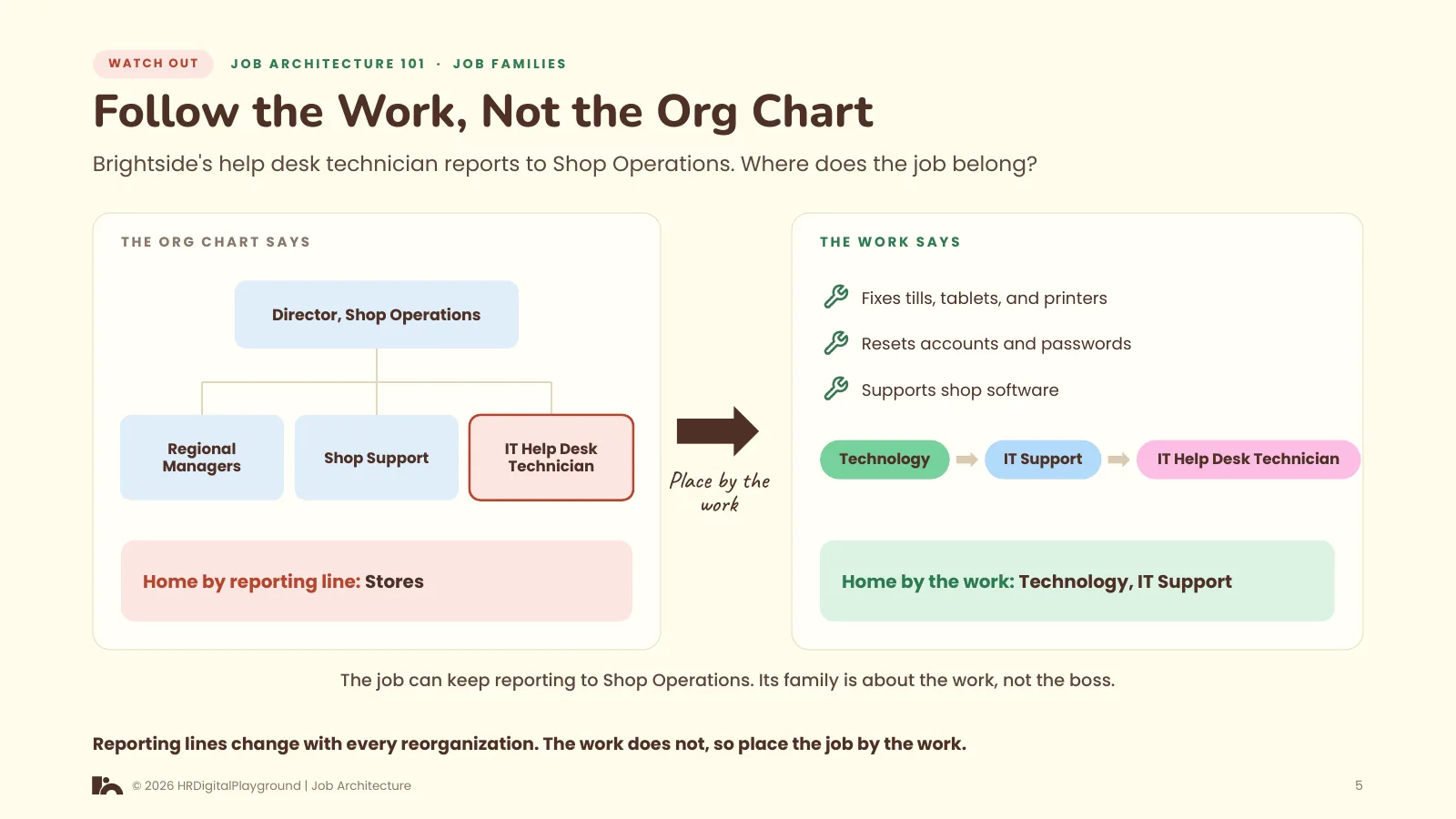
The most common family mistake is copying the org chart. At Brightside, the shops needed quick help with tills and tablets, so the IT Help Desk Technician was hired into Shop Operations and reports to its director. The org chart puts the job in Stores. But the work is fixing hardware, resetting accounts, and supporting software, which is technology know-how. The job is priced against other IT support jobs, recruited from the same talent pool, and its next steps are in IT. So it belongs in the Technology function, IT Support family, while still reporting to Shop Operations. Families and reporting lines are separate on purpose. Companies reorganize often, and if families followed the org chart, every reorganization would scramble job placements, pay comparisons, and career paths.
Page 6 Subfamilies Add Detail
Read the explanation
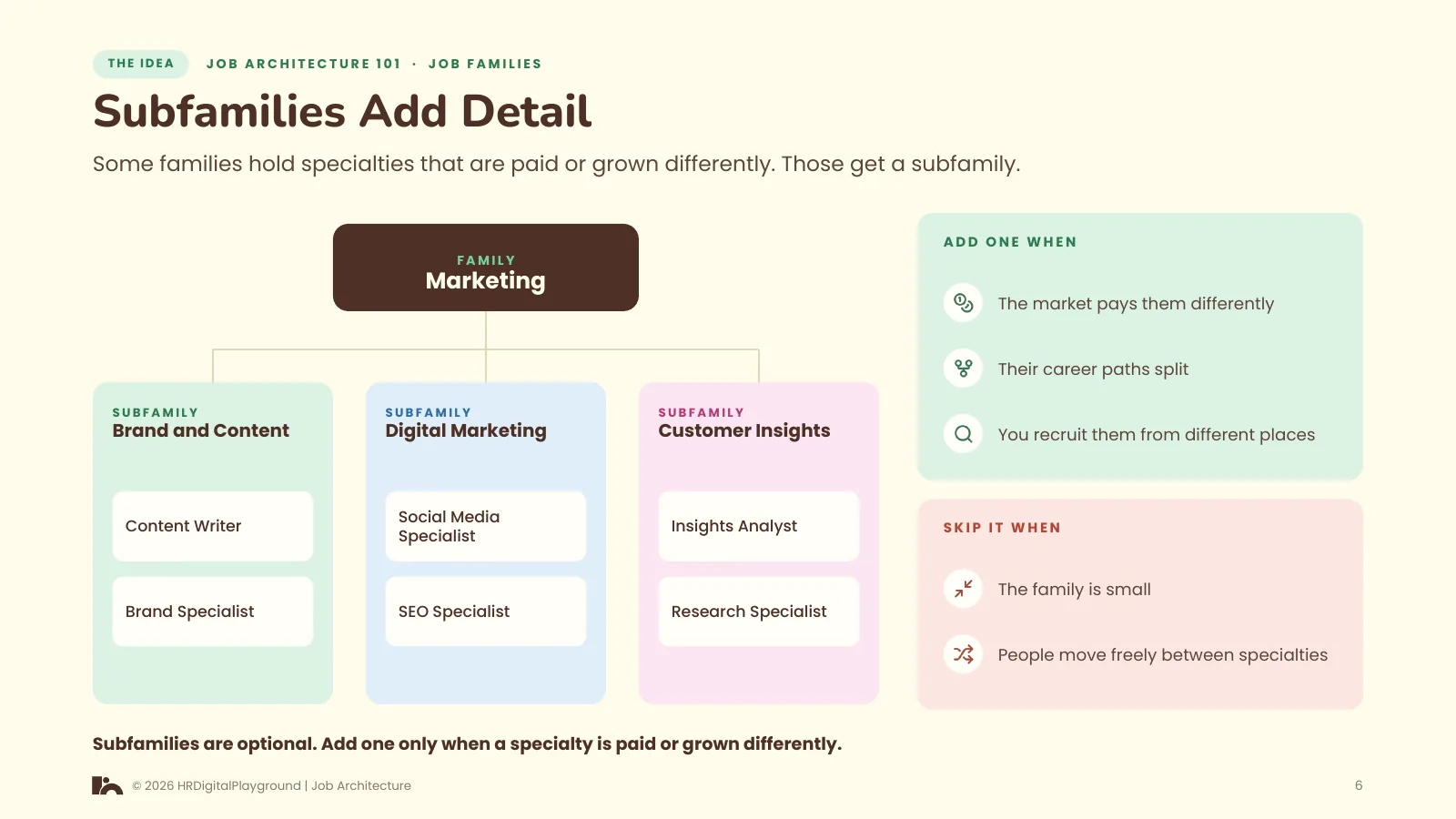
A subfamily is a specialty inside a family. Brightside's Marketing family has three: Brand and Content, Digital Marketing, and Customer Insights. They share marketing know-how, but each needs different skills, hires from a different talent pool, and is priced differently in salary surveys, so separating them makes pay comparisons and career paths more accurate. Subfamilies are optional. Add one when specialists are paid differently in the market, when their career paths split, or when you recruit them from different places. Skip it when the family is small or people move freely between the specialties, because every extra layer is something to maintain. A good rule is to start without subfamilies and add them only where the data shows a real difference.
Page 7 How Many Families Is Right?
Illustrative numbers, fictional company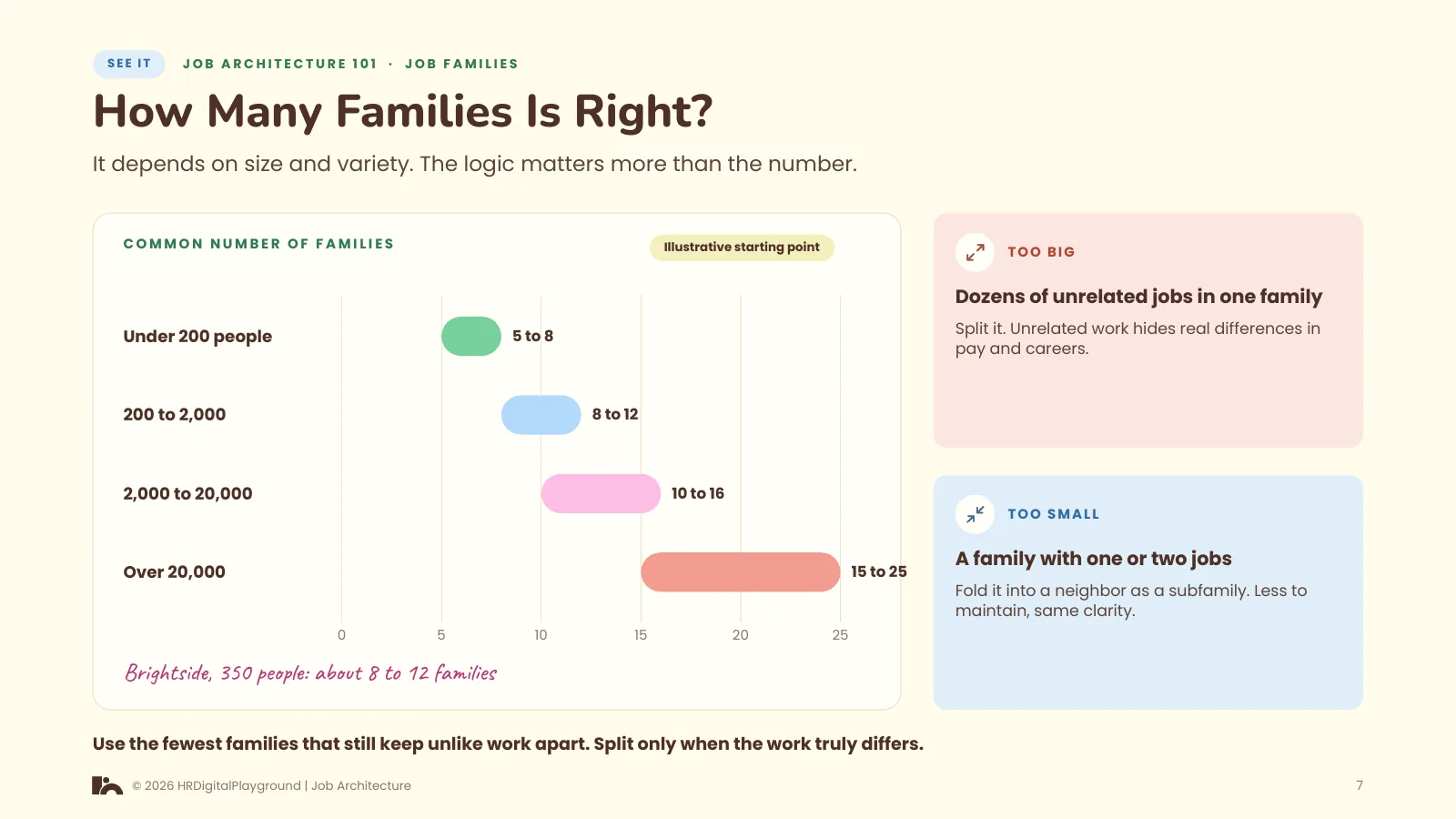
Read the explanation
There is no single right number of families. The ranges on this page are an illustrative starting point, not a universal rule, and a company with unusually varied work can reasonably need more. As a rough guide, companies with fewer than 200 people often use 5 to 8 families. Between 200 and 2,000 people, 8 to 12 is common. Between 2,000 and 20,000 people, 10 to 16. Above 20,000, 15 to 25, often with subfamilies adding detail. Brightside, at about 350 people, lands around 8 to 12. The logic behind the number matters more than the number itself: use the fewest families that still keep genuinely different work apart. Two quick checks keep the count healthy. If one family holds dozens of jobs doing unrelated work, it is probably two or more families. If a family holds only one or two jobs, fold it into a neighbor as a subfamily. Fewer, broader families are easier to maintain and explain, and they make career moves inside a family more likely.
Page 8 Common Family Mistakes
Read the explanation
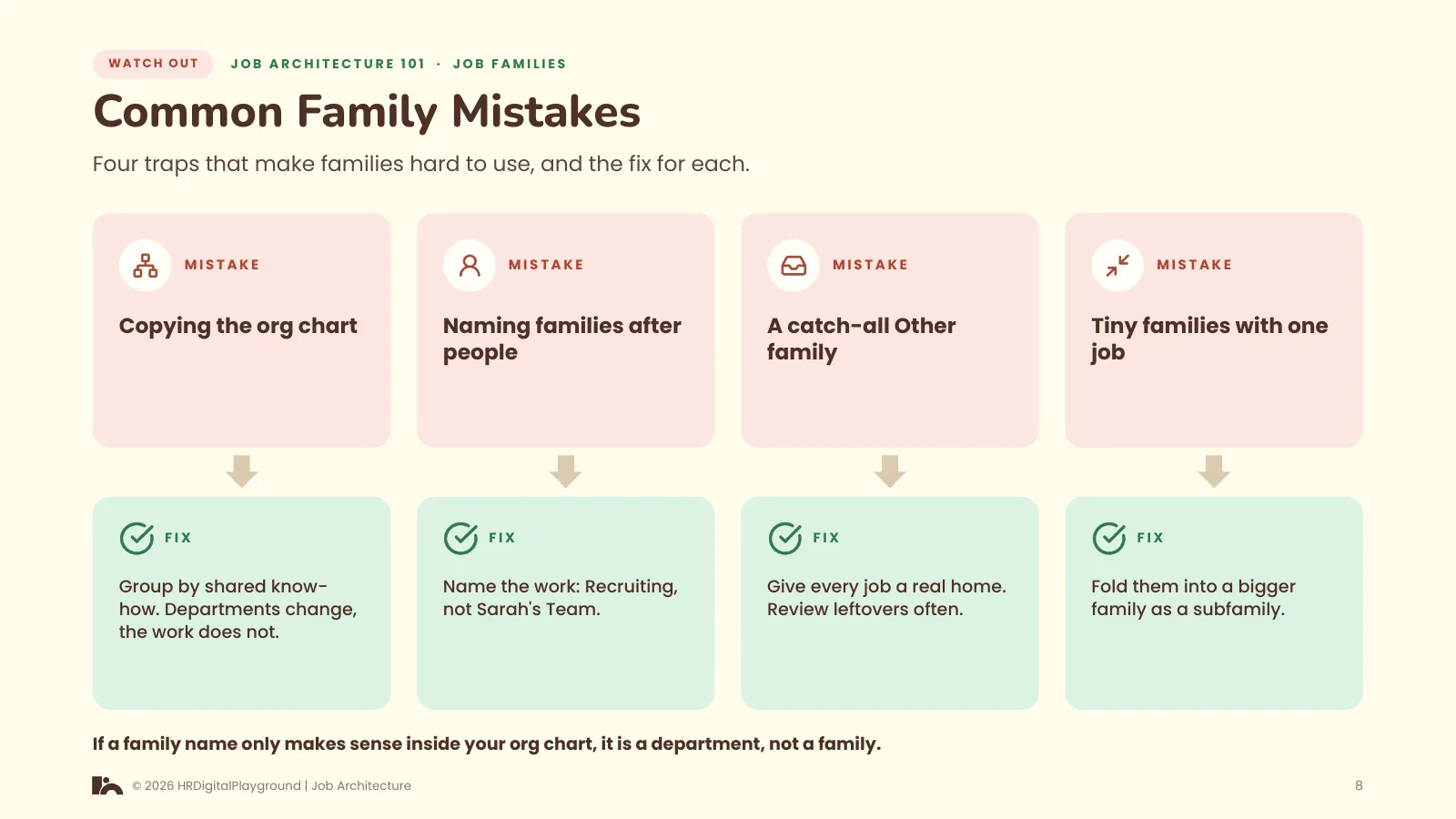
Four mistakes show up again and again. The first is mirroring the org chart, creating one family per department, which breaks every time the company reorganizes. The fix is to group by shared know-how. The second is naming families after people or teams, like Sarah's Team or Project Phoenix, which means nothing to anyone outside and dates quickly. Name the work instead. The third is a catch-all General or Other family, which starts small and grows into a junk drawer that hides jobs nobody placed properly. Give every job a real home and review any leftovers regularly. The fourth is too many tiny families with one job each, which multiplies upkeep and blocks career paths. Fold them into a larger family as subfamilies. Each fix keeps families stable, understandable, and useful for pay and careers.
Page 9 When a Job Could Fit Two Families
Read the explanation
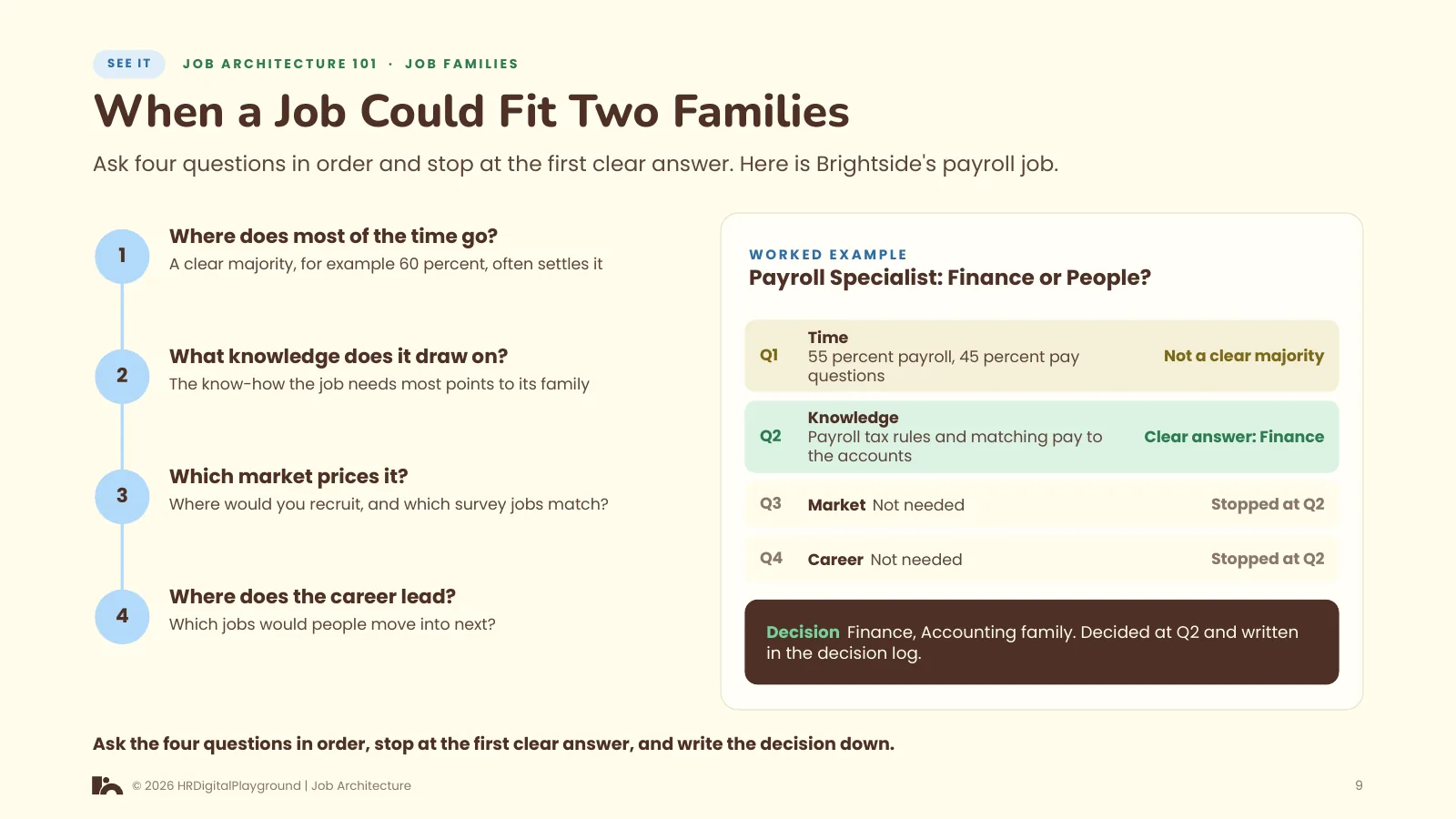
Some jobs sit on a border between two families. Payroll is a classic case: it could live in Finance or in People. Four questions settle these cases, asked in order, stopping at the first clear answer. First, where does most of the time go? A clear majority of time in one kind of work often decides it. Brightside uses 60 percent as its illustrative marker, but the number is a company choice, not a universal rule. Second, what knowledge does the job draw on most? Third, which market prices it: where would you recruit, and which salary survey jobs match it? Fourth, where does the career lead? At Brightside, the Payroll Specialist spends about 55 percent of the time running payroll and taxes and 45 percent answering employee pay questions, so question one is not decisive. Question two is: the job relies on payroll tax rules and reconciling pay to the accounts, which is Finance know-how. Brightside places the job in Finance, in the Accounting family, and records the decision, the deciding question, and who agreed, so nobody re-argues it next year. Both homes are common in practice. What matters is deciding once and writing it down.
Page 10 Find the Family
Read the explanation
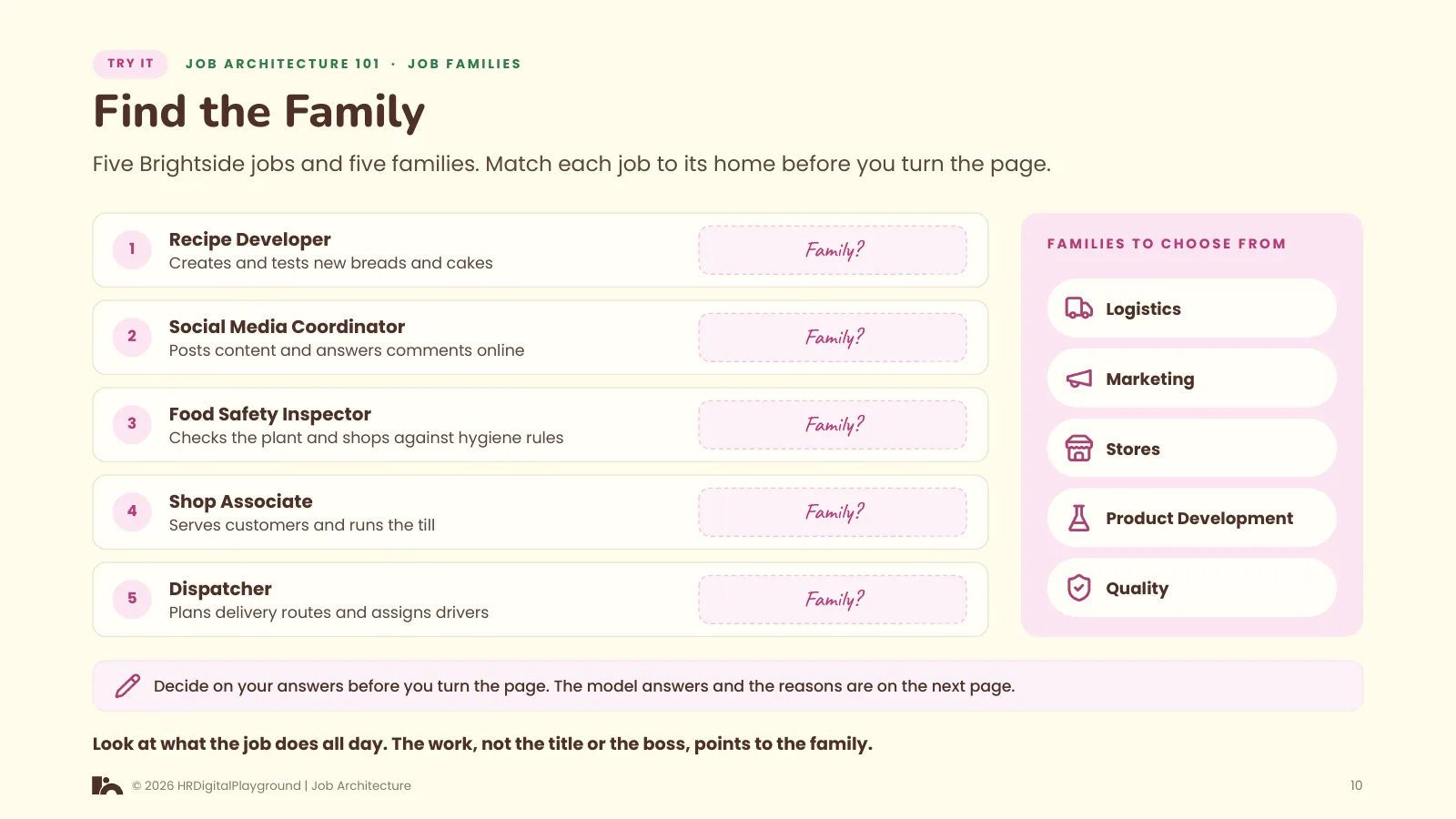
This activity practices placing jobs by the work they do. Read each job's description and pick the family whose purpose and know-how it shares most. Write your answers down before turning the page, where the model answers and the reasons are shown. If any of these feel close, use the four questions in order.
Page 11 Find the Family: Model Answers
Read the explanation
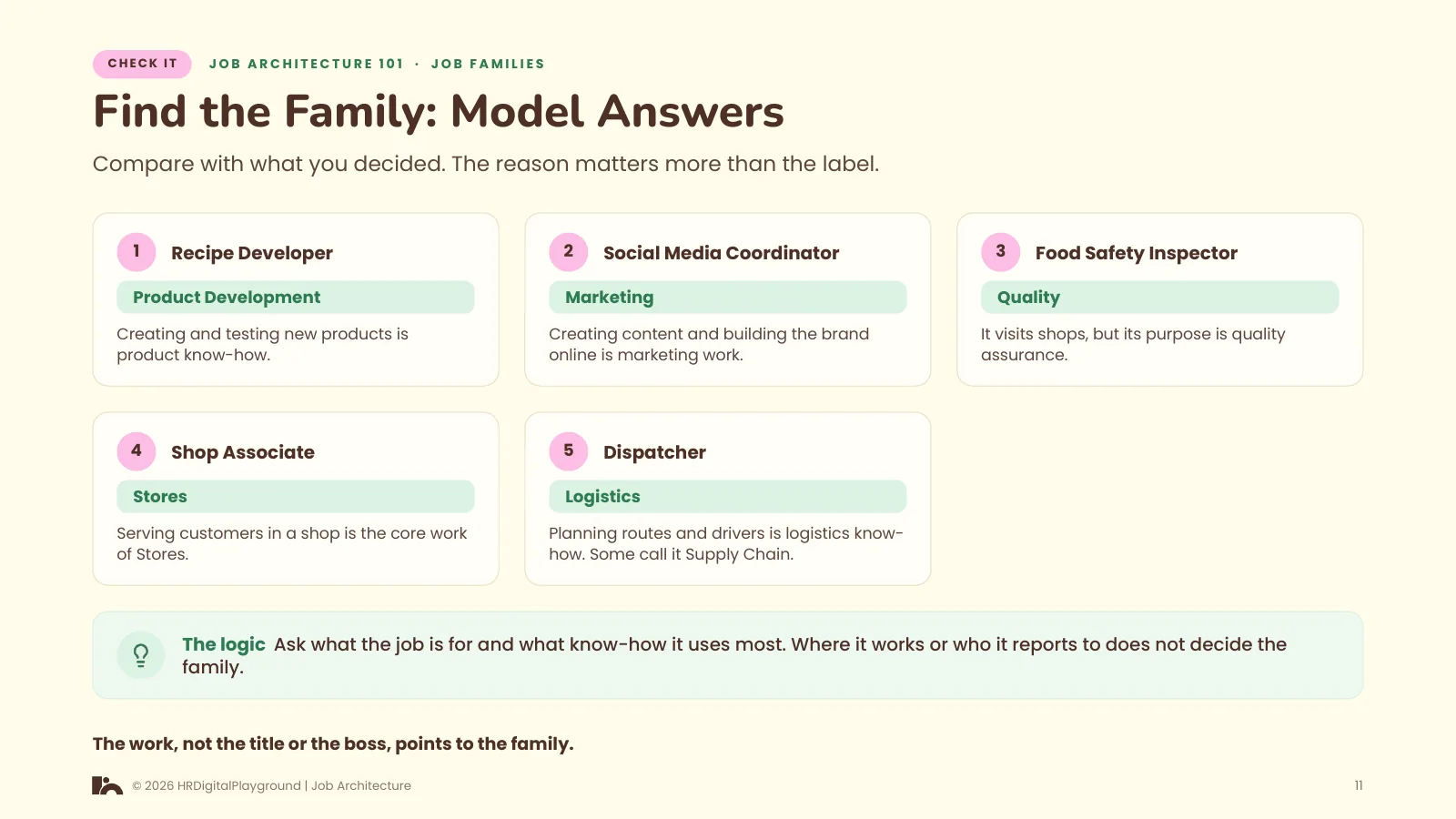
Model answers. The Recipe Developer creates and tests new products, so it belongs in Product Development. The Social Media Coordinator creates and posts content, so it belongs in Marketing. The Food Safety Inspector checks sites against hygiene rules, so it belongs in Quality. It visits the shops, but the purpose and know-how are quality assurance. The Shop Associate serves customers in a shop, so it belongs in Stores. The Dispatcher plans routes and assigns drivers, so it belongs in Logistics, which many companies call Supply Chain.
Page 12 Quick Check
Read the explanation
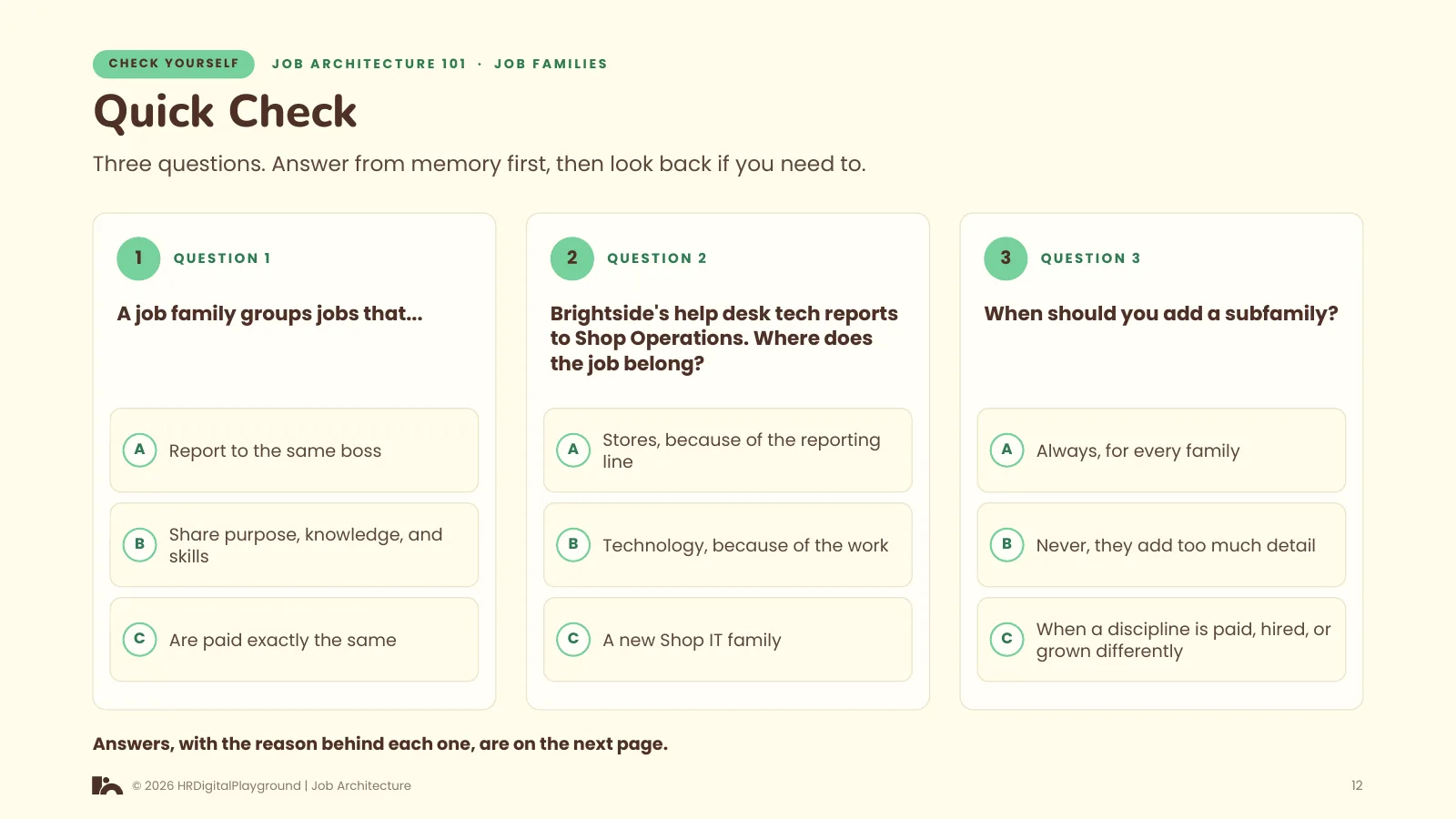
Three questions on families. Question 1 checks the definition: families group related work that shares purpose, knowledge, and skills. Question 2 checks the org chart trap with the help desk example. Question 3 checks when a subfamily is worth adding.
Page 13 Remember
Read the explanation
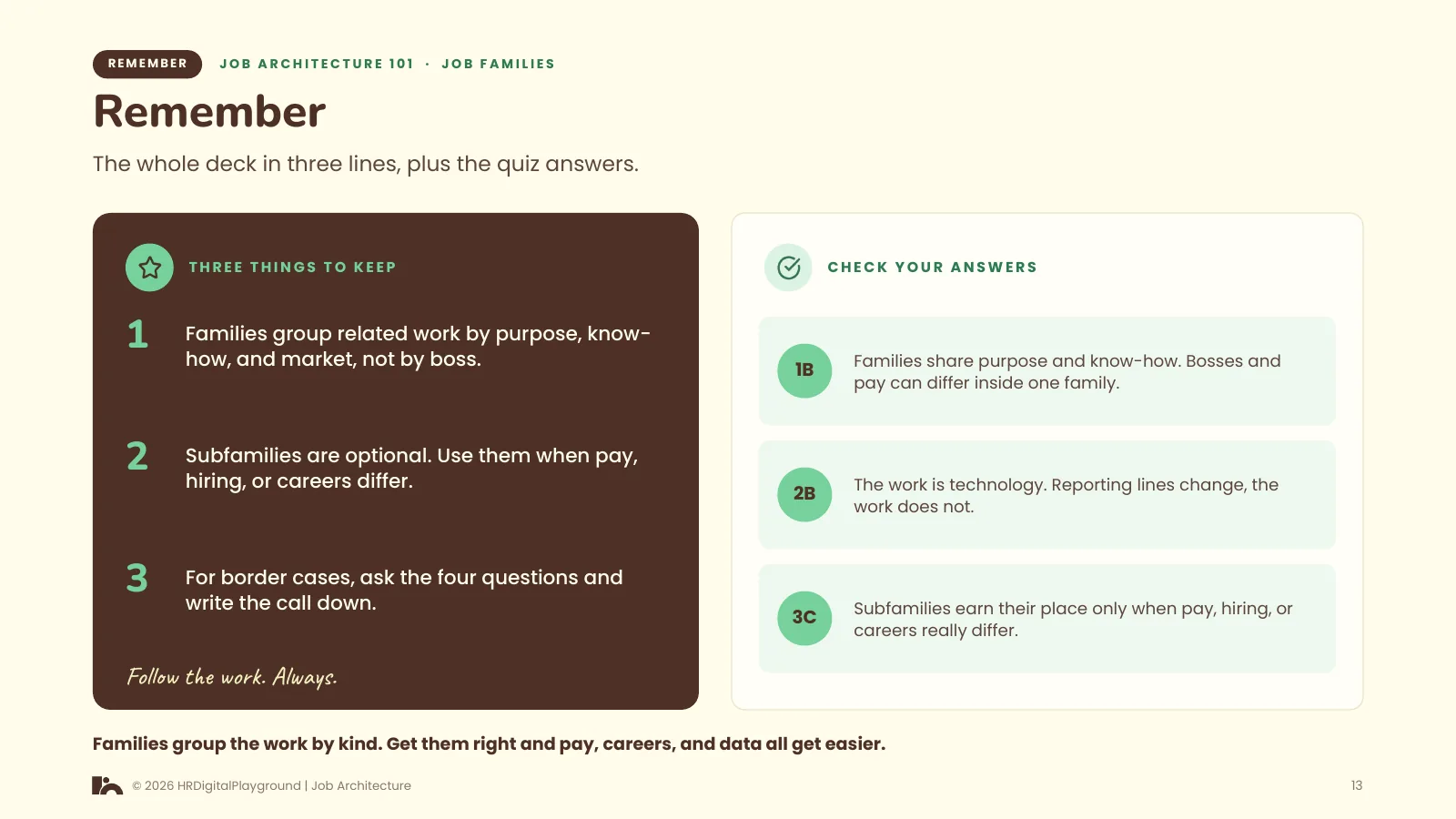
The recap keeps three ideas. Families group related work that shares purpose, knowledge, skills, and a talent market, not reporting lines. Subfamilies are optional detail for disciplines that are paid, hired, or grown differently. When a job could fit two families, ask the four questions in order and write the decision down. Quiz answers: 1 is B, shared purpose, knowledge, and skills. 2 is B, Technology, because families follow the work. 3 is C, add a subfamily only when a discipline is paid, hired, or grown differently.
Page 14 Copyright and Notices
Illustrative numbers, fictional company
Read the explanation
Job Architecture 101: Job Families. Copyright 2026 HRDigitalPlayground | Job Architecture. Published September 2026. Brightside Bakery is a fictional company and all examples are illustrative. The material is general education, not legal, tax, or financial advice.