Course Map
The order, what each deck answers, and the thirty questions
Page 1 Course Map
Read the explanation
This course map is the one place that lists the Job Architecture 101 decks and a suggested order. Every deck stands on its own, so none of them refers to another, and any deck can be read alone when it is needed. Read in order, the thirteen decks move through four stages: understand the ideas and the words, build an architecture, use it every day, and connect it to the rest of HR. The map also shows which deck answers each of thirty common questions, and how every deck is laid out.
Page 2 The Course at a Glance
Read the explanation
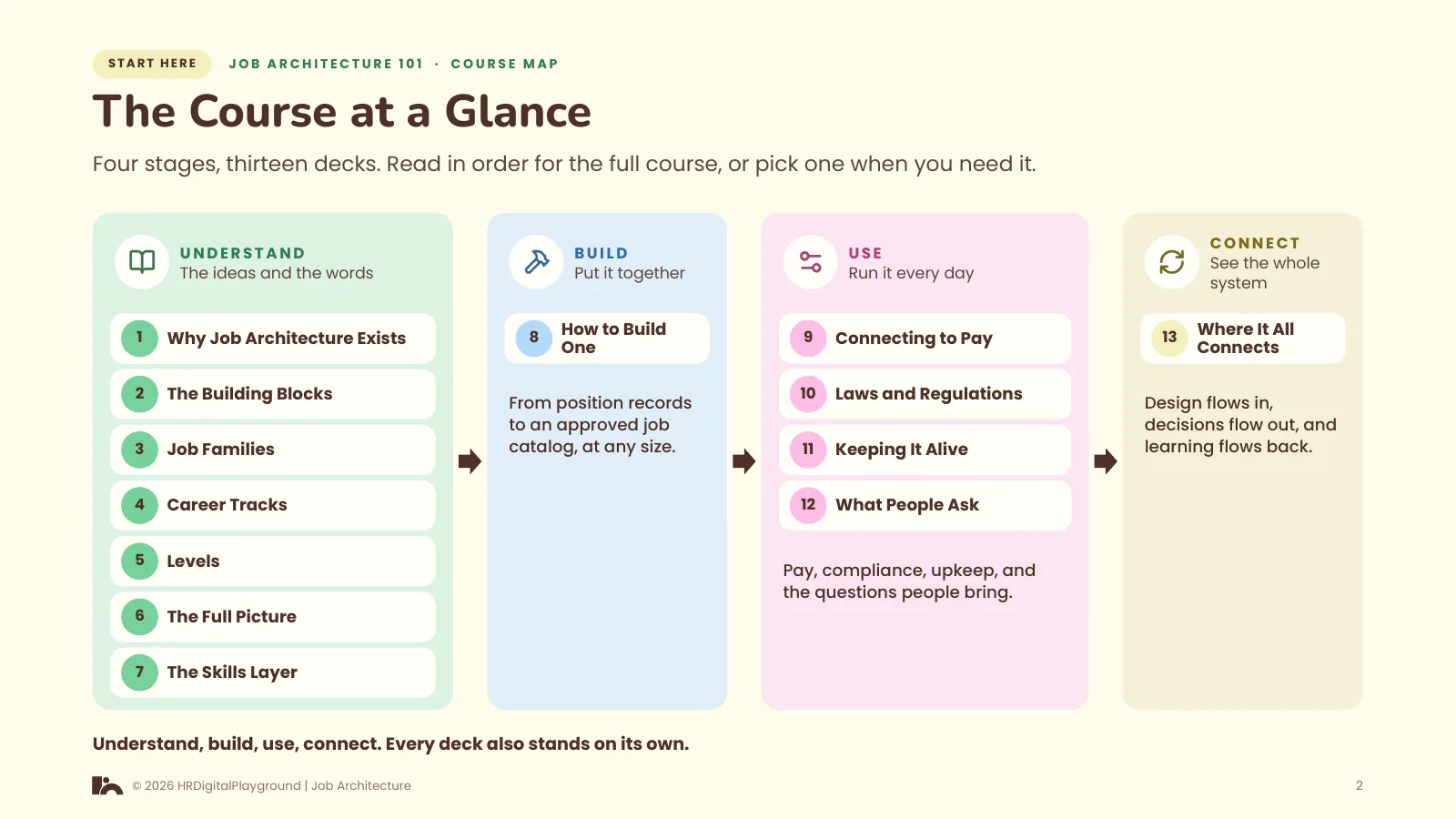
The course moves through four stages. Understand covers the ideas and the words: why job architecture exists, the building blocks from person to position to job, job families, career tracks, levels, the full picture on one grid, and the skills layer. Build covers how to build an architecture, from position records to an approved job catalog, at any size. Use covers running it every day: connecting it to pay, the laws and regulations it supports, keeping it alive after launch, and the questions people ask. Connect shows how job architecture sits at the center of a cycle that runs through strategy, organization design, work design, pay, talent, planning, and change. Each deck stands on its own, with its own example pages, practice, quick check, and recap.
Page 3 What Each Deck Answers
Read the explanation
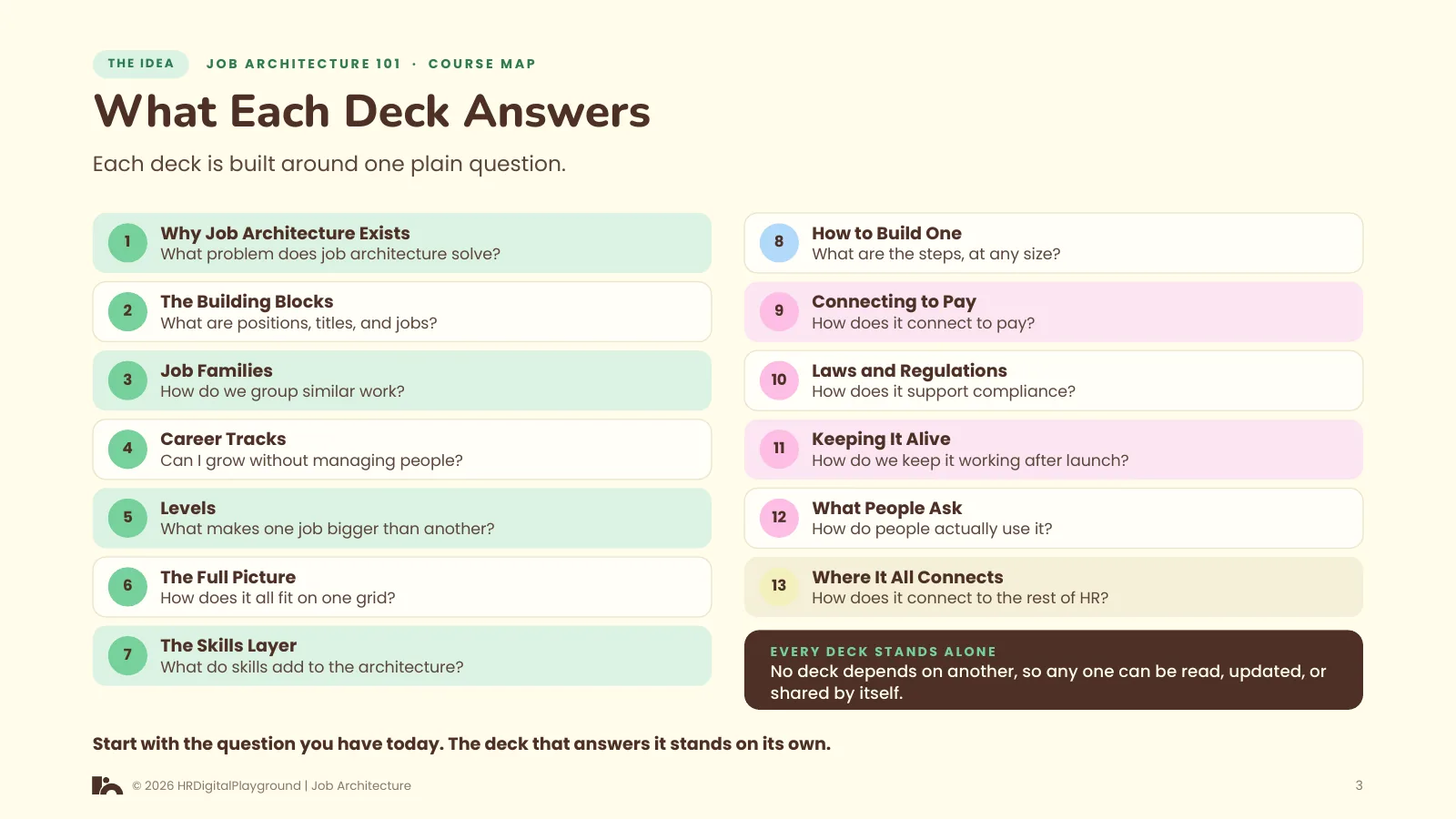
Each deck is built around one plain question, so a learner can start wherever their question is. Why Job Architecture Exists asks what problem it solves. The Building Blocks asks what positions, titles, and jobs are. Job Families asks how to group similar work. Career Tracks asks whether people can grow without managing others. Levels asks what makes one job bigger than another. The Full Picture puts it on one grid. The Skills Layer asks what skills add. How to Build One covers the steps at any size. Connecting to Pay, Laws and Regulations, Keeping It Alive, and What People Ask cover everyday use. Where It All Connects shows how it links to the rest of HR.
Page 4 Thirty Questions, Answered: 1 to 15
Read the explanation
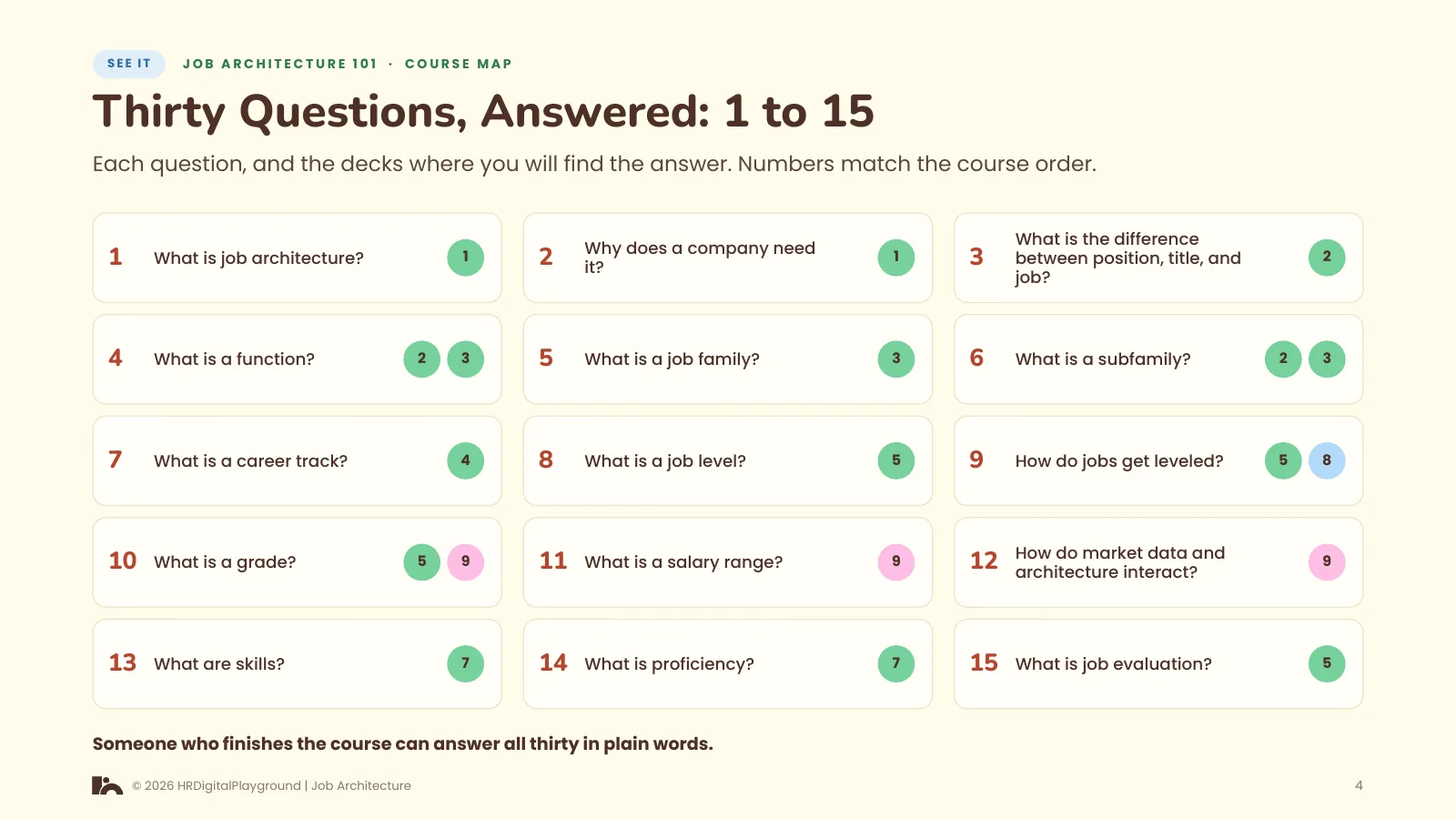
This page lists common job architecture questions and the decks where each is answered, using the numbers from the course order. Question 1, What is job architecture, is answered in Why Job Architecture Exists. Question 2, Why does a company need it, is answered in Why Job Architecture Exists. Question 3, What is the difference between position, title, and job, is answered in The Building Blocks. Question 4, What is a function, is answered in The Building Blocks and Job Families. Question 5, What is a job family, is answered in Job Families. Question 6, What is a subfamily, is answered in The Building Blocks and Job Families. Question 7, What is a career track, is answered in Career Tracks. Question 8, What is a job level, is answered in Levels. Question 9, How do jobs get leveled, is answered in Levels and How to Build One. Question 10, What is a grade, is answered in Levels and Connecting to Pay. Question 11, What is a salary range, is answered in Connecting to Pay. Question 12, How do market data and architecture interact, is answered in Connecting to Pay. Question 13, What are skills, is answered in The Skills Layer. Question 14, What is proficiency, is answered in The Skills Layer. Question 15, What is job evaluation, is answered in Levels.
Page 5 Thirty Questions, Answered: 16 to 30
Read the explanation
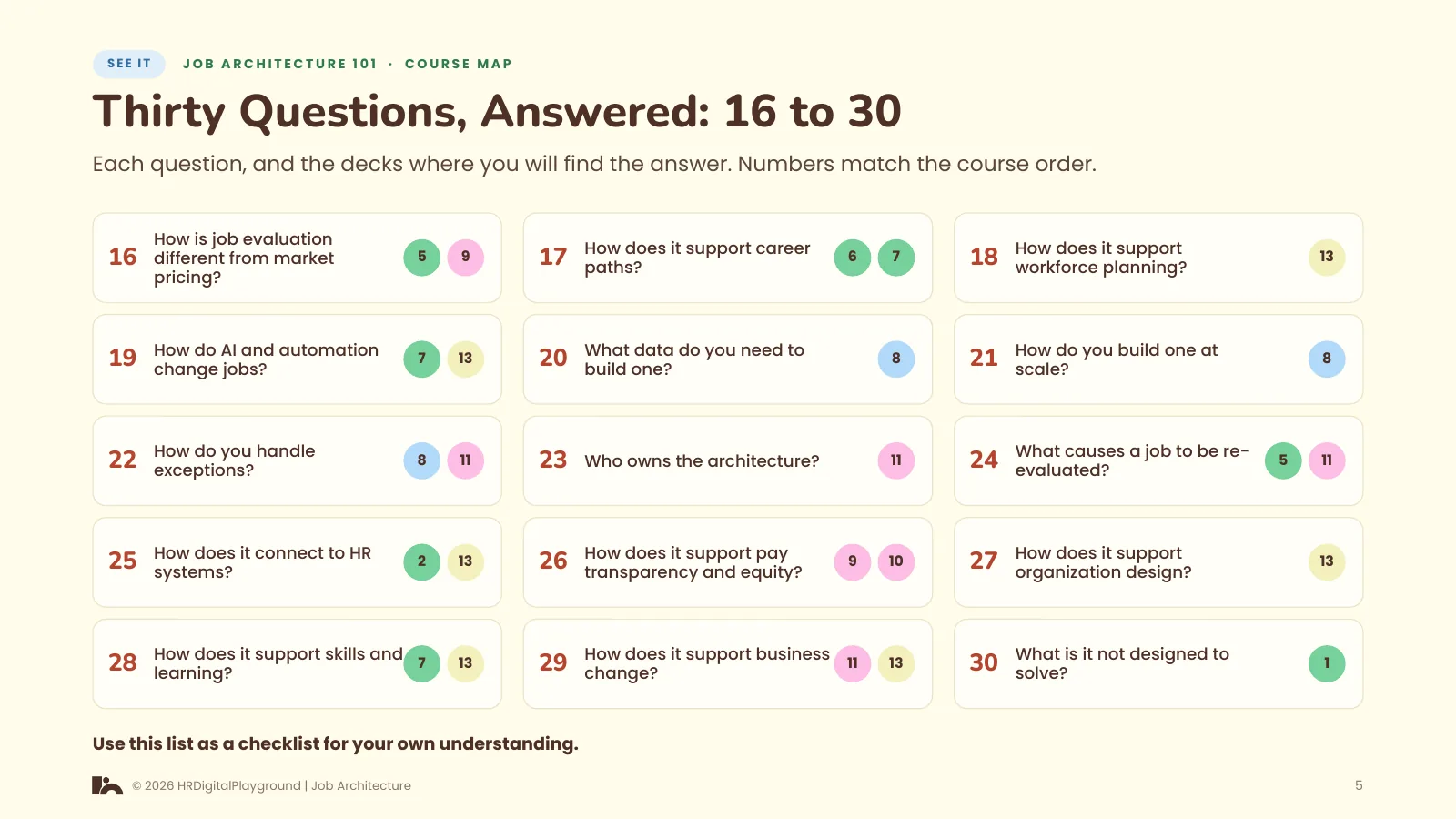
This page lists common job architecture questions and the decks where each is answered, using the numbers from the course order. Question 16, How is job evaluation different from market pricing, is answered in Levels and Connecting to Pay. Question 17, How does it support career paths, is answered in The Full Picture and The Skills Layer. Question 18, How does it support workforce planning, is answered in Where It All Connects. Question 19, How do AI and automation change jobs, is answered in The Skills Layer and Where It All Connects. Question 20, What data do you need to build one, is answered in How to Build One. Question 21, How do you build one at scale, is answered in How to Build One. Question 22, How do you handle exceptions, is answered in How to Build One and Keeping It Alive. Question 23, Who owns the architecture, is answered in Keeping It Alive. Question 24, What causes a job to be re-evaluated, is answered in Levels and Keeping It Alive. Question 25, How does it connect to HR systems, is answered in The Building Blocks and Where It All Connects. Question 26, How does it support pay transparency and equity, is answered in Connecting to Pay and Laws and Regulations. Question 27, How does it support organization design, is answered in Where It All Connects. Question 28, How does it support skills and learning, is answered in The Skills Layer and Where It All Connects. Question 29, How does it support business change, is answered in Keeping It Alive and Where It All Connects. Question 30, What is it not designed to solve, is answered in Why Job Architecture Exists.
Page 6 How Every Deck Works
Read the explanation
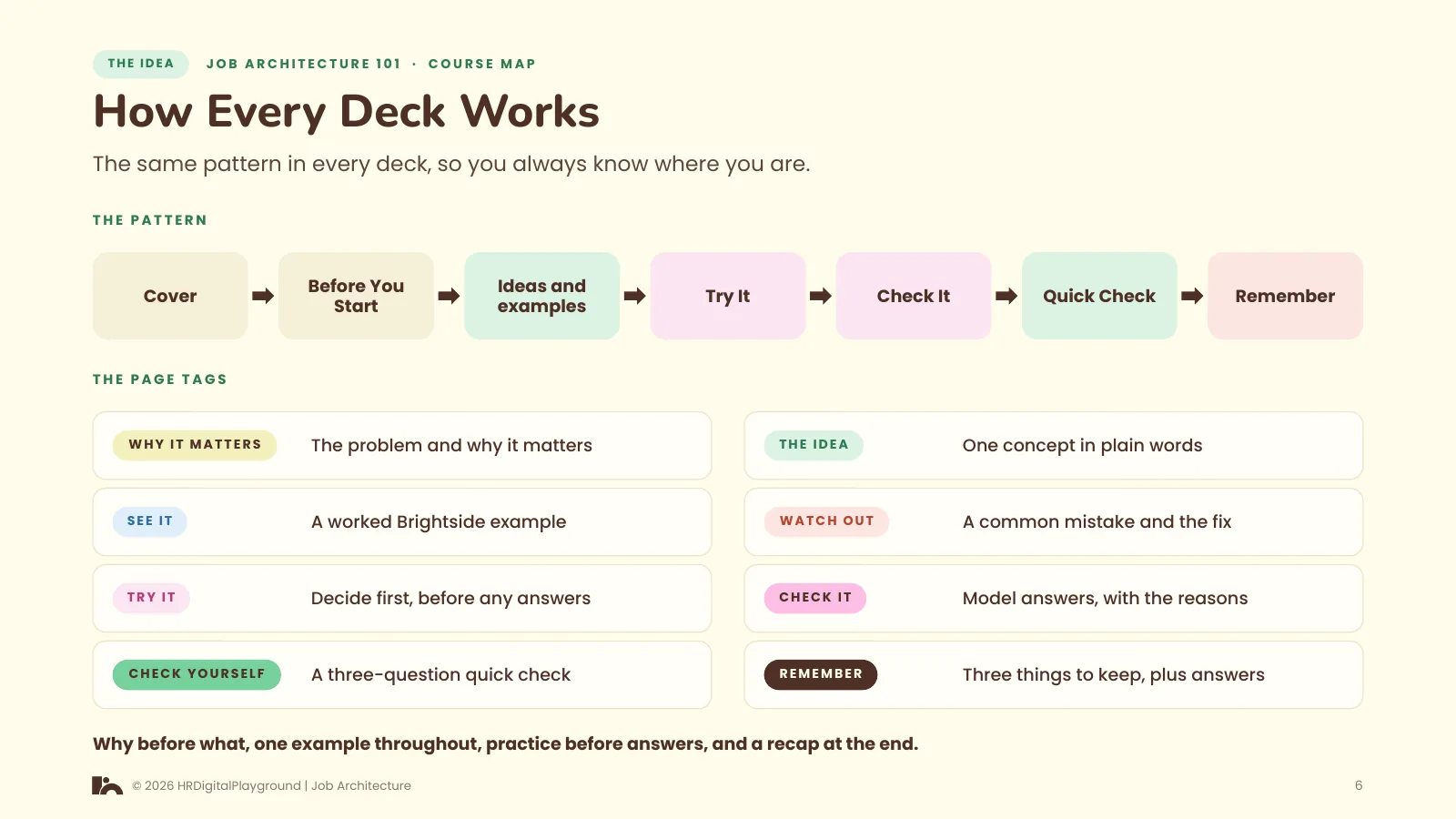
Every deck follows the same adult learning pattern. It opens with a cover and a Before You Start page that lists what you will be able to do, introduces the Brightside Bakery example, and defines the words you will meet. Content pages carry a colored tag that says what kind of page it is: Why It Matters, The Idea, See It, or Watch Out. Practice pages come in pairs: a Try It page asks you to decide first, and a Check It page on the next page gives the model answers and the reasons. Each deck ends with a Quick Check of three questions and a Remember page with three things to keep and the quiz answers. Brightside Bakery is fictional, and its numbers are illustrative.
Page 7 Copyright and Notices
Illustrative numbers, fictional company
Read the explanation
Job Architecture 101: Course Map. Copyright 2026 HRDigitalPlayground | Job Architecture. Published September 2026. Brightside Bakery is a fictional company and all examples are illustrative. The material is general education, not legal, tax, or financial advice.