Connecting to Pay
How does it connect to pay?

Page 1 Connecting to Pay
Read the explanation
This deck answers: how does job architecture connect to pay? Every pay decision, from what to offer a candidate to whether two people are paid fairly, depends on knowing which job someone does and how big it is. The deck separates the three questions of internal job size, external market pay, and pay design, then shows how jobs are matched to salary surveys, how market data becomes a salary structure, the common ways levels connect to pay, what the parts of a pay range mean, what can decide pay within a range, how posted ranges and pay equity checks use the architecture, and how levels drive bonuses, raises, and promotions. It ends with a pricing activity, three quick questions, and a recap.
Page 2 Before You Start
Read the explanation
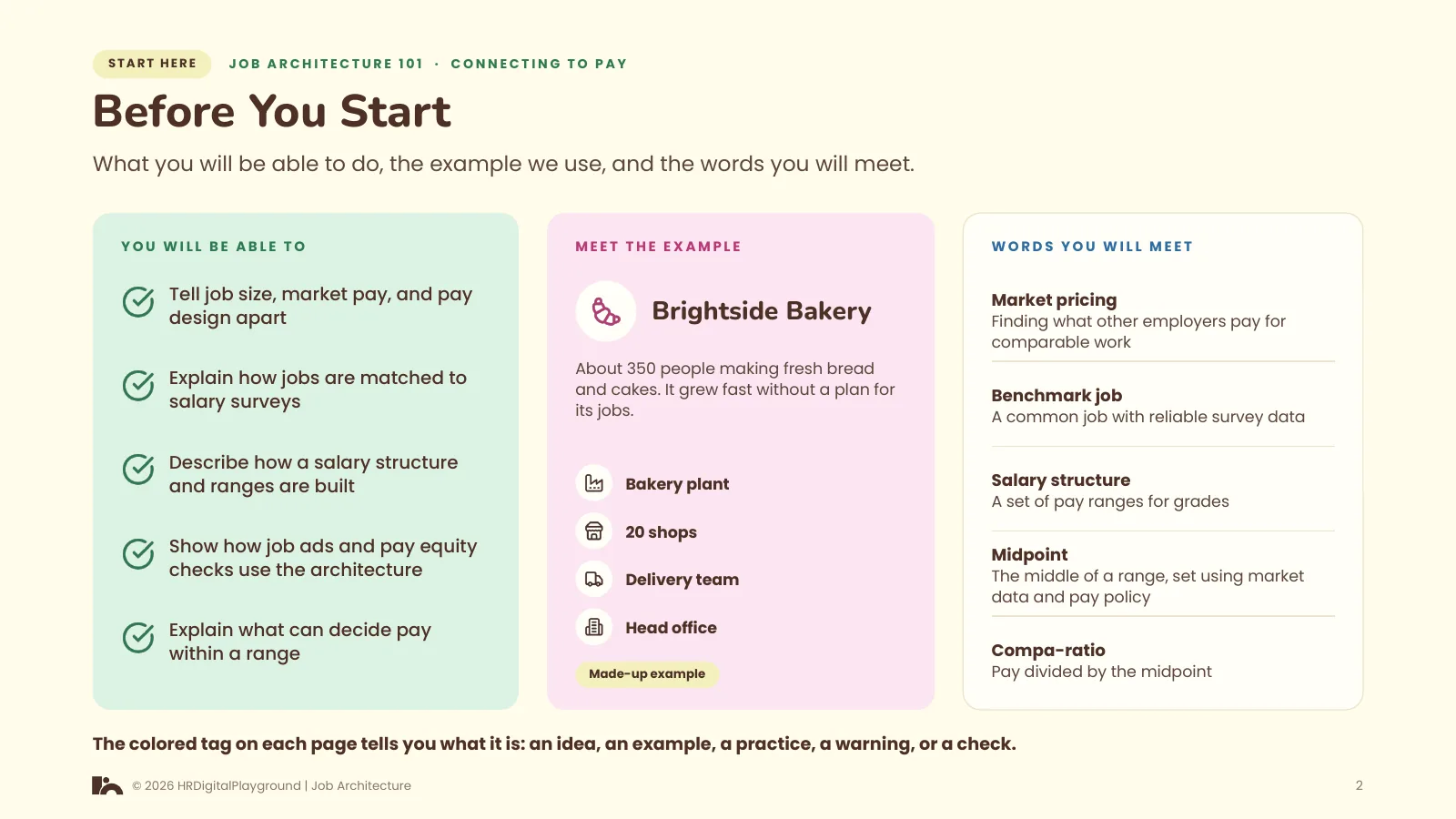
This deck covers connecting to pay. It is written for someone with no background in HR, compensation, or organization design, and it follows adult learning principles: why before what, one realistic example throughout, practice with answers, a short quiz, and a one-page recap. The example is Brightside Bakery, a made-up company of about 350 people with a bakery plant, twenty shops, a delivery team, and a head office. It grew fast without a plan for its jobs, so it has far more titles than real jobs and no shared way to compare them. The words on this page are defined again where they first appear.
Page 3 Pay Needs a Map
Read the explanation
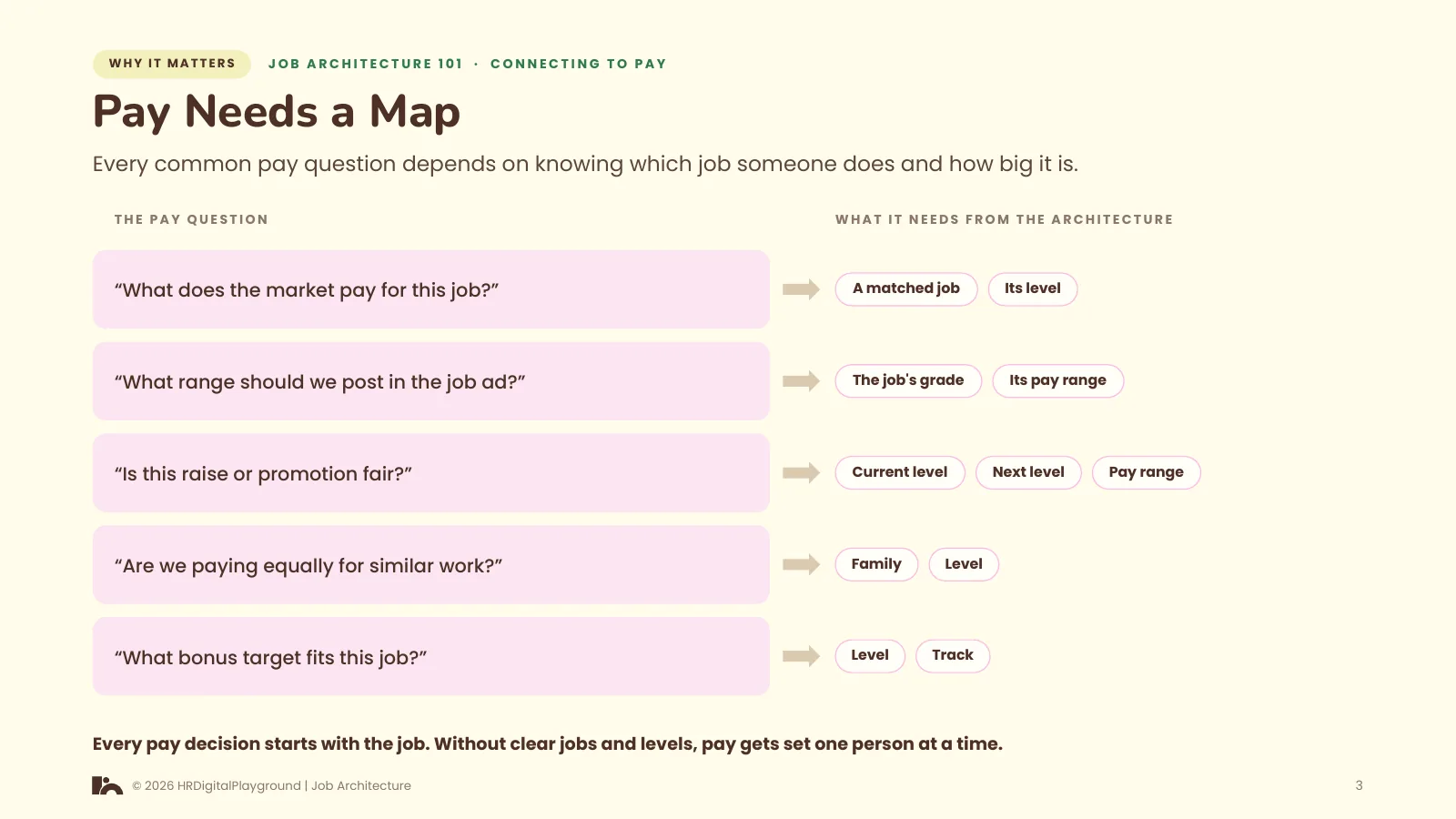
Pay questions sound like money questions, but each one is really a job question first. To know what the market pays for a job, you need a clearly defined job at a known level to compare with salary surveys. To post a range in a job ad, you need the job's grade and the range attached to it. To judge whether a raise or promotion is fair, you need the level of the current job and the next one. To check that people doing similar work are paid equally, you need jobs grouped by family and level so like is compared with like. To set a bonus target, you need the job's level and track. When a company has no job architecture, each of these questions gets answered case by case, which is slow, inconsistent, and hard to defend.
Page 4 Three Different Questions
Illustrative numbers, fictional company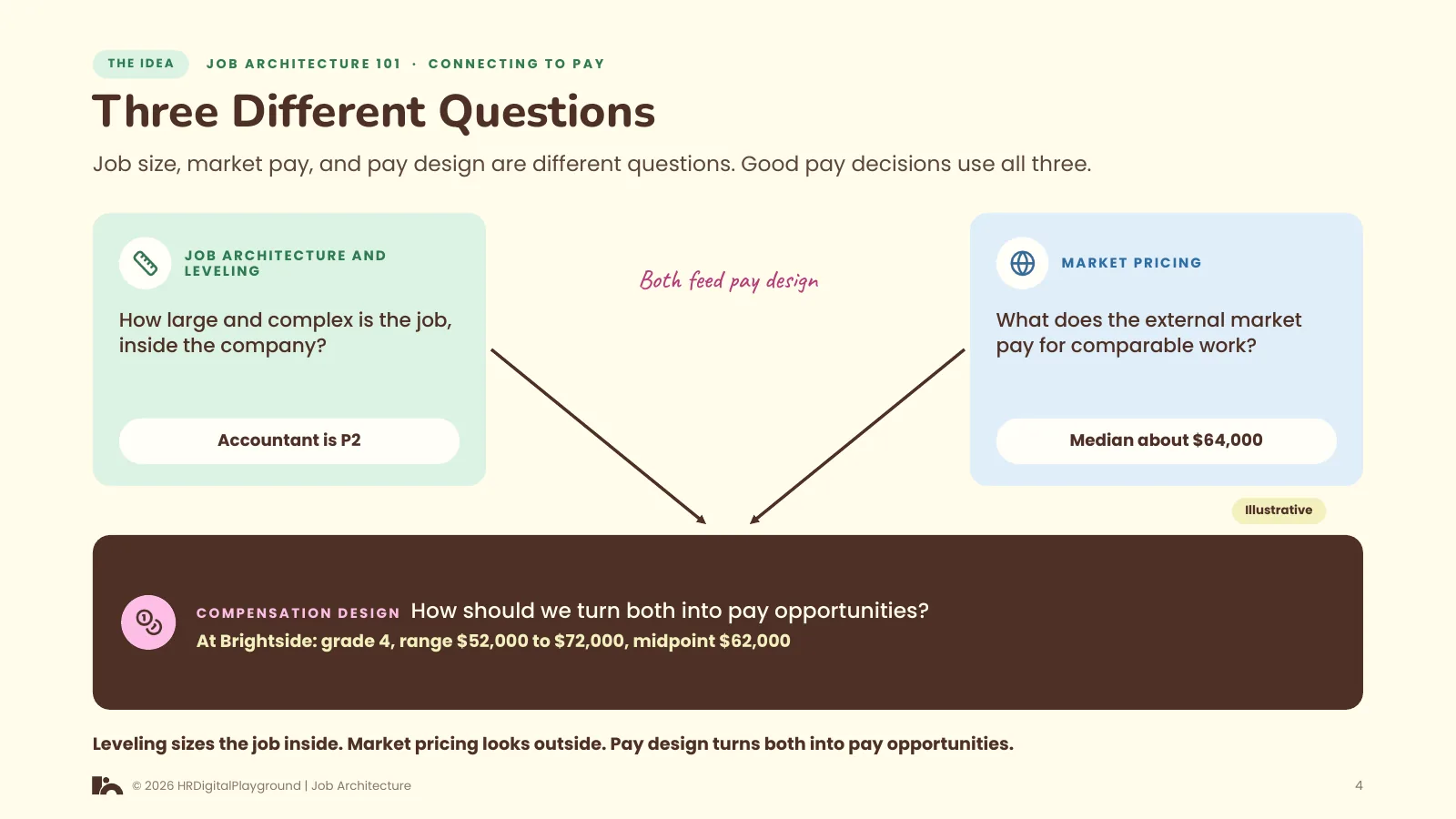
Read the explanation
Three questions sit behind every pay structure, and they are easy to mix up. Job architecture and leveling answer an internal question: how large and complex is this job compared with other jobs here? Market pricing answers an external question: what does the labor market pay for comparable work? Compensation design answers the translation question: how should the organization turn both into pay opportunities, given its pay philosophy, budget, and the law? At Brightside, the Accountant job is sized internally at P2. Market data for comparable work shows a median of about $64,000. Brightside's pay design, which aims at the market median for most jobs, turns that into grade 4 with a range of $52,000 to $72,000 and a midpoint of $62,000. None of the three answers replaces the others. A job can be big internally and cheap in the market, or small internally and scarce in the market, and pay design is where those tensions get resolved. The figures are illustrative.
Page 5 Matching Jobs to Salary Surveys
Illustrative numbers, fictional company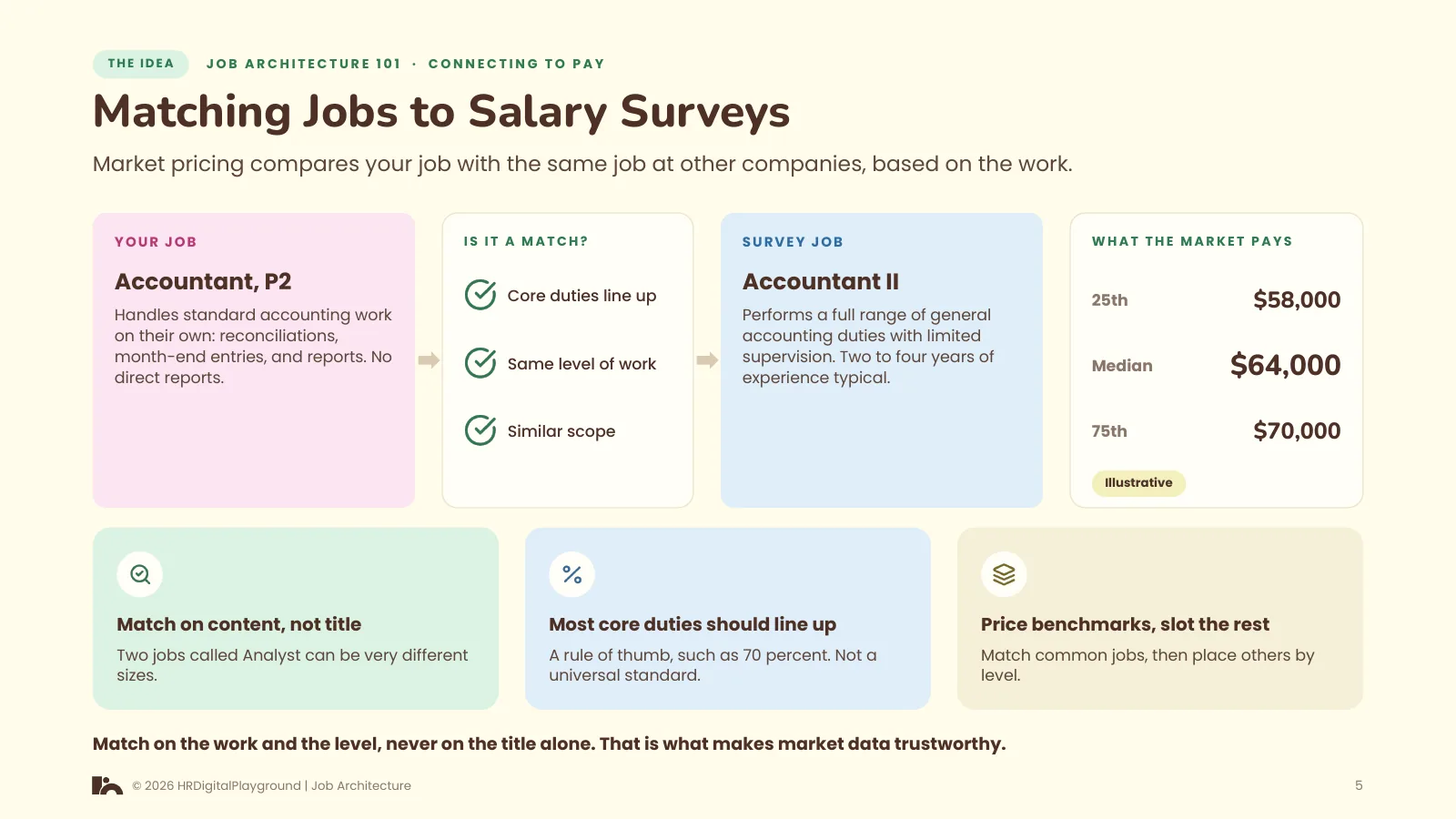
Read the explanation
Salary surveys collect pay data from many companies for a list of standard jobs, each with a short description and a level. Market pricing means finding the survey job that matches yours and reading what the market pays for it. The match is based on the work, not the title. Compare the survey description with your job's main duties, its level, and its scope, such as team size or budget. A common rule of thumb is that most of the core duties, for example around 70 percent, should line up before you call it a match. That is a practitioner habit, not a universal standard. The survey then reports pay at several points: the 25th percentile, where a quarter of companies pay less, the median or 50th percentile, and the 75th percentile. You do not need to price every job. Companies price their benchmark jobs, common jobs with good survey matches, and then place the remaining jobs by comparing their level with the benchmarks, which is called slotting. Survey data comes from vendors or industry groups, and the job architecture is what lets you use it well.
Page 6 From Market Data to a Salary Structure
Illustrative numbers, fictional company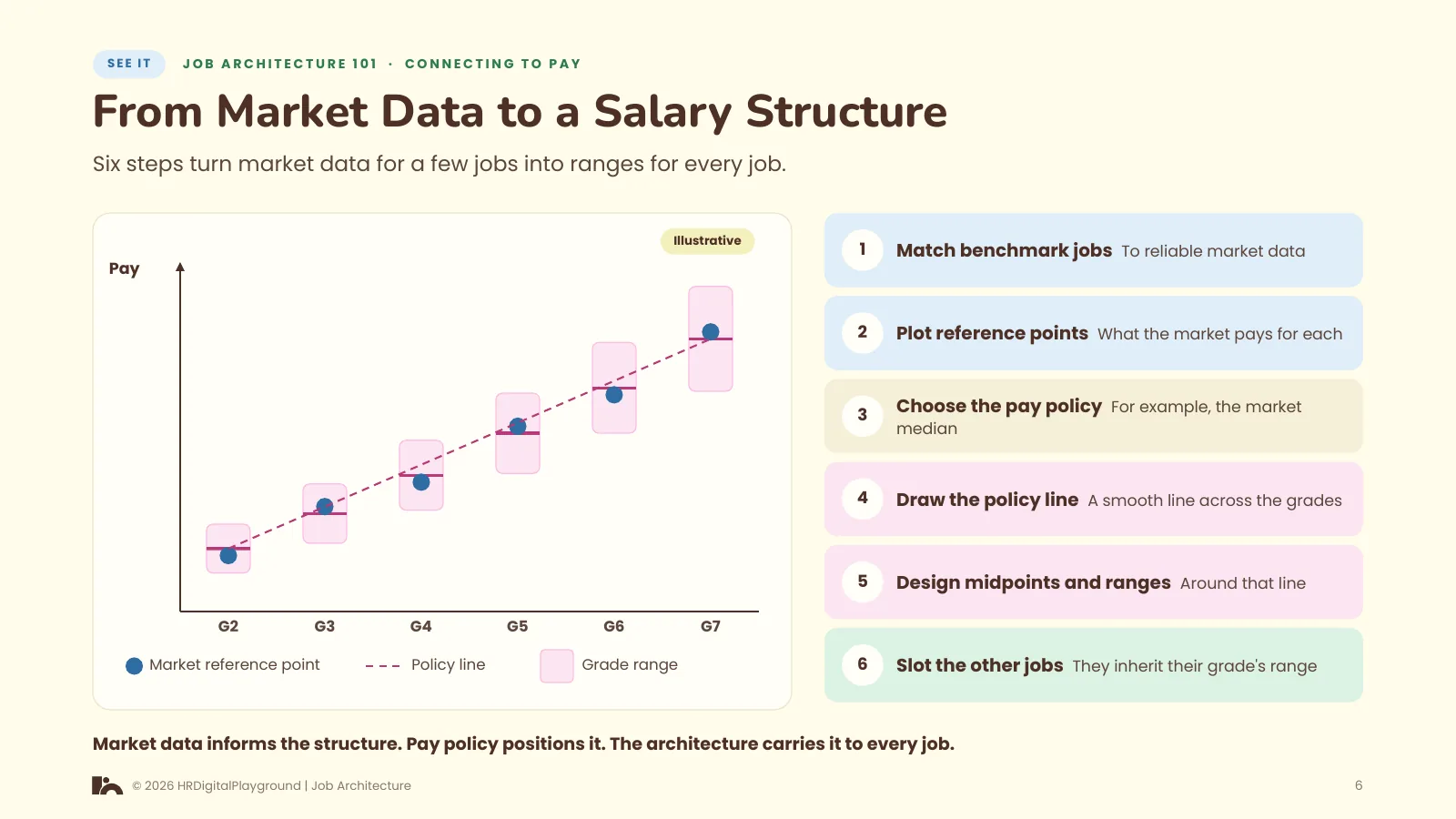
Read the explanation
A salary structure is a set of pay ranges for grades, and it is built in six steps. First, benchmark jobs are matched to reliable market data. Second, those market observations become reference points, placed on a chart at each benchmark job's grade. Third, the organization chooses its market position, its pay policy, for example the market median for most jobs, or above it where talent is scarce. Fourth, the reference points and the policy together create a market reference line, often called a policy line, a smooth line across the grades. Fifth, grade midpoints and ranges are designed around that line. Midpoints often rise by a steady percentage from grade to grade, for example 10 to 20 percent, which keeps the structure orderly where data is thin. Sixth, jobs without a market match inherit their range from the architecture, because each one sits in a grade. Notice what does not happen: the market rate for a job does not simply become its midpoint. Market data informs the structure, and the company's policy and design decide it. The chart is illustrative.
Page 7 Common Ways to Connect Levels to Pay
Read the explanation
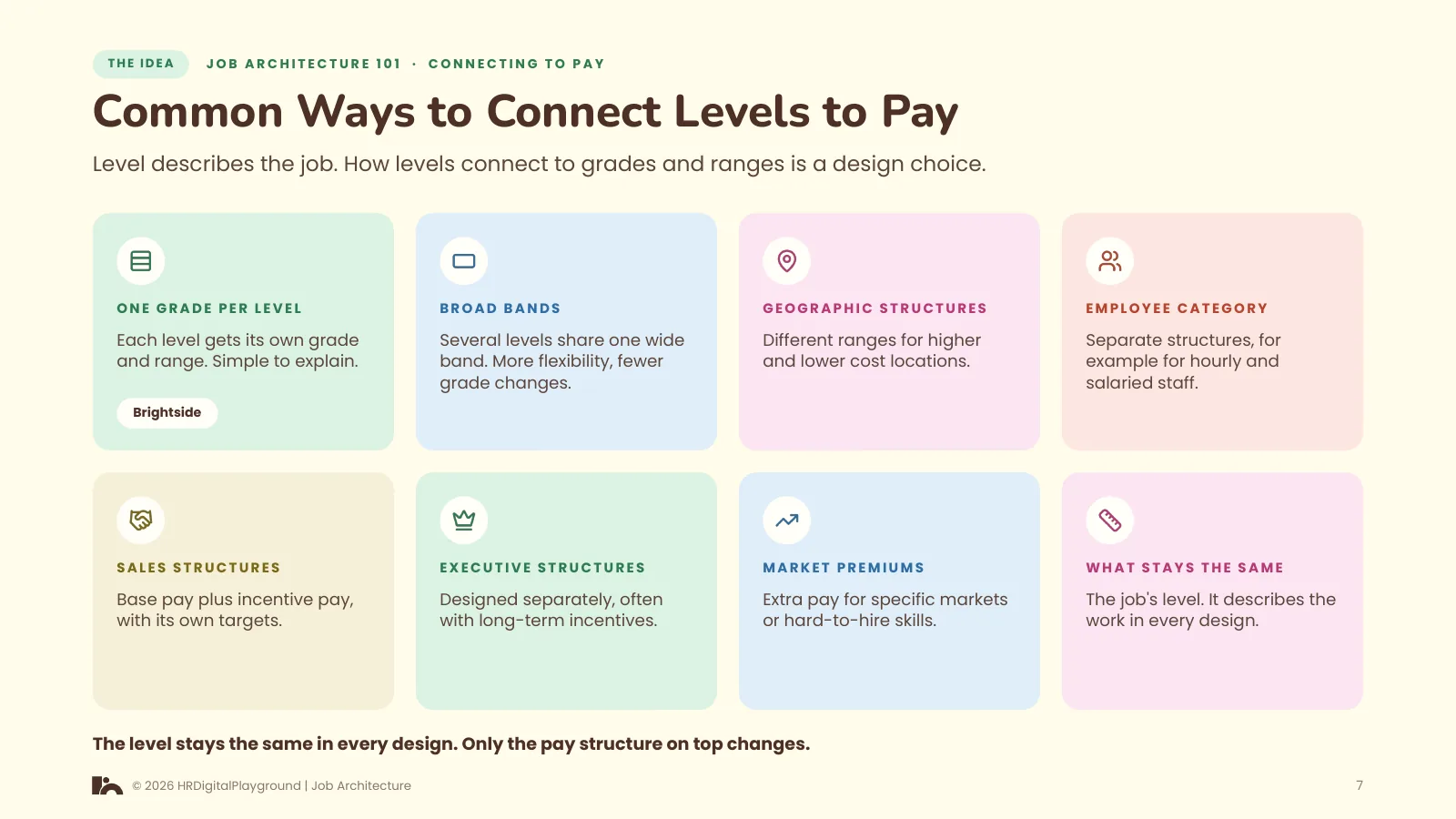
A job's level describes its size. How levels connect to grades and salary ranges is a separate design choice, and companies make it differently. Some use one grade per level, as Brightside does, which is simple to explain. Some group several levels into one broad band with a wide range, which gives managers flexibility and fewer grade changes. Many run more than one structure: geographic structures for high- and low-cost locations, structures for different employee categories such as hourly and salaried staff, sales structures that combine base pay with incentive pay, and executive structures. Some add premiums for specific markets or skills, such as hard-to-hire technical roles. In every one of these designs, the job's level stays the same. What changes is the pay structure placed on top of it. That is why the architecture can stay stable while pay design evolves.
Page 8 Anatomy of a Pay Range
Illustrative numbers, fictional company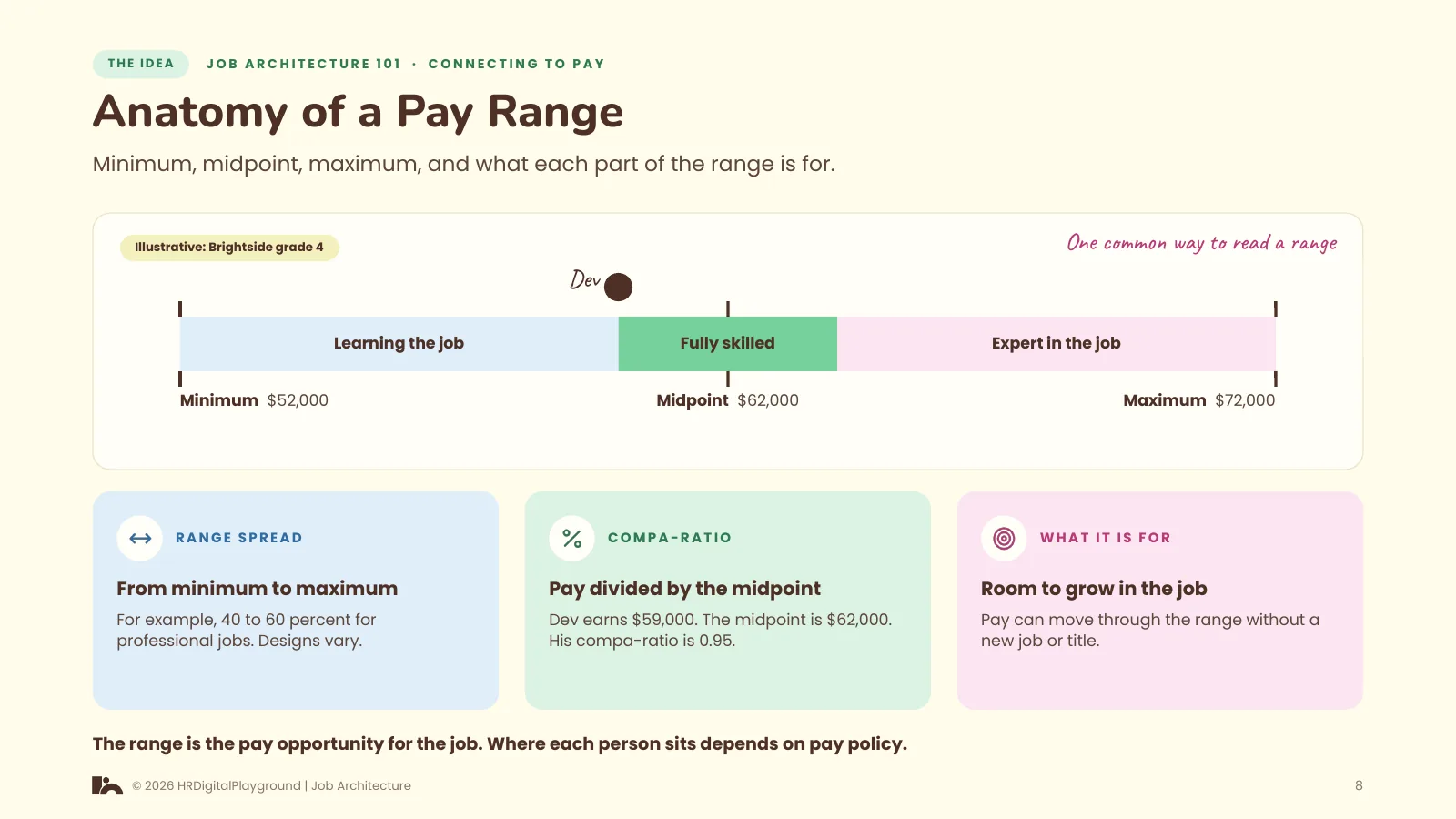
Read the explanation
A pay range has three anchor points. The minimum is the least the company pays anyone in a job at that grade, often where someone new to the job starts. The midpoint is often set near the company's chosen market position for a fully skilled person. The maximum is the most the company will pay for the job, reserved for people who are expert in it. The distance from minimum to maximum is the range spread. Spreads vary by design. As an illustration, many structures use around 40 to 60 percent for professional jobs, narrower spreads for support jobs, and wider ones for executive jobs, because bigger jobs take longer to master. The compa-ratio compares one person's pay with the midpoint: pay divided by midpoint. A compa-ratio of 0.95 means pay is 5 percent below the midpoint, and 1.10 means 10 percent above it. Companies use compa-ratios to spot people paid low for their skill, to guide raises, and to check fairness. The figures here are illustrative.
Page 9 What Decides Pay Within a Range
Read the explanation
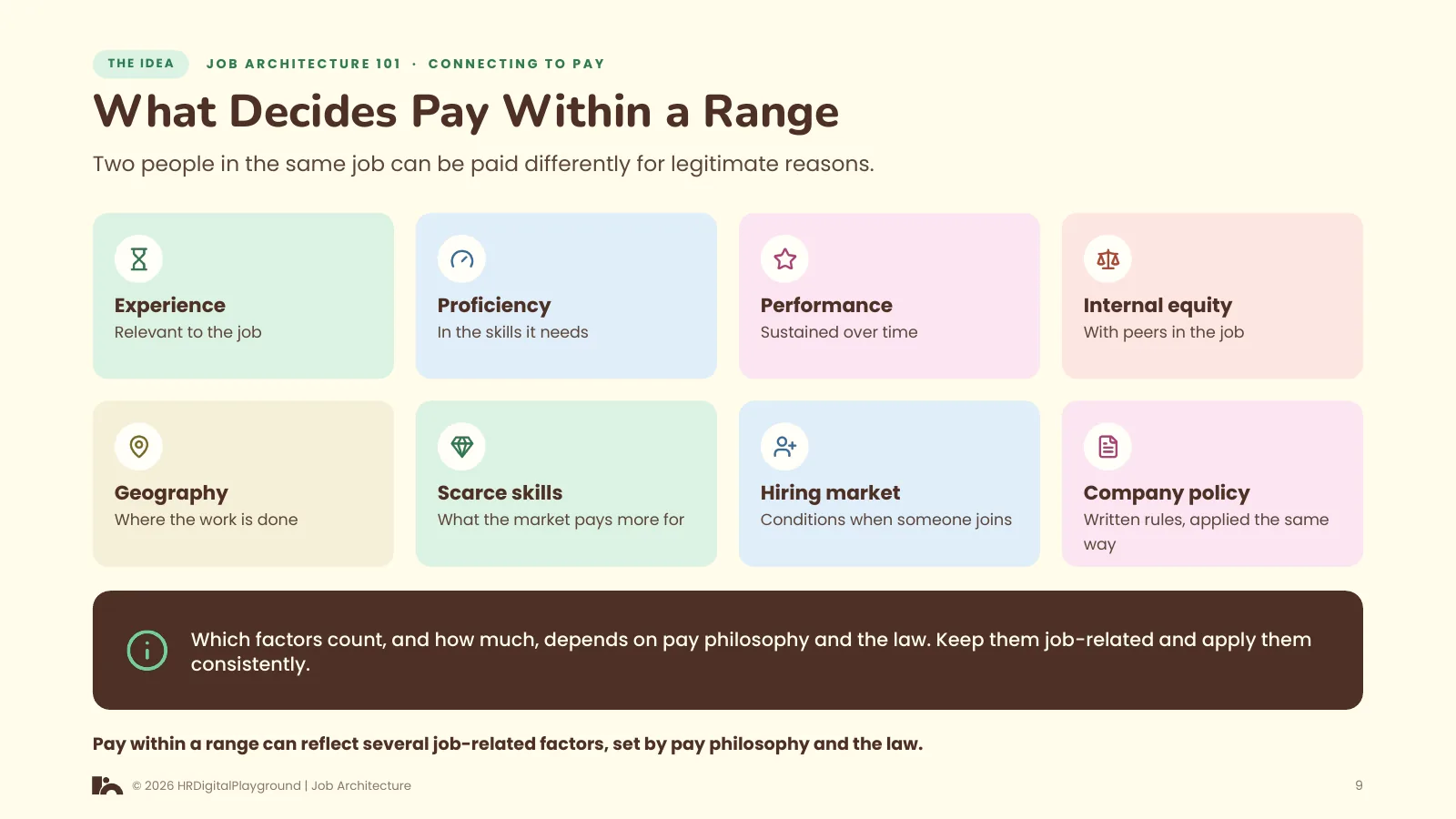
The job's level and grade set the range. Where a person sits within it can legitimately reflect several factors, depending on the organization's compensation philosophy and the law where they work. Common factors include relevant experience, proficiency in the skills the job needs, sustained performance, internal equity with colleagues in the same job, geography, scarce skills the market pays more for, conditions in the hiring market when the person joined, and company policy, such as how new hires are placed. Two cautions matter. First, the factors should be job-related and applied consistently, because pay equity laws in many places require differences to be explained by legitimate factors such as these. Second, some factors that seem natural are restricted in some places. Several jurisdictions, for example, limit the use of a candidate's salary history. Brightside writes its factors into a short pay policy so managers apply them the same way.
Page 10 Pay Ranges in Job Ads
Illustrative numbers, fictional company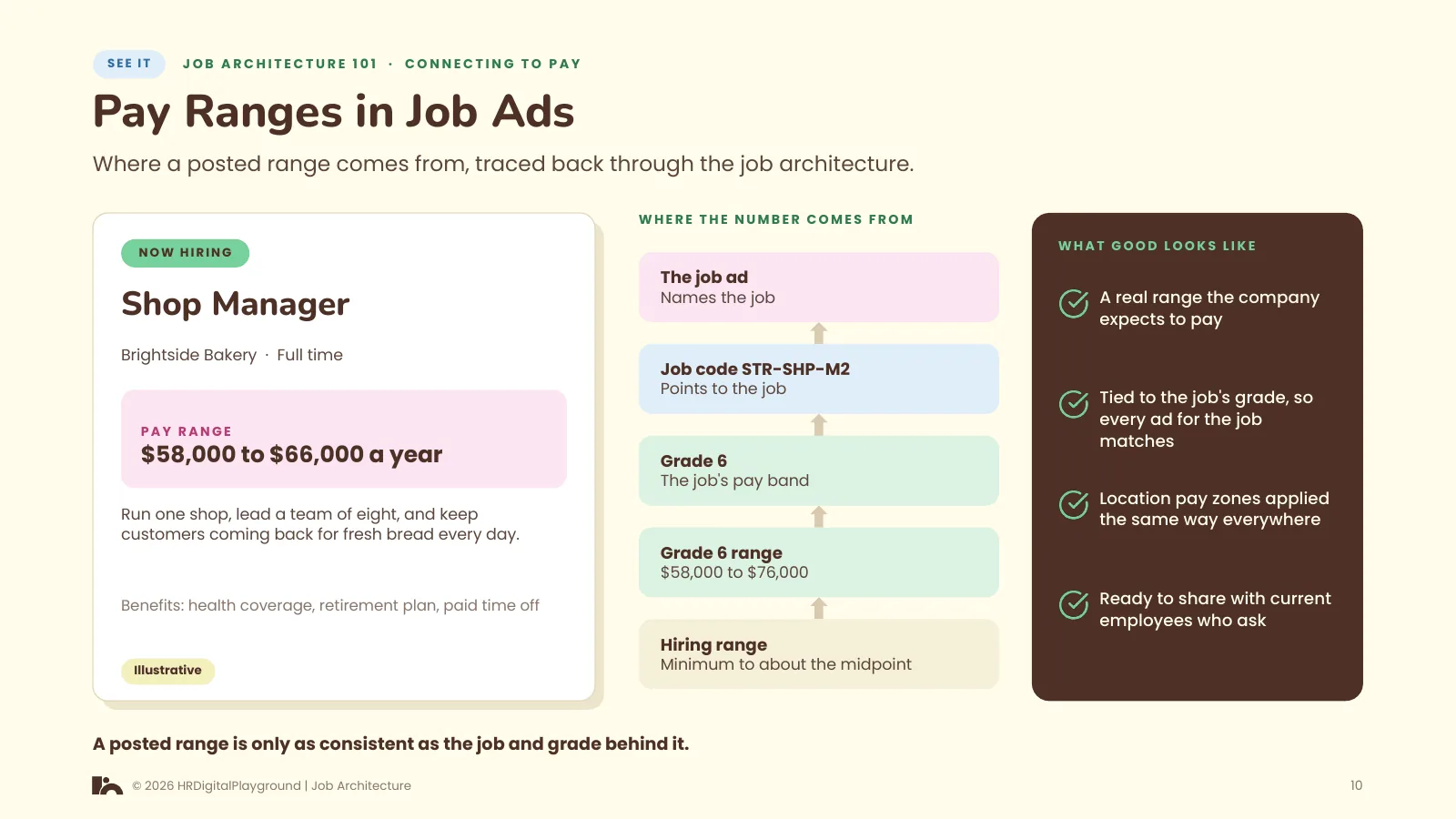
Read the explanation
In a growing number of places, employers must include a pay range in job ads, and some must share ranges with current employees who ask. A posted range should come from the job architecture rather than from a hiring manager's guess. The chain works like this: the job ad names a job, the job has a code, the code points to a grade, and the grade has a pay range. Many companies post a hiring range, the part of the full range where they realistically expect to hire, which is often from the minimum to around the midpoint. Laws generally expect a good-faith range, meaning one the company genuinely expects to pay. Because every ad for the same job points to the same grade, ads stay consistent across teams and locations. Where companies pay differently by location, they apply location pay zones on top of the same structure. Rules differ by place, so check the requirements where each job is based.
Page 11 Pay Equity: Comparing Like With Like
Read the explanation
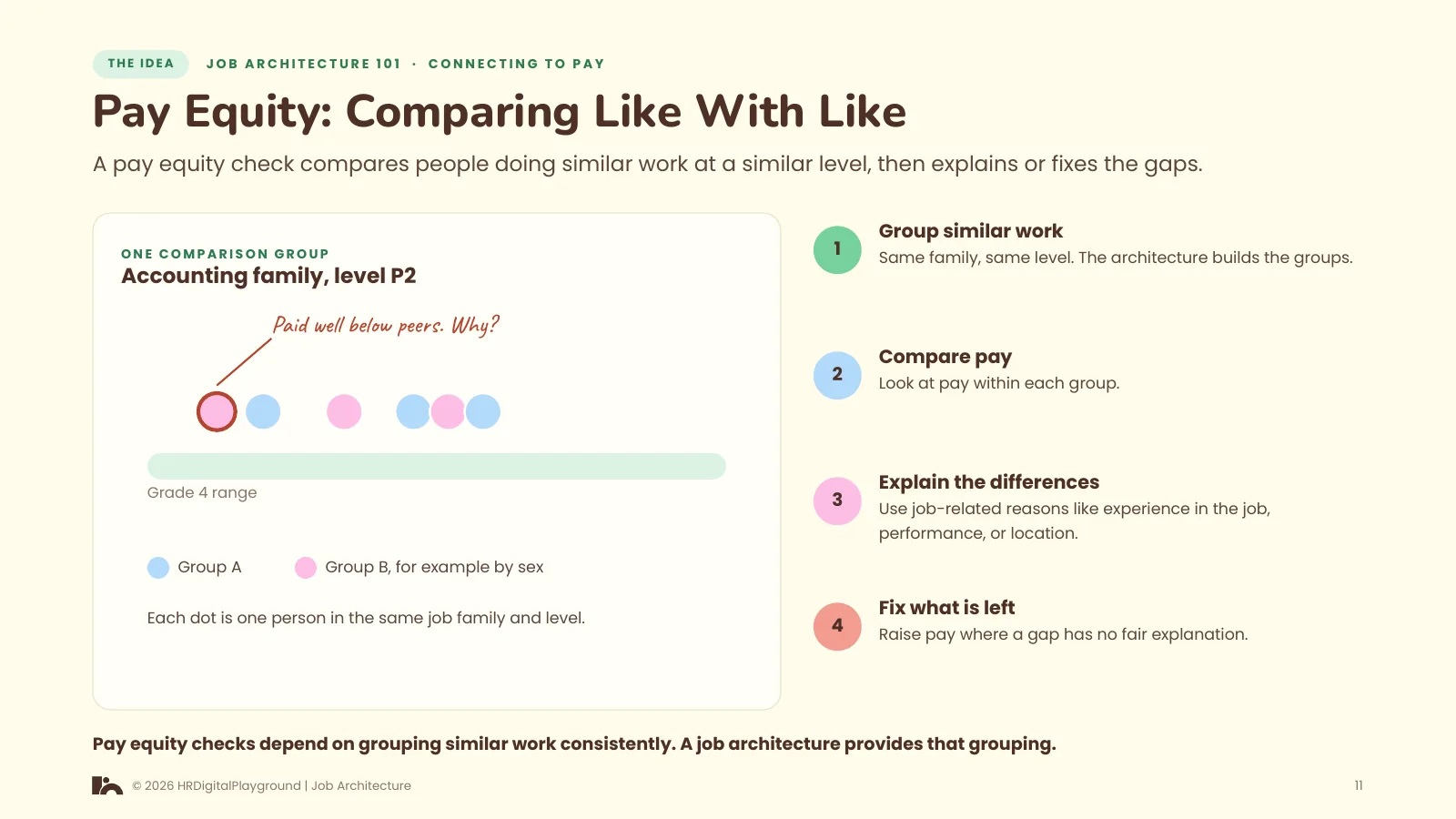
A pay equity check asks whether people doing similar work are paid fairly, regardless of sex, race, or other protected characteristics. The first step is building comparison groups, and a consistent job architecture provides most of them: people in the same family at the same level form a natural group, such as Accounting at P2. The second step is comparing pay within each group. The third step is explaining differences with legitimate, job-related factors, such as experience in the job, performance, or location. The fourth step is fixing any gap that cannot be explained, usually by raising the pay of the people who are behind. Larger companies often use statistical models that test many factors at once, but those models still start from the architecture's groups. If families and levels are inconsistent, the groups are wrong and the results are hard to trust. A job architecture does not guarantee equal pay on its own. It makes the comparison possible. Many companies run this check every year, often with legal counsel, and the legal standard for which jobs must be compared differs by jurisdiction.
Page 12 Levels Drive Bonuses, Raises, and Promotions
Illustrative numbers, fictional company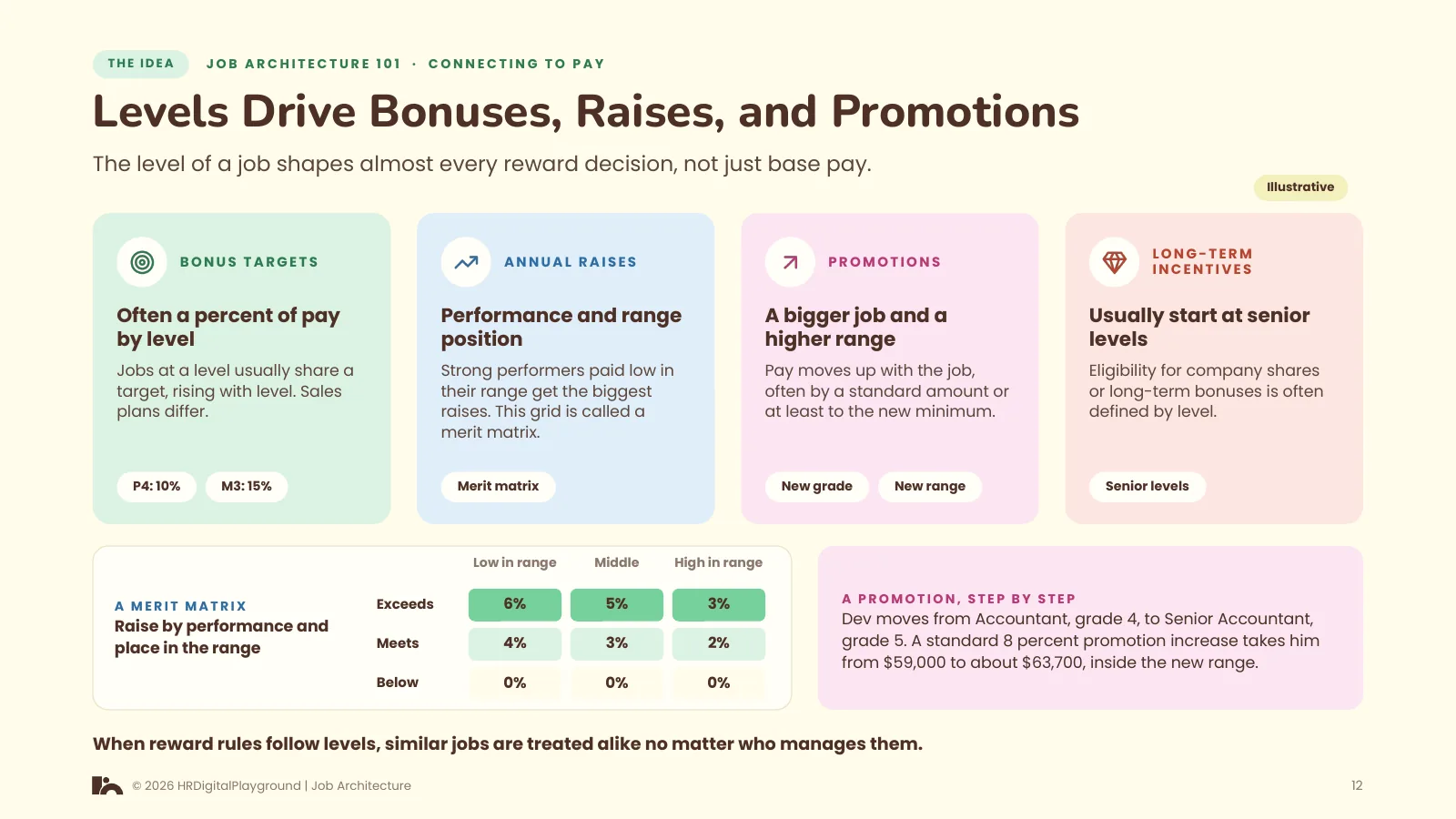
Read the explanation
Levels shape rewards beyond base pay. Many companies set bonus targets as a percentage of pay by level, rising as jobs get bigger, so jobs at the same level share a target unless a separate plan, such as a sales plan, applies. Annual raises, often called merit increases, usually depend on two things: how well the person performed and where their pay sits in the range, so strong performers low in the range get the biggest raises. That grid of performance by range position is called a merit matrix. Promotions move someone to a bigger job with a higher range, and many companies set a standard promotion increase or move the person at least to the new minimum. Long-term incentives, such as company shares, usually start at senior levels, and eligibility is often defined by level. When these rules hang off levels, rewards are consistent across teams and easy to explain. The percentages shown here are illustrative.
Page 13 When Pay Bends the Structure
Read the explanation
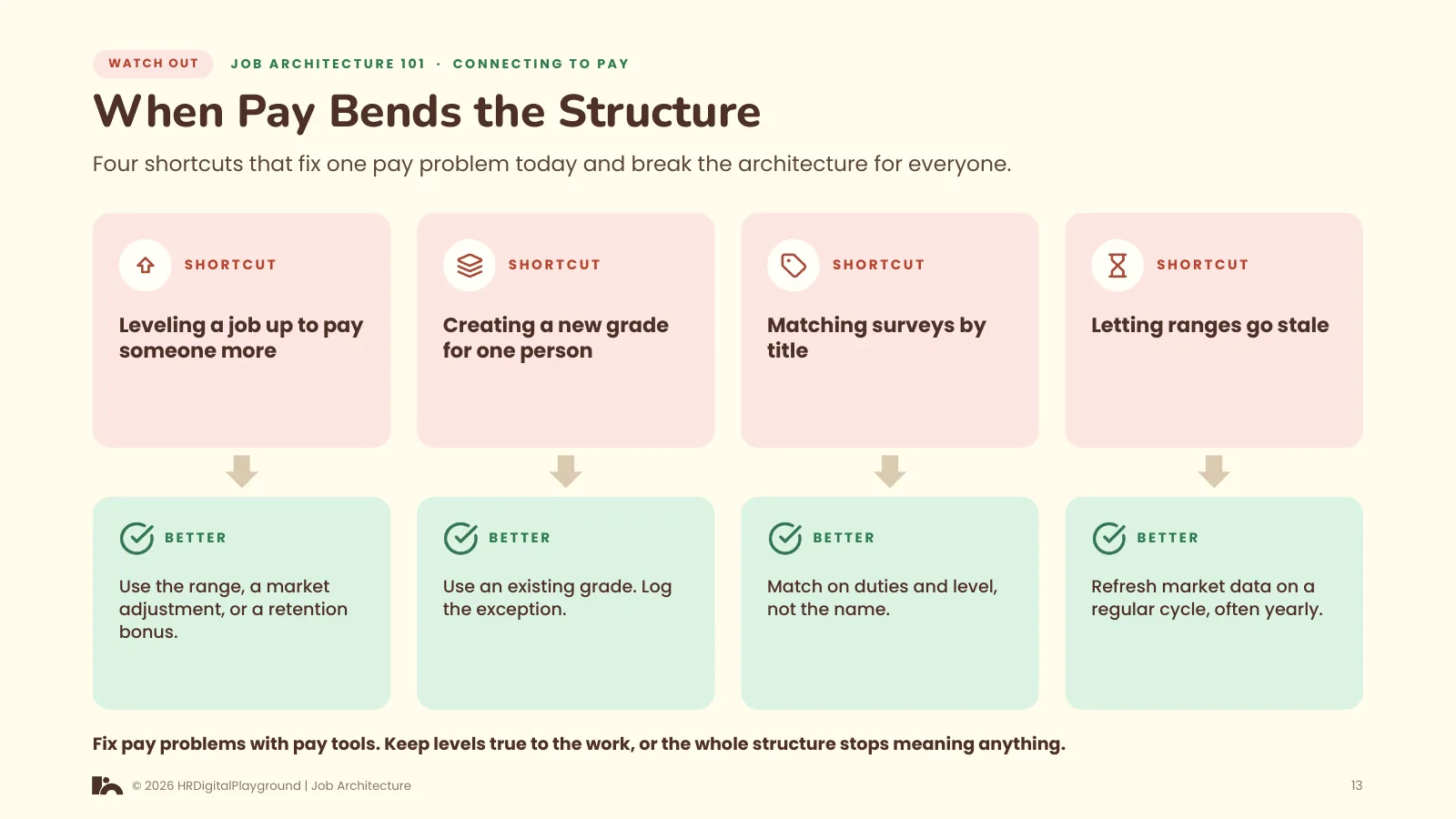
The most common way a job architecture decays is by bending it to solve pay problems. Leveling a job up so someone can be paid more fixes one case but makes the level mean less for everyone, and every similar job will ask for the same treatment. Use pay tools instead: a higher place in the range, a market adjustment for jobs the market pays more for, or a retention bonus. Creating a new grade for one person adds a permanent layer for a temporary problem. Place the job in an existing grade and record any exception in the decision log. Matching salary surveys by title produces wrong market data, because titles vary so much between companies. Match on the duties and the level. Finally, letting ranges go stale means offers fall behind the market and people leave. Refresh market data every year and move ranges when the market moves.
Page 14 Price This Job
Read the explanation
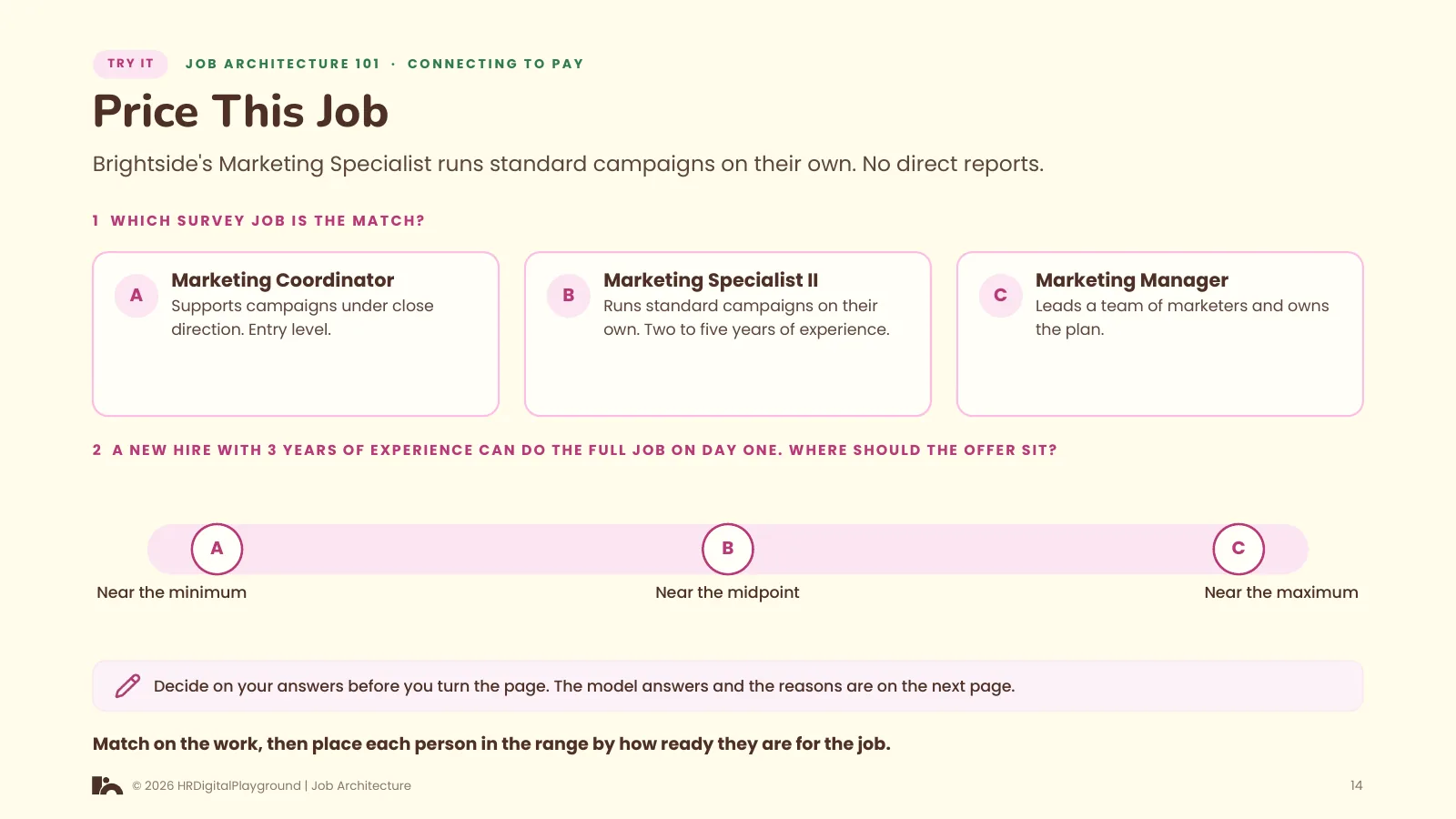
This activity practices two pay decisions that depend on the architecture. First, pick the survey job that matches Brightside's Marketing Specialist, which plans and runs standard campaigns independently with no direct reports. Second, decide where an offer should sit for a new hire with three years of experience who can do the full job from day one. Decide both before turning the page.
Page 15 Price This Job: Model Answers
Read the explanation
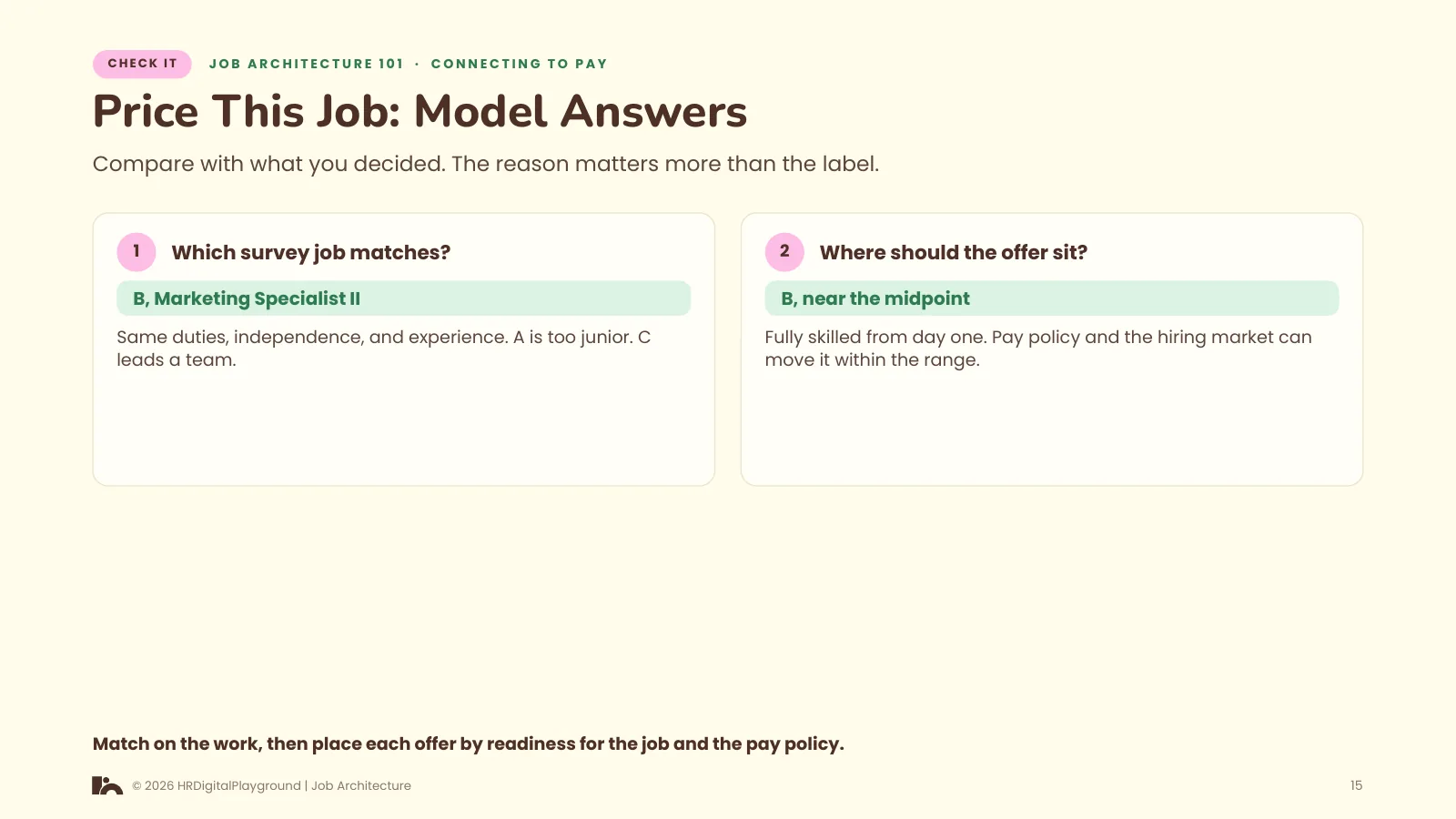
Model answers. Question one is B. The Marketing Specialist II survey job matches the duties, the independence, and the experience. The Marketing Coordinator survey job is too junior, because it works under close direction, and the Marketing Manager survey job leads a team, so it is a management job. Question two is B, near the midpoint, because under a common pay policy a person who is fully skilled from day one sits near the midpoint. Someone still learning the job would usually start nearer the minimum, and the company's own pay policy and the local hiring market can move the offer within the range.
Page 16 Quick Check
Read the explanation
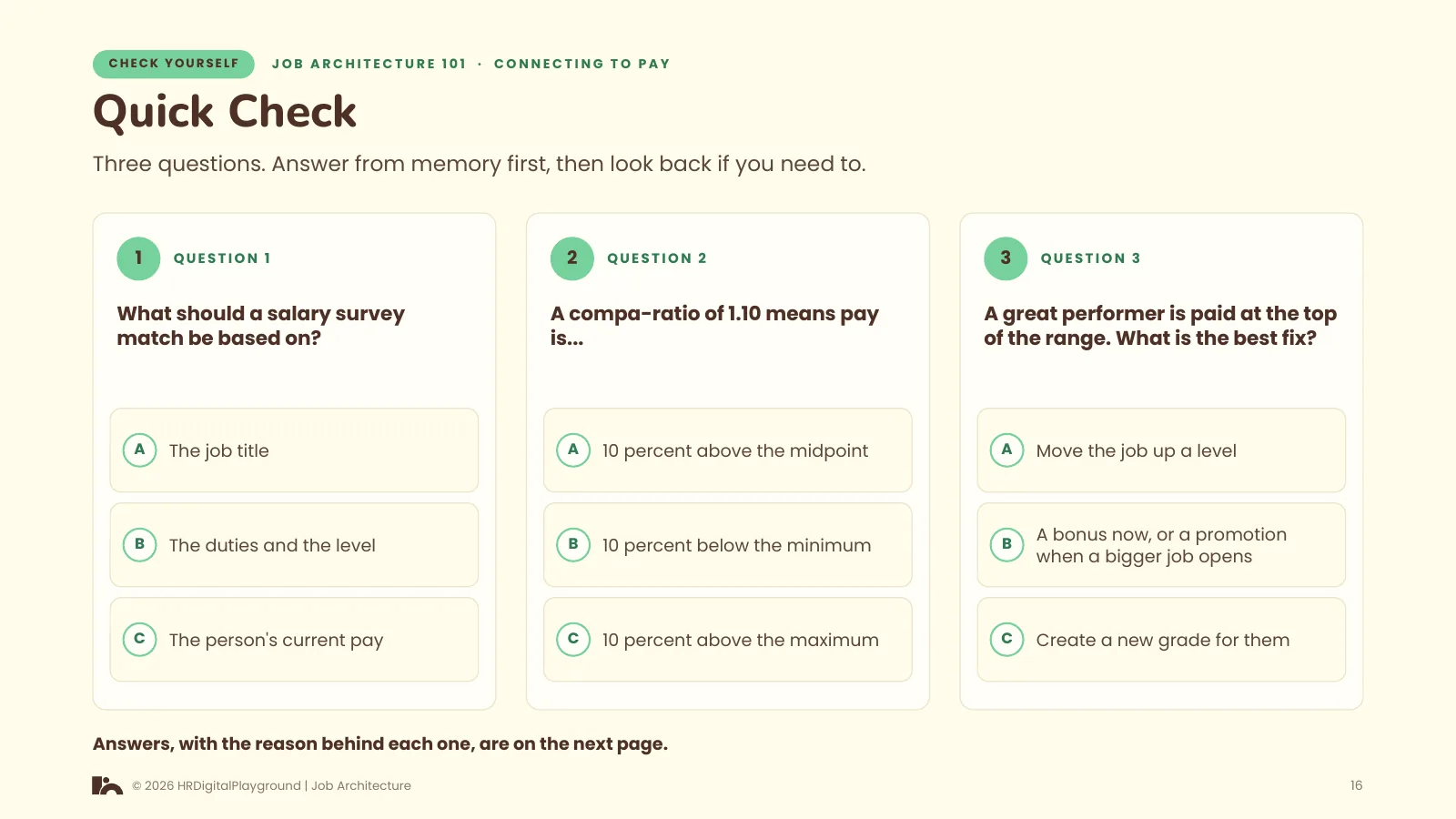
Three questions on pay. Question 1 checks the basis of a survey match. Question 2 checks what a compa-ratio means. Question 3 checks the right response when someone's pay reaches the top of their range.
Page 17 Remember
Read the explanation
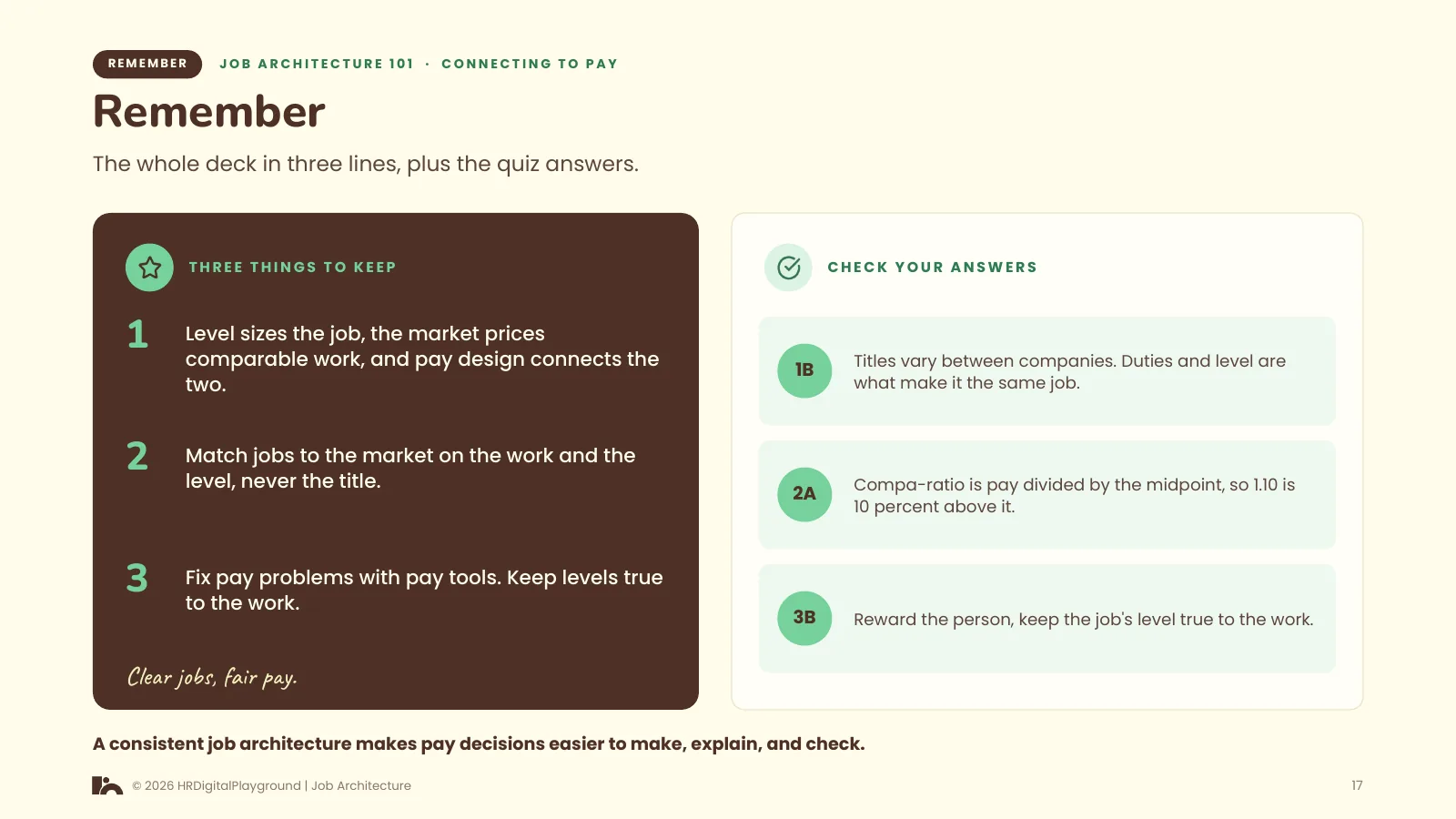
The recap keeps three ideas. Leveling sizes the job inside, market pricing looks outside, and pay design turns both into pay opportunities. Market pricing matches jobs to surveys on the work and the level, never the title. And pay problems should be fixed with pay tools rather than by bending the structure. Quiz answers: 1 is B, match on duties and level. 2 is A, 10 percent above the midpoint. 3 is B, reward with a bonus now or a promotion when a genuinely bigger job exists, and never inflate the level.
Page 18 Copyright and Notices
Illustrative numbers, fictional company
Read the explanation
Job Architecture 101: Connecting to Pay. Copyright 2026 HRDigitalPlayground | Job Architecture. Published September 2026. Brightside Bakery is a fictional company and all examples are illustrative. The material is general education, not legal, tax, or financial advice.