Career Tracks
Can I grow without managing people?

Page 1 Career Tracks
Read the explanation
This deck answers: can I grow without managing people? Career tracks, sometimes called career streams, describe the kind of contribution a job makes. The deck introduces a common set of four tracks, shows the other tracks and models organizations use and the principle behind them, explains the dual career ladder that lets experts grow without becoming managers, gives three questions for picking a job's track, shows why a manager title does not make a job a management job, and explains how people move between tracks. It ends with a practice activity, three quick questions, and a recap.
Page 2 Before You Start
Read the explanation
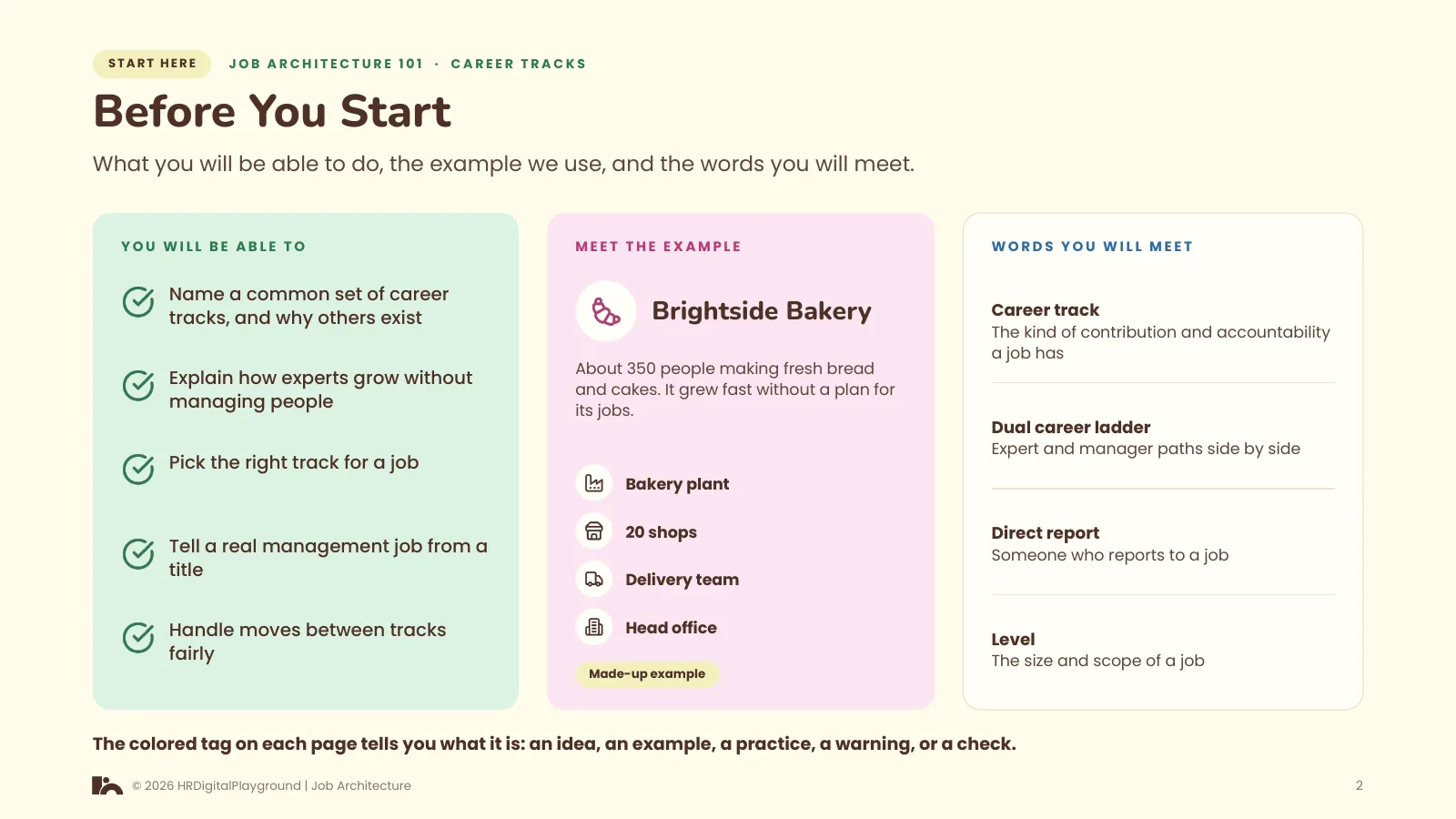
This deck covers career tracks. It is written for someone with no background in HR, compensation, or organization design, and it follows adult learning principles: why before what, one realistic example throughout, practice with answers, a short quiz, and a one-page recap. The example is Brightside Bakery, a made-up company of about 350 people with a bakery plant, twenty shops, a delivery team, and a head office. It grew fast without a plan for its jobs, so it has far more titles than real jobs and no shared way to compare them. The words on this page are defined again where they first appear.
Page 3 A Common Set of Tracks
Read the explanation
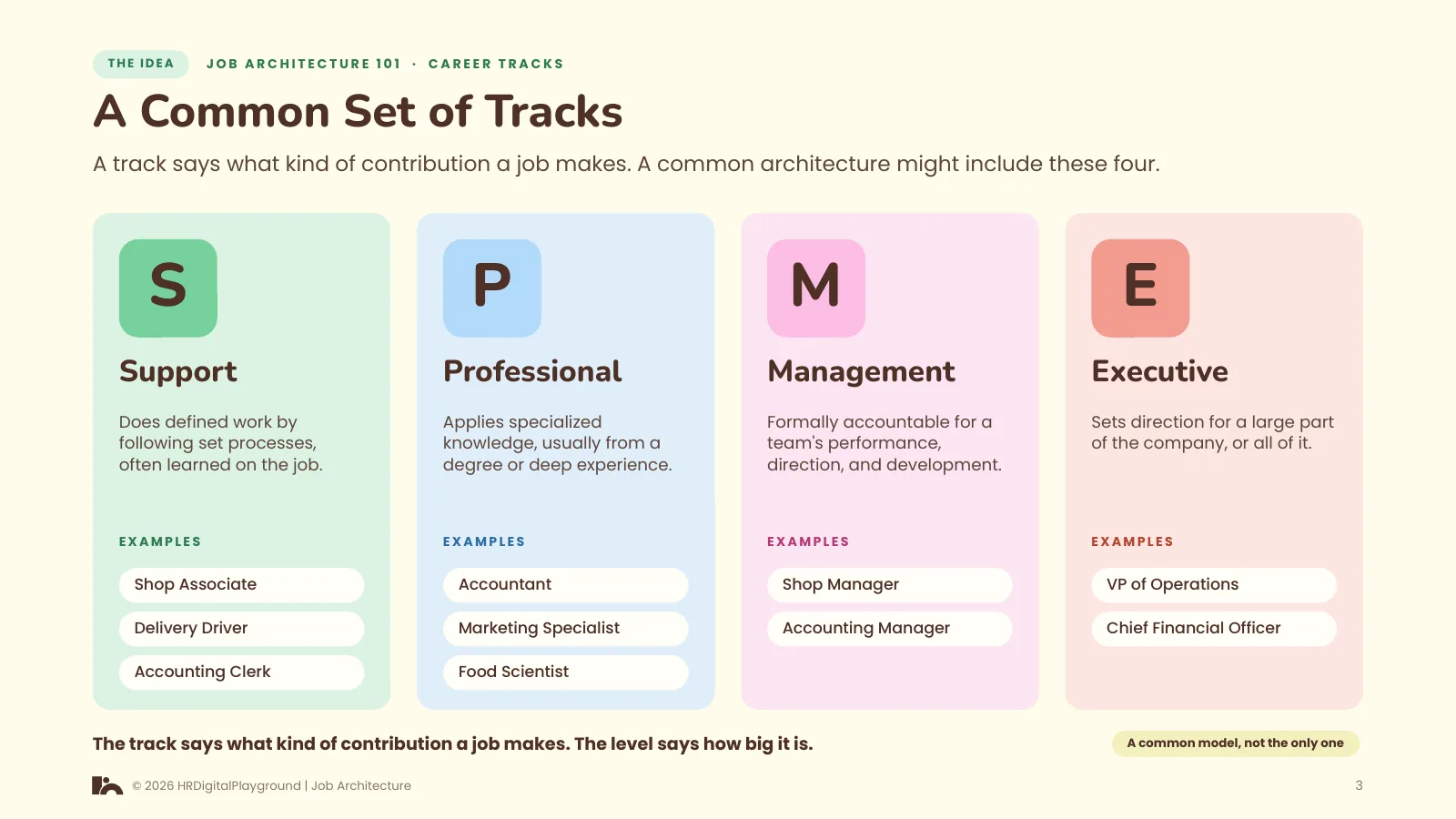
A career track describes the kind of contribution and accountability a job has. A common architecture might include four tracks, and Brightside uses these four, but they are one common model, not the only one. Support jobs do defined work by following set processes and procedures, often learned on the job, such as Shop Associate, Delivery Driver, or Accounting Clerk. Many support jobs are paid hourly. Professional jobs apply specialized knowledge, usually from a degree or equivalent deep experience, such as Accountant, Marketing Specialist, or Food Scientist. Management jobs are formally accountable for the sustained performance, direction, development, and organization of a team, such as Shop Manager or Accounting Manager. Executive jobs set direction for a large part of the company or all of it, such as a Vice President of Operations or a Chief Financial Officer. Names vary. Support is also called Operations or Business Support. The letters S, P, M, and E are a common shorthand.
Page 4 Other Tracks and Models
Read the explanation
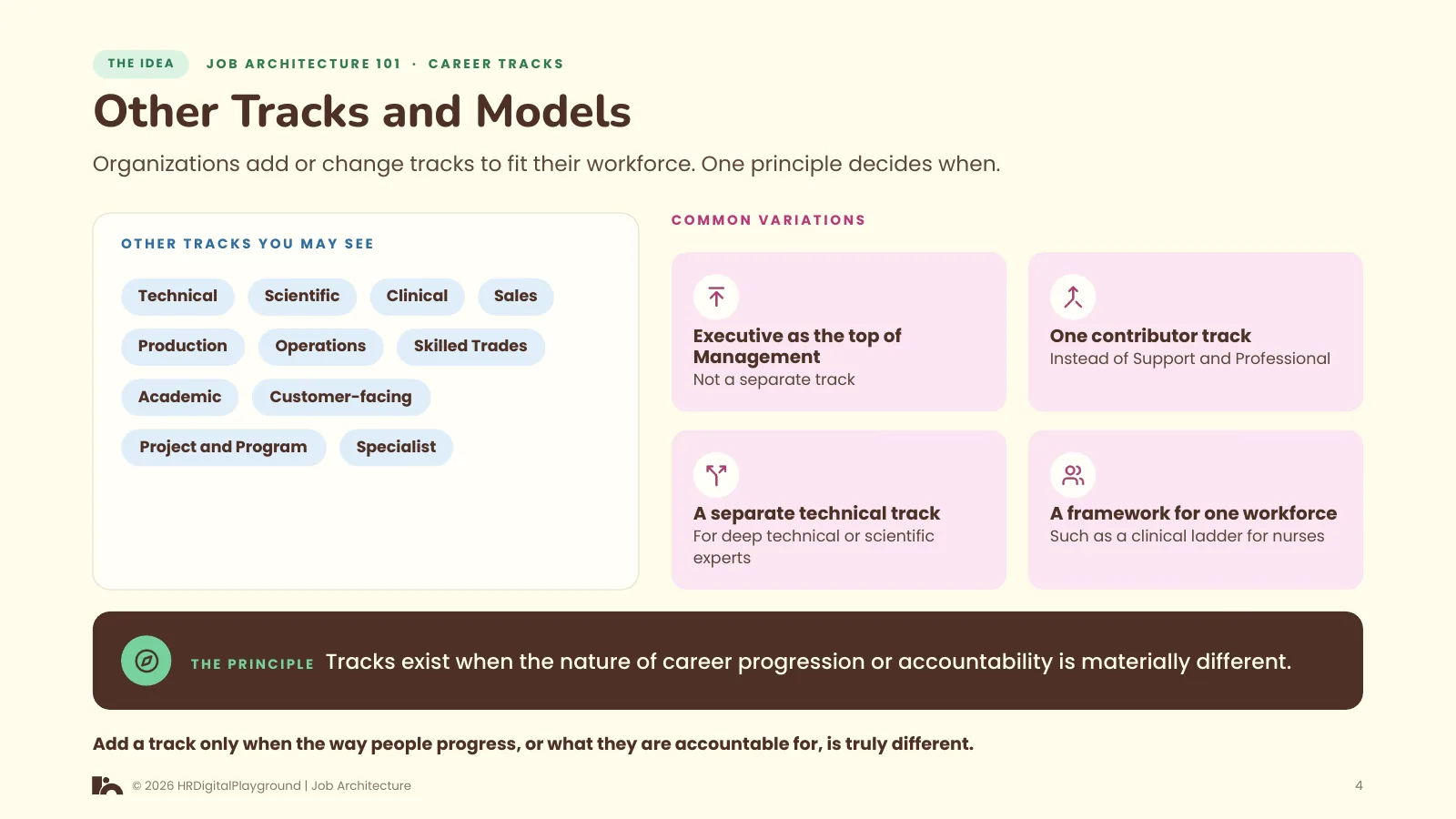
Four tracks are common, but they are not universal. Organizations add or rename tracks to fit their workforce. You may see Technical, Scientific, Clinical, Sales, Production, Operations, Skilled Trades, Academic, Customer-facing, Project and Program, or Specialist tracks. Some organizations treat Executive as the top of the Management track rather than a track of its own. Some use one individual contributor track instead of separate Support and Professional tracks. Some separate highly technical expert careers, such as engineers or scientists, into their own track. And some use a framework built for one workforce, such as a clinical ladder for nurses or a separate framework for hourly plant roles. The principle behind all of these choices is the same: tracks exist when the nature of career progression or accountability is materially different. A hospital adds a Clinical track because nurses progress through clinical expertise and patient accountability in a way that differs from both office professionals and managers. If progression and accountability are the same, a new track adds upkeep without adding clarity.
Page 5 You Can Grow Without Managing
Read the explanation
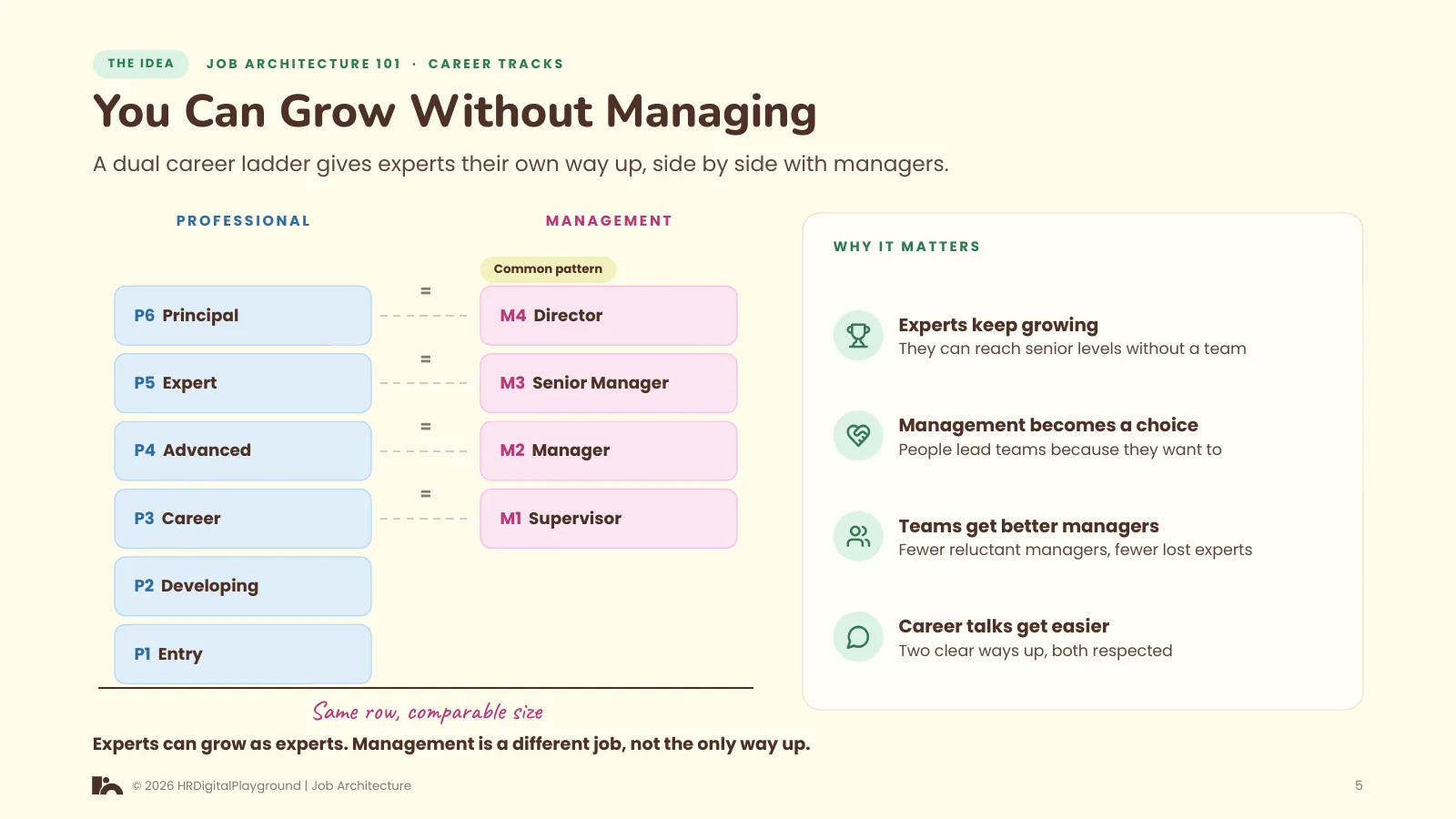
In many companies the only way to earn more used to be managing people, so great experts became reluctant managers, and companies lost an expert and gained a poor manager. A dual career ladder fixes this. The Professional ladder and the Management ladder run side by side, and their steps line up by size, so a senior expert can reach the same size of job, and often a similar pay opportunity, as a manager without taking on a team. In a common pattern, a P3 lines up with an M1, a P4 with an M2, and so on. Management becomes a choice for people who want to lead people, rather than the price of a raise. The payoff is better retention of experts, better managers, and clearer conversations about careers. The steps are sized with the same factors on both ladders. How rows connect to pay grades is a separate design choice each company makes.
Page 6 Which Track Is It?
Read the explanation
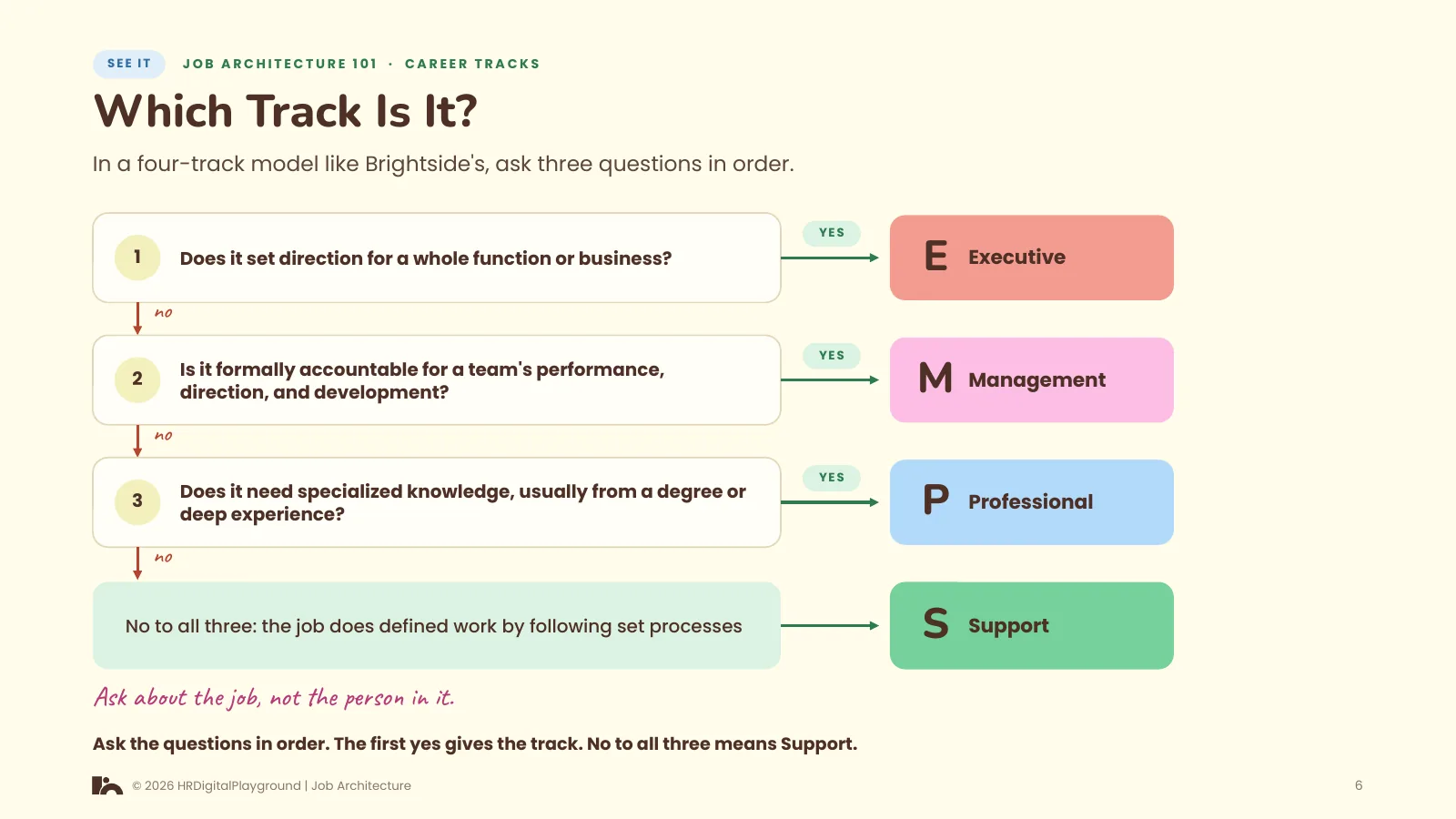
In a four-track model like Brightside's, three questions, asked in order, place almost any job on a track. First, does the job set direction for a whole function or business? If yes, it is Executive. Second, is the job formally accountable for the sustained performance, direction, development, and organization of a team? If yes, it is Management. Third, does the job need specialized knowledge, usually from a degree or equivalent years of study and experience? If yes, it is Professional. If the answer to all three is no, the job does defined work by following set processes, and it is Support. Ask about the job, not the person in it. A Support job held by someone with a degree is still a Support job, because the job does not require the degree.
Page 7 A Manager Title Doesn't Make a Manager
Read the explanation
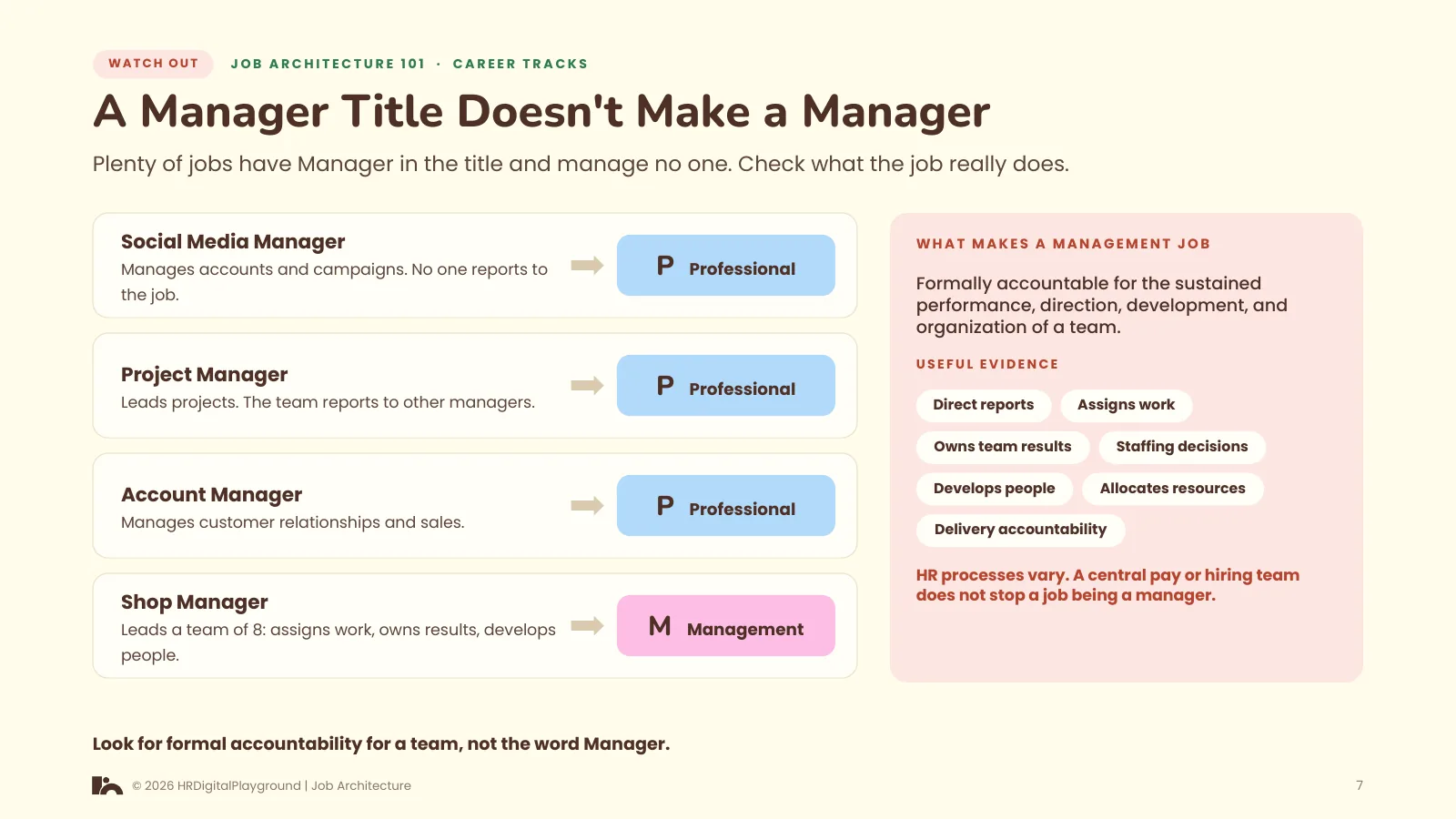
The word Manager appears in many titles that have nothing to do with managing a team. A Social Media Manager may manage accounts and campaigns, not employees. A Project Manager leads projects and coordinates people who report to someone else. An Account Manager manages customer relationships and belongs with Sales professionals. These are Professional jobs, and placing them on the Management track inflates their level and distorts pay comparisons. A management job is formally accountable for the sustained performance, direction, development, and organization of a team. Useful evidence includes direct reports, assigning work, accountability for the team's performance, staffing decisions, responsibility for developing people, allocating resources, and accountability for delivery. HR processes vary between companies, so do not define a manager too narrowly. A Shop Manager is still a manager even if pay is set centrally and recruiting is run by a central team. Some companies also set a minimum number of direct reports for the Management track. That is a company rule, not a universal one. When a title and the work disagree, place the job by the work, and consider fixing the title, for example Social Media Specialist instead of Social Media Manager.
Page 8 Switching Tracks
Read the explanation
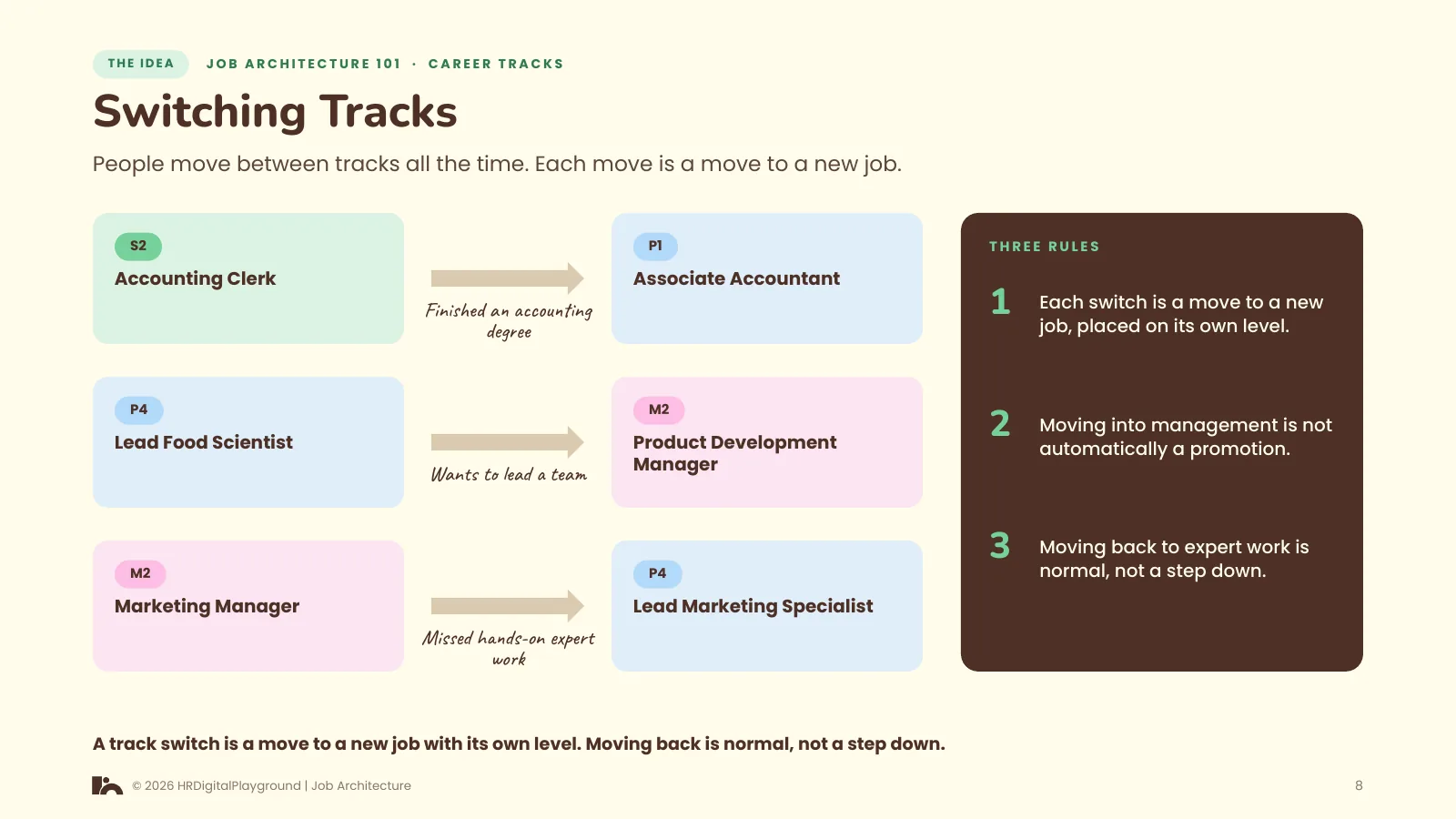
Tracks describe jobs, not people, so people can and do move between them. An Accounting Clerk on the Support track who finishes an accounting degree can move to Associate Accountant on the Professional track. A Lead Food Scientist can move into management as a Product Development Manager. A Marketing Manager can return to expert work as a Lead Marketing Specialist. Three rules keep these moves fair. First, each move is a move to a new job, placed on that job's own level, so the new pay and expectations follow the new job. Second, a move to management is not automatically a promotion. In the common pattern, a P4 and an M2 sit on the same row, so moving between them is a sideways move in size. Third, moving back from management to expert work is normal and should not be treated as a demotion when the size of the job is the same.
Page 9 Pick the Track
Read the explanation
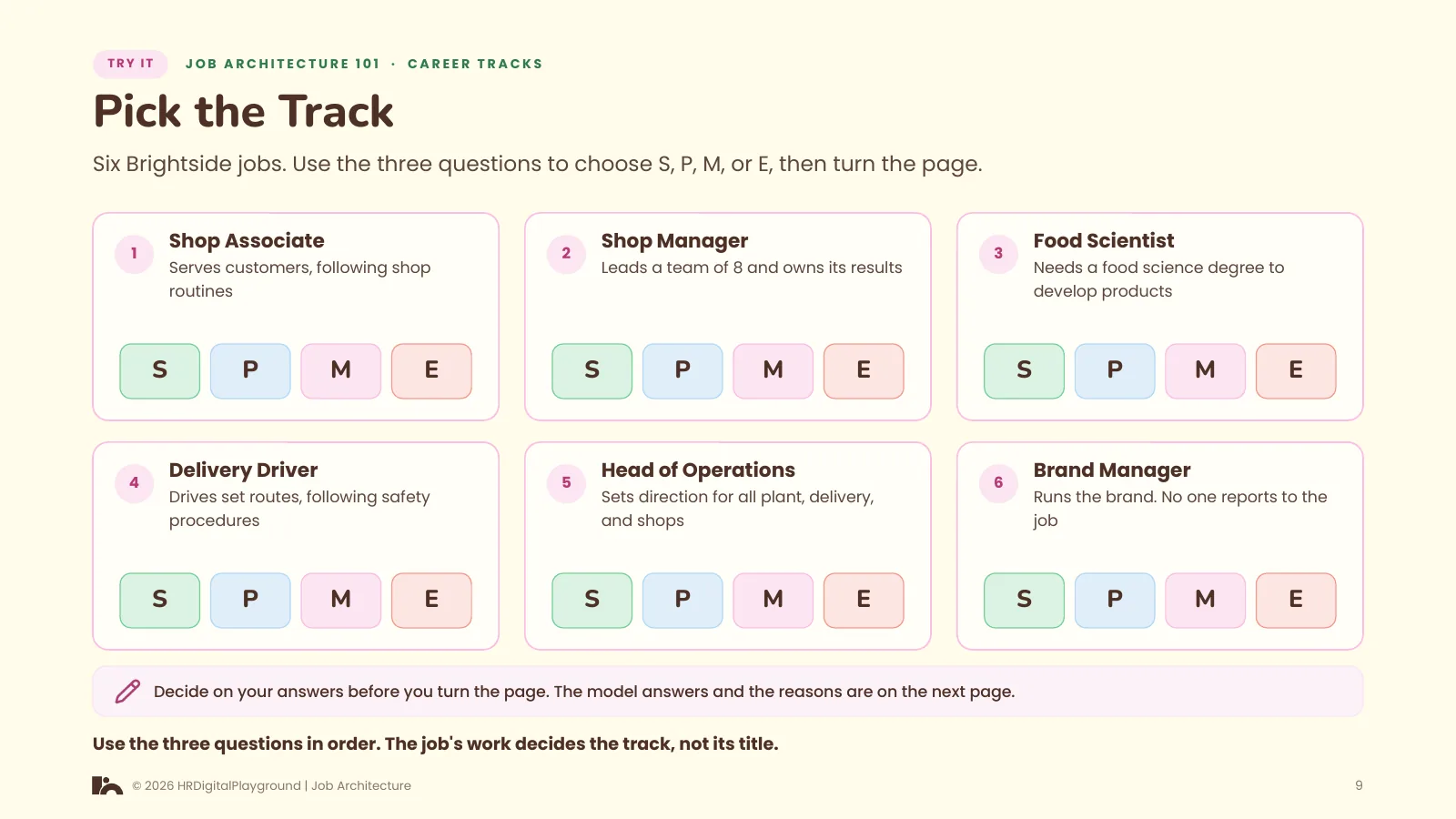
This activity practices the three track questions on six Brightside jobs. Decide S, P, M, or E for each, and write down which question gave you the answer. The model answers and reasons are on the next page.
Page 10 Pick the Track: Model Answers
Read the explanation
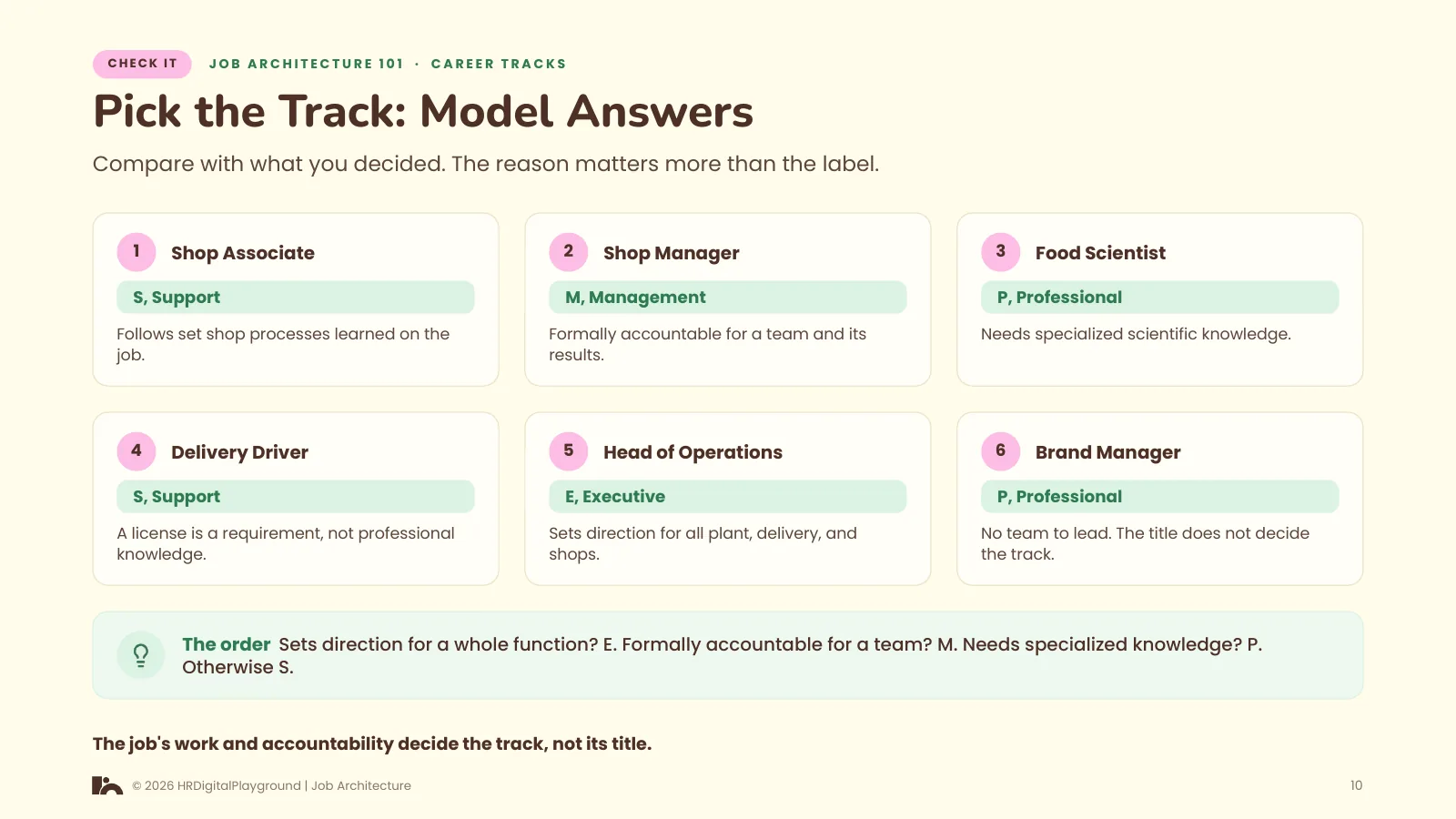
Model answers. The Shop Associate follows set processes learned on the job, so Support. The Shop Manager is formally accountable for a team of eight and its results, so Management. The Food Scientist needs specialized scientific knowledge, so Professional. The Delivery Driver follows set routes and procedures, so Support, even though the job needs a driving license, because a license is a requirement, not specialized professional knowledge. The Head of Operations sets direction for all of Brightside's operations, so Executive. The Brand Manager has no team to lead, so despite the title the job is Professional.
Page 11 Quick Check
Read the explanation
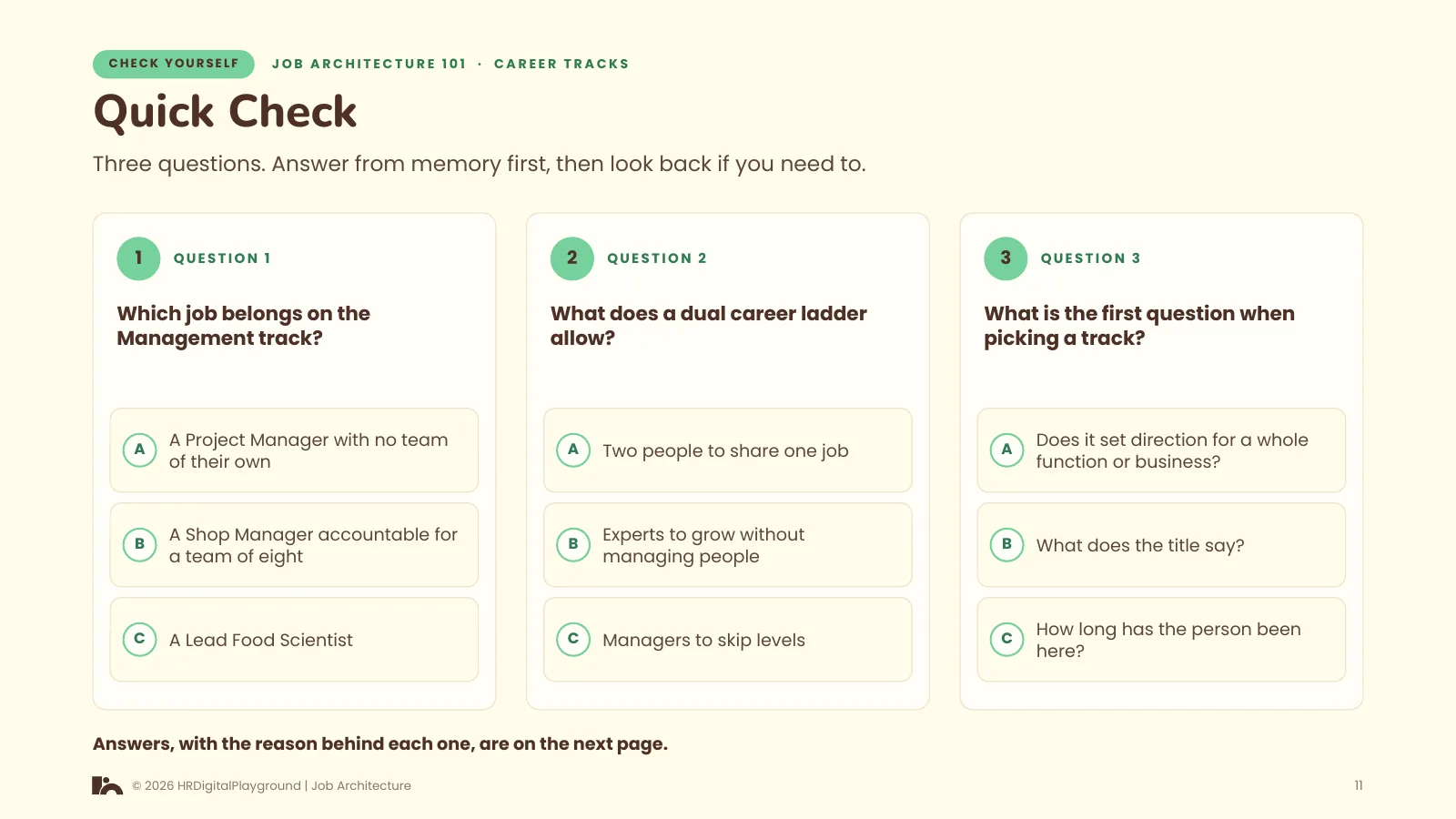
Three questions on tracks. Question 1 checks the management test. Question 2 checks the purpose of a dual career ladder. Question 3 checks the order of the track questions.
Page 12 Remember
Read the explanation
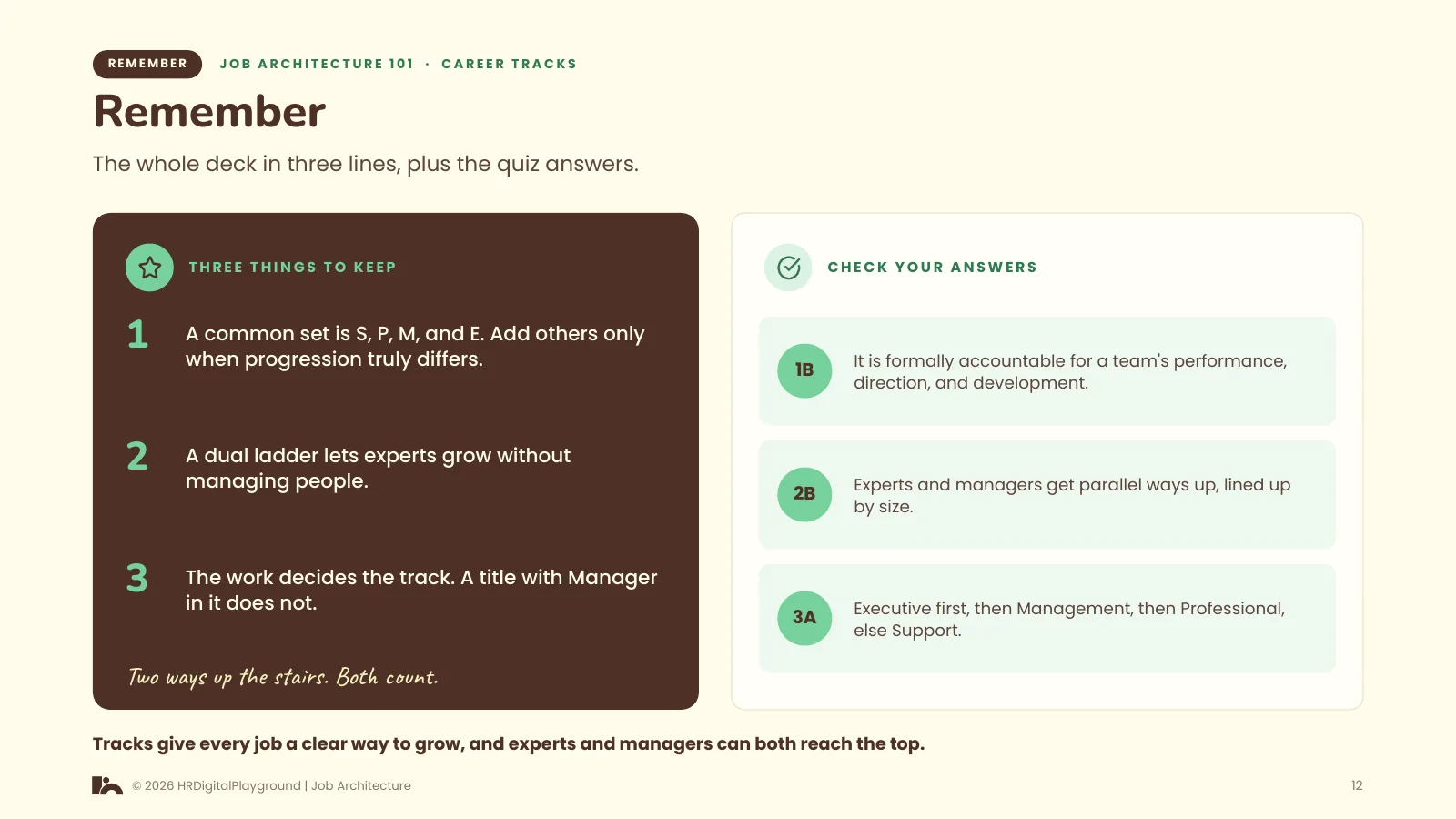
The recap keeps three ideas. A common set of tracks is Support, Professional, Management, and Executive, and organizations add others when progression or accountability is materially different. A dual career ladder lets experts grow without managing people. And the track follows the work, so a manager title alone does not make a management job. Quiz answers: 1 is B, the Shop Manager, who is formally accountable for a team. 2 is B, experts can grow without managing. 3 is A, start with whether the job sets direction for a whole function or business.
Page 13 Copyright and Notices
Illustrative numbers, fictional company
Read the explanation
Job Architecture 101: Career Tracks. Copyright 2026 HRDigitalPlayground | Job Architecture. Published September 2026. Brightside Bakery is a fictional company and all examples are illustrative. The material is general education, not legal, tax, or financial advice.